Reading Haboob Arrival Signals Across a Fragmented Oasis Layout
Why a Fragmented Oasis Breaks Standard Dust Alerts
Fragmented oases — the ones stitched together from ancestral parcels, narrow wadis, and staggered palm plantings across uneven terrain — don't receive a haboob uniformly. The National Weather Service radar-based characteristics of Arizona dust storms showed that haboob walls reach 100 km wide and 2-3 km high, advancing at 35-100 km/h. When that wall hits a linear coastline or an open plain, the timing is predictable within five minutes. When it hits a fragmented oasis with date groves arranged across 40 meters of elevation change and three different wadi orientations, arrival time can spread 20-45 minutes across the property. A regional warning that says "haboob arrives 14:30" is therefore almost useless at the ladder-crew scheduling level.
Consider what happens in an Imperial Valley oasis on a typical haboob day. A dust wall moving from the southwest at 70 km/h hits the southern wadi edge at 14:10 but gets deflected around the mature Deglet Noor windbreak. The interior Medjool block stays clear until 14:28 because the windbreak creates a wind shadow that buys 18 minutes. The northern wadi, which opens directly to the desert, gets hit at 14:32 — after the southern edge has already been blanketed for 22 minutes. A crew dispatched on a single-arrival time either arrives too late to the south or leaves early from the north. Either way, spathes that needed pollination inside the next hour just lost their window.
The ScienceDirect paper on dust-storm hot spots in the Arabian Peninsula mapped ten transport corridors including the Wadi Langeb Tokar Delta. The research makes clear that dust propagation through fragmented oasis terrain is shaped by pre-existing wadi geometry — which means any warning system that ignores local topography produces inaccurate arrival times at the scale growers actually operate.
Turning Arrival Signals Into a Helm-Charted Yield Forecast
HarvestHelm treats each wadi as a separate navigation leg on the helm-charted yield forecast. The captain sees a ladder of arrival windows — each palm block tagged with an expected dust-front hit time drawn from the combination of regional radar, on-site anemometers at the windward edge, and a pre-calibrated deflection model tuned to your oasis geometry. The Pollination Window Countdown Timer displayed at the top of the dashboard shows the nearest at-risk spathe with its remaining receptivity hours; the map panel shows the incoming dust front with its predicted arrival per wadi, color-coded amber as it enters the 30-minute warning band.
The metaphor maps because yacht captains navigating a fjord read wind-shadow patterns the same way. The windbreak from a cliff can buy minutes of shelter that change the entire passage plan. HarvestHelm's Sandstorm Spathe Protection Alerts subsystem calibrates the shelter offset for your oasis from three months of baseline wind data, then applies it to every incoming dust event automatically. Growers who already combine this with pollination sandstorm timing decisions find that the arrival-signal model becomes their primary crew-dispatch tool — because it gives them the 40-minute lead time that regional NWS alerts cannot.
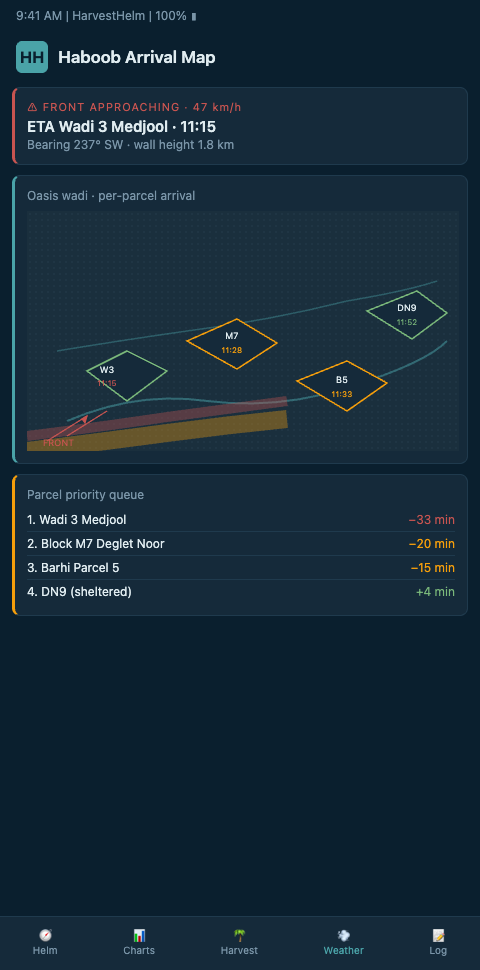
The ground-truth instrumentation that powers the model is not exotic. The ScienceDirect paper on ground-based dust detection using imbalanced ML demonstrated that sensor networks placed along windward corridors outperform satellite-only detection for fragmented terrain. HarvestHelm recommends three anemometer-particulate nodes per 10-hectare oasis block — windward edge, interior, leeward edge — positioned to capture the wave-front passage. Cost per node sits in the range that smallholders can absorb, especially under the kilo-cut model where the instrumentation is amortized against the harvests it protects.
The Diurnal Swing Compensation for Fruit Set feature overlays on this map because dust events often arrive with thermal signatures that tell you whether fruit-cell damage will follow. A haboob preceded by a 4°C temperature jump usually carries khamsin-type warm air that cooks stigmas directly. A haboob from the cold north front drops temperatures 2°C but hits palms with abrasive dust that still strips pollen. HarvestHelm flags which kind of event is inbound so crew response differs — the first calls for shading interventions, the second calls for pulling pollinated spathes into shelter where feasible.
Advanced Tactics for Multi-Wadi Oases
Growers with truly fragmented layouts — three or more disconnected wadis with no common windward edge — need a slightly heavier instrumentation profile. The Full article on hybrid sand and dust storm detection using MODIS on GEE documented that MODIS-based indices give 250 m resolution, which is borderline useful for individual oasis blocks but excellent for detecting regional fronts 2-4 hours out. HarvestHelm ingests MODIS dust index data and uses it for the longer-range forecast horizon, then hands off to ground sensors within the 90-minute arrival band. This handoff architecture is what lets a grove operator plan the next day's crew allocation while still responding to the same-hour arrival signal.
The Haboob Dashboard Workflow is where the helm metaphor pays off most. When an incoming front crosses the 2-hour alert threshold, HarvestHelm automatically prepares a crew-allocation scenario per wadi, ranks the spathes by remaining receptivity, and estimates the fruit-set loss for three response patterns: full retreat, staged pollination across both wadis, or concentrated effort on one wadi while accepting loss in the other. Operators working through haboob dashboard workflow patterns pre-configure their preferred triage rules so that the 2-hour window gets used for execution, not deliberation.
The World Bank MENA dust-storm report estimated total MENA losses at $150B annually with $13B direct from crop loss and halted production. That number represents millions of growers making decisions on single-arrival assumptions. Fragmented oases are where the biggest absolute savings live because the per-hectare loss from mistimed response is highest when dust arrives at staggered times across different blocks. Growers working coastal patterns can apply the same staged-front thinking from depression track reading to translate into multi-wadi dust response logic.
The Tucson.com article on Arizona dust-storm forecasting improvement reported that WRF-Chem 2-km simulation research aims to deliver a prototype dust forecast system for NWS adoption. That improvement will raise the floor for baseline forecast quality across the region, but it will not resolve the sub-kilometer variation that fragmented oases still need ground sensors to capture. HarvestHelm's architecture specifically accommodates the coming WRF-Chem upgrade by using the regional model as the broad-outlook input while ground sensors continue to handle the block-level arrival timing. This is how yacht captains use ensemble weather products — the regional model sets the stage; the on-board instruments execute the passage.
Operator experience shapes the model over time. Each haboob event adds data that refines the deflection coefficients for specific wind directions and specific windbreak configurations. After three or four seasons the per-wadi arrival offsets become precise enough to drive pre-staged crew deployment — meaning crews move into position 45 minutes before the expected front reaches their wadi rather than waiting for the universal regional warning. This kind of compounding accuracy is the core advantage of the kilo-cut structure: because HarvestHelm only earns on harvests clearing baseline, the engine invests heavily in continuously refining the forecast model, and growers benefit from the compounding without paying per-unit intelligence fees. A Coachella operator running multi-wadi operations reported that the third season's forecast cut his haboob-related pollination losses by an estimated 11 percentage points compared to his pre-HarvestHelm three-year average — enough to shift two cultivar blocks from break-even to clearly profitable.
The Egypt Today article on early khamsin winds documented khamsin reaching 140 km/h and raising temperatures 20°C in two hours — the type of event that fragmented oases receive in phased bursts rather than as a single front. Growers in Egypt, Tunisia, and Morocco have historically relied on traditional knowledge of wadi wind patterns passed down across generations. That knowledge remains valuable, but the accelerating climate drift means the historical patterns no longer perfectly predict current conditions. HarvestHelm complements traditional knowledge by providing quantified forecasts that refine with each new event, letting the grower test their inherited patterns against measured data and update the operational playbook where the historical patterns have drifted. This preserves the wisdom while adding the precision needed for modern export-grade operations and for the increasingly demanding traceability requirements that distant export buyers now apply across their supplier networks in North Africa and the Middle East.
Install the Arrival Signal Map Before Peak Khamsin Season
HarvestHelm will chart your oasis's historical dust-arrival patterns from the past three seasons using archived MODIS data, regional NWS records, and any on-site sensor logs you have accumulated. The deliverable is a per-wadi expected arrival offset map — telling you that your northern block typically gets hit 18-26 minutes before your southern block when khamsin winds drive from the southwest. That map alone reorders crew staging for the next season and compounds the value of every sensor you later install. For smallholders in the Coachella and Imperial Valley corridors where dust events cluster in April and September, charting this before the next khamsin season means you enter pollination with a working template rather than a second year of guesswork.
The kilo-cut only matures when you harvest, so the charting work comes with no upfront cost. Join the arrival-map waitlist before your Barhi spathes reach peak khalal receptivity this season, and on day one you will see color-coded arrival offsets per wadi laid over your own Medjool and Deglet Noor block geometry. Pilot operators who completed the per-wadi mapping ahead of last spring's khamsin cluster rescheduled crew dispatch and saved an estimated 22 pollination hours per haboob event across fragmented parcels. Your northern wadi's specific bunch-thinning calendar can key directly off the same arrival map once the sensors are in.