How to Forecast Fruit Set After an Early Monsoon Arrival
When Monsoon Arrives Early: 10 to 25% of Mango Yield in the Balance
An early monsoon is not a win for mango fruit set. Counterintuitively, it is often the worst possible timing. Aamboss reporting on unseasonal rainfall documents that unseasonal rains and early monsoons cause 10 to 25% annual mango losses in India. FreshPlaza coverage of erratic rainfall described how unseasonal rainfall between December and March triggers vegetative growth, irregular flowering, and reduced fruit formation across major growing regions.
The mechanism is physiological. ISHS research on physiological mechanisms of premature fruit drop in mango showed maximum temperatures above 30 degrees Celsius combined with relative humidity of 60 to 70% and fruit temperature above 35 degrees Celsius induce plant stress and drop during early fruit development. Mango.org's guide on understanding and managing fruit drop emphasized that water stress during the first four to six weeks of fruit set dramatically reduces retention.
Translation: an early monsoon that lands while your blocks are in early fruit set creates exactly the stress profile that triggers abscission zone formation at the pedicel. ScienceDirect molecular research on premature fruit drop established that the abscission zone at the pedicel and panicle develops a separation layer after bloom when stress conditions align. Once that layer forms, the fruit is lost, not because of pests or pathogens, but because the tree has decided to abandon it.
The stakes compound quickly in heavy-loss years. FreshPlaza's reporting on 50 to 60% mango output drops after weather disruptions quantified how compound weather events can halve regional tonnage. When an early monsoon hits plantations already in early fruit set, the difference between plantations that forecast the stress and plantations that do not is the difference between finishing the season and folding.
A concrete scenario: an early monsoon arrives eight days ahead of climatology while your Alphonso blocks are at BBCH stage 72 (pea-size fruit). Canopy humidity spikes to 92% for four consecutive nights. Fruit-surface temperature swings drive abscission zone formation. Within 14 days, you have lost 20 to 35% of the retained fruit count. This is the scenario the helm is built to prevent, by flagging the risk 72 hours before the first canopy humidity spike and staging targeted interventions block by block.
Helm-Charted Fruit Set Forecast: Navigating an Early Monsoon
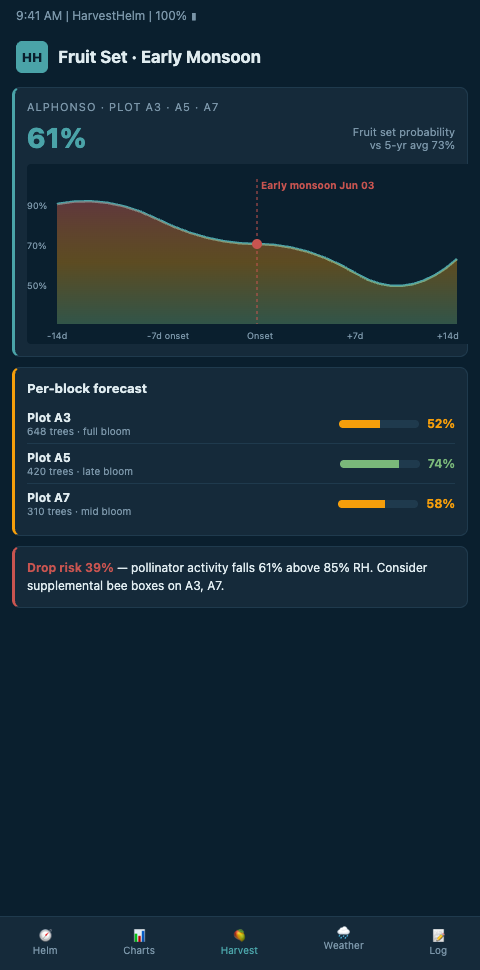
HarvestHelm forecasts fruit set during early monsoon scenarios using canopy sensor data fused with IMD outlook bulletins on the helm-charted yield forecast dashboard. The yacht metaphor works well here: an early monsoon is a squall arriving ahead of schedule. The captain's job is to reset the sails, adjust heading, and protect the cargo, not to pretend the squall is not happening.
The first layer is stress index tracking. The helm continuously computes a per-block stress index based on maximum temperature, relative humidity, leaf wetness integrals, and fruit surface temperature (inferred from canopy sensor data). When the index crosses the 30-degree-plus, 60-to-70% RH, high-fruit-temperature zone, the helm flags the block as "abscission-conducive." Interventions include targeted irrigation (not blanket), canopy shading via reflective mulches, and selective foliar sprays that reduce transpiration stress.
The second layer is rainfall threshold analysis. A Nature Communications Earth study on optimal rainfall thresholds for monsoon production found that excessive monsoon rainfall causes greater yield loss than deficits, which changes how you interpret an early monsoon. The helm differentiates "modest early rain" (sometimes beneficial for irrigation-stressed blocks) from "excess early rain" (strongly abscission-conducive). Thresholds are cultivar-specific and block-specific.
The third layer is retention modeling. Using Mango.org fruit drop research as a baseline and feeding in sensor-observed stress history, the helm projects retention rates per block over the next 72 hours, 7 days, and 21 days. This is the yield forecast at the core of the dashboard: how many fruits on the tree today are likely to still be there when harvest begins.
The fourth layer is action routing. Every forecasted retention shortfall comes with a proposed intervention: irrigation adjustment, canopy shading, foliar spray, or, in severe cases, accelerated early harvest of affected blocks. Action costs are estimated against projected retention recovery, so managers can compare the economic cost of intervention against the economic value of the retained fruit.
The fifth layer is cultivar-differentiated response. Alphonso, Kesar, and Tommy Atkins differ in fruit retention curves under stress. Alphonso is especially sensitive to early-monsoon humidity spikes during fruit set, while Tommy Atkins tolerates moderate humidity better but falters under combined heat-plus-humidity stress. The helm maintains cultivar-specific retention models so that interventions are calibrated to each block's genetics, not a plantation average. This detail matters when you are choosing between shading Block 4 Alphonso and irrigating Block 11 Kesar with limited resources.
The kilo-cut pricing means HarvestHelm absorbs cost alongside you when an early monsoon does damage despite your best efforts. If the season collapses, we collect nothing. If the helm helps you retain export-grade tonnage that otherwise would have dropped, we take a small share. That alignment matters when you are reacting to an unplanned monsoon squall: you want a platform that is on your side, not extracting subscription fees while your fruit drops.
Advanced Tactics: Preparing Early-Monsoon Playbooks Before the Season Starts
Three advanced practices prepare plantations for early-monsoon fruit set volatility before the season begins.
First, build pre-season retention scenarios per block. Before flowering, the helm projects retention outcomes under three scenarios: on-time monsoon, 7-day early monsoon, and 14-day early monsoon. Each scenario has associated intervention costs and yield outcomes. Managers enter the season with playbooks already sketched. When the monsoon actually arrives, you are executing a pre-built plan, not improvising. This builds on the same discipline covered in monsoon mango flowering analysis.
Second, map the retention model onto the flush-bloom humidity timeline so you have continuity from bloom through fruit set. Blocks that bloomed under cool-period stress often show residual stress sensitivity through early fruit set. The helm carries the stress history forward, so early-monsoon interventions account for what each block has already absorbed.
This continuity matters because a block under mild accumulated stress from the bloom phase reacts more violently to an early-monsoon humidity spike than a block that bloomed under ideal conditions. Without history carried forward, interventions under-dose the blocks that need the most support and over-dose blocks that would recover on their own. The captain's chart is only useful if it remembers the last waypoint.
Third, coordinate with export packers early. When the helm projects an early-monsoon retention drop of 18% across three blocks, your packing-house contracts and export shipping slots need rebalancing. Operators who wait for visible drop to call the packer pay the rescheduling premium. Operators who share helm-projected shortfalls two weeks before visible impact negotiate better terms. The data-driven conversation replaces reactive damage control.
Cross-crop parallel: date palm operators run analogous peak-heat fruit set workflows for diurnal stress events, and the logic transfers well to mango in monsoon drift scenarios. Both crops suffer abscission-driven losses during unusual temperature or moisture events, and both benefit from canopy-level sensor data feeding retention models.
Fourth, pair retention modeling with input cost tracking. Every intervention (irrigation, shading, foliar spray) has cost. The helm maintains a running P&L per block that compares intervention cost against avoided tonnage loss. After a season, you can see which blocks generated positive ROI from helm-driven interventions and which did not. Blocks with consistent negative ROI are candidates for structural changes, perhaps cultivar replacement, block reconfiguration, or simply earlier harvest in future seasons. The data tells you where capital goes next.
Fifth, maintain a cross-season retention archive. After three years of archived data, the plantation knows which weather patterns drive which retention outcomes for which blocks. Future early-monsoon seasons stop being surprises and become familiar territory. The helm becomes the captain's long-term logbook, not just a real-time instrument panel.
CTA: Build Your Early-Monsoon Fruit Set Playbook Before the Next Weather Surprise
If your last one or two mango seasons lost tonnage to premature fruit drop after unseasonal or early monsoon rains, HarvestHelm can deploy canopy stress sensors and build the fruit set forecast for your Alphonso, Kesar, or Tommy Atkins blocks before next fruit set window opens. We pre-build intervention scenarios, map retention projections onto your export-shipping calendar, and only collect when retained tonnage actually ships to international packers. Zero upfront cost.
Plantations across Ratnagiri, Junagadh, and Southern India's heavy-monsoon belts have the most to gain from a pre-built playbook that replaces scramble with helm-charted response. Reach out to size your sensor footprint before the next pre-monsoon window. Day one of the dashboard surfaces abscission-zone probability per block across BBCH stage 71 through 74, with pre-built irrigation and reflective-mulch actions queued against three monsoon-arrival scenarios. Waitlist priority goes to plantations that have absorbed 20-percent-plus drop events within the last two seasons, where pre-staged retention scripts deliver the fastest packhouse payback.