How to Predict Monsoon Arrival Shifts for Mango Flowering Cycles
The 11-Day Drift That Cost Maharashtra Its First Alphonso Cycle
The 2025 Alphonso season opened with a failed first flowering cycle across Maharashtra's Konkan belt. Growers who had built harvest labor contracts around the traditional February-March bloom watched panicle emergence slip, then stall, then collapse into a compressed one-month window. FreshPlaza reported that harvest compressed from three months to one, a structural shift tied to monsoon onset variance the IMD's Kerala declaration could not capture at canopy scale.
The official IMD Monsoon Onset Over Kerala system publishes arrival forecasts with roughly ±4 days accuracy, but Alphonso flowering depends on a conditional stack: cool-dry nights, dormant flush cycles, and the absence of unseasonal rainfall during panicle emergence. When northeast monsoon residuals or winter temperature anomalies disrupt that stack, the district forecast keeps saying "onset normal" while your panicles are already aborting. A Wire Science report on Malayali mango flowering mystery documented exactly this pattern, with erratic northeast monsoon and winter temperature changes disrupting traditional Feb-March flowering across southern plantations.
For plantation managers running 40 to 400 acres of Alphonso, Kesar, or Tommy Atkins blocks, the problem is not absent weather data. It is that regional models smooth over the 200-meter canopy heterogeneity where flowering physiology actually happens. MDPI Agriculture classified tropical fruits like mango as highly sensitive to monsoon onset shifts that influence crop growth, making this drift a direct existential risk to export margins. You need a prediction layer that reads your canopy, not the nearest 50-kilometer grid cell.
The economics are harsh when onset drifts. Spray rigs committed for anthracnose prevention arrive two weeks early. Pickers booked for peak pull weeks sit idle. Export packers who had forward contracts on Alphonso Grade A for Mumbai-to-London air freight watch tonnage targets slip. Every week of drift not absorbed into the operational plan compounds into lost export margin, idle equipment cost, and labor retention pressure. A plantation running on regional forecasts alone is navigating an ocean by a shoreline map.
Helm-Charted Monsoon Arrival: Building a Canopy-Level Forecast
HarvestHelm approaches monsoon arrival the way a yacht skipper approaches a weather front. The regional chart shows you the system. Your canopy instruments show you how the system is actually bending around your block geometry. The helm-charted yield forecast merges both signals into one dashboard where every dial reflects downstream action on flush, bloom, and spray timing.
The foundation is a micro-climate sensor lattice spaced at roughly 200-meter intervals across plantation blocks, tracking leaf wetness integrals, canopy temperature, relative humidity, and panicle stage progression. A Springer analysis of weather changes on mango phenostages showed measurable shifts in bud swelling and panicle elongation tied directly to weather variability invisible in station data. Your canopy sensors are reading exactly those shifts in near real time.
Real-world forecasting tools can narrow the onset question further. A Discover Applied Sciences study on Kerala monsoon onset prediction showed NWP-based methods can predict Kerala monsoon onset 2-3 weeks in advance for Kharif agricultural decisions. HarvestHelm pulls those forecasts into the helm view alongside your canopy trajectory, so you never face an IMD bulletin alone.
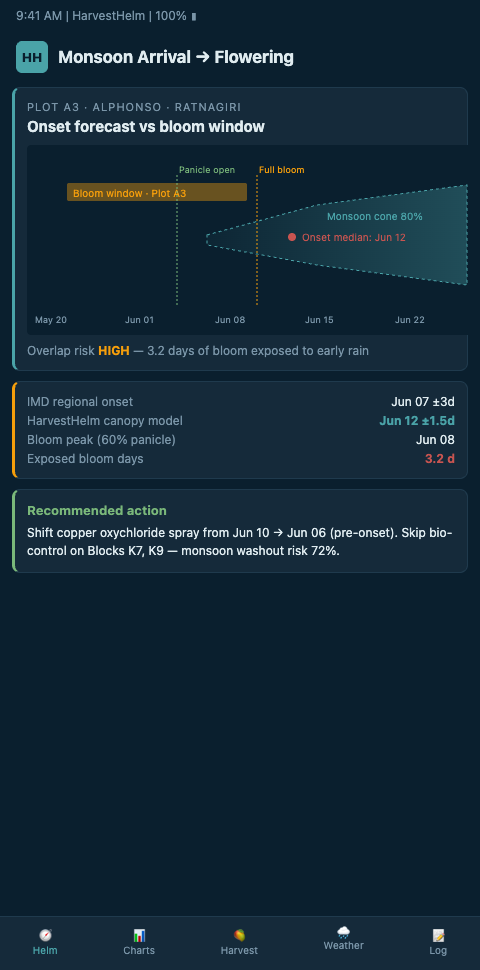
The second layer ingests IMD forecast bulletins and Doppler nowcasts, reconciling them against the 72-hour canopy trajectory your sensors are actually producing. When IMD calls onset for Kerala on June 5 and your Konkan sensors show stalled night temperature drop plus unusually high morning dew points, the helm flags a probable monsoon-drift event before panicle initiation begins. That is the captain's bridge view: you see both the chart and the ocean.
The third layer runs a cultivar-specific response model. Alphonso, Kesar, and Tommy Atkins do not respond identically to the same monsoon drift. Research on varietal temperature response showed that a mean minimum of 15 to 17 degrees Celsius maximizes the hermaphrodite-to-staminate flower ratio, and that falling below 15 degrees skews the ratio toward staminate flowers and cuts fruit set. HarvestHelm maps that physiology onto your block-level sensor data. Your dashboard shows "Alphonso Block 4: hermaphrodite ratio at risk" before you see it in the orchard.
Critically, every recommendation maps to a dated action. Delay paclobutrazol by 12 days. Pull floral induction sprays forward 5 days. Reposition monitoring gangs to the south face where canopy dew is exceeding thresholds first. You get a flush-bloom humidity timeline that actually maps onto your labor calendar.
The monetization is kilo-cut only. HarvestHelm charges nothing upfront. If the yield forecast helps you land export-grade tonnage you would otherwise have lost to monsoon drift, we take a small cut of the successful harvest. If the forecast fails and your season collapses, you owe nothing. That alignment matters when you are debating whether to trust a new system against a 30-year bloom tradition.
The fourth layer generates block-level playbooks. For each plantation block, the helm maintains a living document: current phenostage, 72-hour canopy humidity trajectory, panicle emergence percentage, anthracnose pressure index, and prescribed next actions. Block managers pull this up on their phones between orchard walks. When Block 7 shifts from "pre-flush stable" to "floral induction active," every downstream schedule, from hopper scout routes to copper sulfate inventory, recomputes automatically. The bridge is always up to date because the captain, the mate, and the deck crew all see the same chart.
Advanced Tactics: Reading Drift Signatures Before IMD Declares
The IMD declaration criteria are lagging by design. The system waits for sustained rainfall, westerly wind depth, and OLR thresholds before calling onset. By the time declaration happens, your panicles have been making decisions for days. Three leading signatures consistently appear in canopy data before official declaration.
First, morning dew point convergence. When canopy dew point rises within 2 degrees of dry-bulb temperature for three consecutive mornings, you are almost certainly within the pre-monsoon moisture advection phase. If your panicle block is past floral initiation, this window is when anthracnose conidia start germinating. If you are pre-initiation, you are looking at a probable flush-cycle reset.
Second, night temperature asymmetry. Springer research on mango phenostages found that bud break requires sustained cool nights. When your south-facing blocks show night lows holding 2 to 3 degrees above north-facing blocks, block-level flowering asynchrony is already baked in. The helm flags that asymmetry and stages your labor by block, not by plantation.
Third, leaf wetness integral acceleration. Daily leaf wetness duration above 8 hours for four consecutive days is a near-certain signal that canopy-internal humidity has decoupled from station humidity. This is where regional models fall silent and your dashboard becomes the only honest source. Managers who have adopted this approach often start by comparing forecasts with early monsoon fruit set projections under different drift scenarios to pressure-test the sensor layout.
A fourth pattern worth tracking is the paclobutrazol response window. Applications intended to advance floral bud break behave differently when pre-monsoon moisture stress shifts. IgMin Research noted that a 0.7-1.0 degree Celsius rise could render parts of Maharashtra, Karnataka, Tamil Nadu, and Andhra Pradesh unsuitable for quality Alphonso. The helm integrates temperature drift into your paclobutrazol dosing model, so your flush cycle chemistry stays aligned with the actual bloom window.
For plantations spanning significant altitude variation or terraced terrain, the bloom-timing logic shares structural features with apple systems that track elevation bloom timing across slope gradients. The cross-crop pattern is the same: regional forecasts are calibrated to open-air conditions, but bloom physiology happens in micro-topographies invisible to 50-kilometer grids.
Finally, keep a running log of drift events across seasons. The helm archives every deviation between IMD bulletins and canopy measurements, annotated with your actions and the yield outcomes. After three seasons, you have a plantation-specific drift model that is worth more than any regional forecast. You will know, for example, that your Block 4 Alphonso consistently leads the district onset by five days when post-monsoon October rains exceed 40 millimeters, or that Kesar in Block 11 reliably lags Alphonso by eight days during neutral ENSO years. Those relationships, once captured, are how a plantation moves from reactive scrambling to deliberate navigation.
CTA: Put a Helm on Your Monsoon Drift Before Your Next Flush
If your last Alphonso or Kesar season lost weeks to a drifted monsoon onset the district forecast never flagged, HarvestHelm can deploy a canopy-scale sensor lattice across your plantation ahead of the next pre-monsoon flush. We build your bloom window chart, reconcile it against live IMD and Doppler inputs, and flag drift signatures before panicle initiation stalls. You pay nothing until export-grade tonnage actually ships. If the drift costs you the season anyway, we absorb the loss alongside you. Book a plantation walkthrough to size your sensor footprint before the northeast monsoon residuals arrive.
Waitlist priority goes to Konkan and Ratnagiri plantations running 60-plus acres of Alphonso alongside Kesar or Tommy Atkins blocks, where onset variance drives the widest yield swings. Day one of your helm deployment shows a block-level cool-period accumulator, a live monsoon arrival confidence band tightening by the hour, and a paclobutrazol dosing schedule that shifts when the canopy tells it to. Reserve your slot at least 45 days before your traditional flush cycle so we can capture a pre-drift baseline across north-facing and south-facing blocks. The kilo-cut contract only bills against Grade A fruit that clears packhouse brix readings, which means the platform is carrying risk alongside your orchard from the first sensor installed.