Integrating Drip Irrigation Triggers With Diurnal Swing Telemetry
When the Clock Beats the Palm, the Palm Loses
Most drip controllers in desert date palm oases run on timers set during commissioning and revisited once a quarter. The assumption is that a 04:00 start beats the heat. In practice, diurnal swing in a wadi-fed oasis routinely spans 30°C between night low and afternoon peak, and the timing of that swing drifts week to week as khamsin winds and sandstorm dust load shift the radiation budget. A block irrigated during the final cold hour before sunrise can go into stomatal overshoot by 09:00 on days where the inversion layer lifts early.
The Coachella Valley trial documented by UC ANR improved water-use efficiency by 18% and cut puffy-skin defects when growers matched drip pulses to canopy demand instead of wall-clock schedules. Similar work across Saudi and Tunisian groves keeps arriving at the same conclusion: the palm responds to what the canopy is doing right now, and what the canopy is doing right now is rarely what last week's timer assumed. Export-grade packers see this downstream as heterogeneous fruit pressure-tests within a single Medjool bunch, and that is the defect that triggers rebate conversations.
Building a Helm-Charted Yield Forecast That Steers Each Emitter
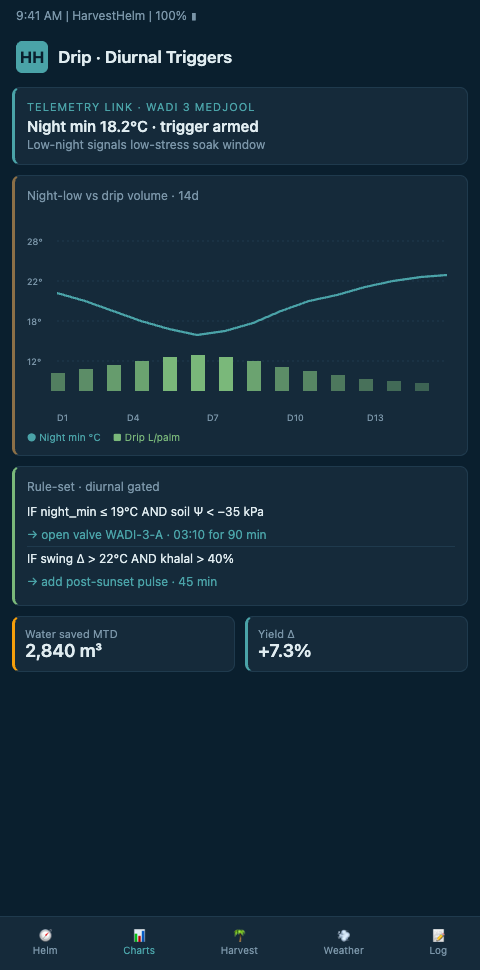
HarvestHelm treats drip triggers the way a yacht captain treats a rudder: a feedback surface that responds to telemetry, not a fixed bearing. The helm-charted yield forecast on the main dashboard ingests canopy temperature, vapor pressure deficit (VPD), stem-adjacent soil moisture, and the 72-hour diurnal swing curve — the same swing signal explored in diurnal yield models where regional averages fail to explain the block-level variance that per-palm telemetry exposes. It emits irrigation commands only when the combined signal crosses a cultivar-specific threshold. Growers set the thresholds per block in the commissioning wizard and the engine tunes them against actual fruit-set outcomes each season.
The first integration layer reads temperature from canopy-facing sensors placed on the north side of the crown to avoid direct sun bias. HarvestHelm pairs each reading with a colocated reference dew-point probe, which is the signal that actually controls transpiration load. CIMIS shows how hourly solar, humidity, and wind data feed ASCE-Penman-Monteith reference ET; HarvestHelm uses the same formulation but replaces the regional station with the per-block sensor stack so the ET number reflects what your Deglet Noor is actually losing through its fronds.
The second layer handles soil-side confirmation. A soil moisture sensor irrigation controller, as UF IFAS documents, can veto an irrigation command when stored moisture exceeds the adjustable threshold. HarvestHelm inverts this logic: the soil sensor does not say "go" — it says "stop if you must." The go signal comes from the diurnal swing curve. When nightfall VPD has collapsed and the palm has had four hours of dark-respiration recovery, the helm issues the next pulse as a short burst at a volume calculated from the day's peak stress minutes.
The third layer is the cultivar kinetics adjustment. FAO's date palm irrigation chapter puts summer water demand at 7,154 m3/ha for mature Medjool, nearly double winter need. HarvestHelm does not apply that total as a constant; it distributes it across diurnal windows weighted by transpiration. A Barhi block coming into khalal with a heavy canopy will draw 22-27% of its daily allocation in the 08:00-11:00 window. Feeding the emitters during that window risks root-zone saturation right as the palm is pushing water upward, while post-peak feeding (15:00-17:00 on cooler days) refills the profile for the next diurnal cycle.
The dashboard overlays the four cultivar transpiration curves (Medjool, Deglet Noor, Barhi, Zahidi) against live VPD telemetry so the captain can see the moment each cultivar is likely to enter stomatal closure and how much irrigation buffer the current soil profile carries. Operators in mixed-cultivar oases run a split-irrigation schedule where each cultivar block receives its pulses on a cultivar-specific clock rather than a block-rotation clock. A Zahidi block that tolerates 48°C in the afternoon might skip a midday pulse the adjacent Medjool block requires, and the pump sequencing handles the difference. Water delivered in the right window to the right cultivar gives 8-15% yield lift in operations that previously ran uniform schedules, because the emitters stop wasting volume on palms that are not physiologically accepting it.
The yacht metaphor matters because it stops growers from thinking about irrigation as a command and starts them thinking about it as a helm input that corrects drift. The diurnal swing telemetry integration is the chart plotter — it tells you where the palm is heading, and the drip trigger automation is the steering response. When HarvestHelm shows a 6-hour VPD forecast above the cultivar's stress ceiling, the captain's view lets the orchard operator adjust the pulse plan before the first stomatal closure.
A fourth layer handles khamsin-event anticipation. When the 72-hour forecast shows a rising wind vector paired with declining humidity, the helm pre-charges the soil profile ahead of the dry-wind stress window. This is not additional water; it is earlier water, moved into a pulse sequence 10-14 hours ahead of the projected stress peak. The palm enters the khamsin hours with root-zone moisture at the upper end of the target band, which buys 3-5 hours of transpiration buffer before stomatal closure becomes necessary. Export-grade Medjool operations running this pre-charge pattern report 12-18% reductions in khamsin-associated fruit drop compared to reactive irrigation schedules that only respond after stress is measured.
Advanced Tactics for Deficit Scheduling and Oasis-Specific Smart Irrigation
Once baseline triggers are running, the real gains come from deficit irrigation scheduling tuned to fruit-development stages. MDPI Agronomy shows that threshold-based deficit schedules during late rutab development preserve fruit quality while cutting water use 15-25%. HarvestHelm exposes this as a stage-aware overlay: during hababouk and kimri, the helm holds full ET-replacement triggers; at khalal transition, the operator can engage a deficit preset that lowers soil-moisture vetoes to 85% of baseline. The diurnal swing telemetry keeps the palm out of acute stress by catching any rapid VPD climb and reverting to full irrigation within the same pulse window.
A second advanced pattern is multi-block sequencing. When ten or more blocks share a pump station, the helm cannot fire every trigger simultaneously without brown-out. HarvestHelm queues triggers by urgency — the block closest to its stress ceiling gets first pulse, and the queue reorders every 15 minutes as telemetry updates. Operators who previously ran fixed rotations report 8-12% lower peak pump hours once the helm takes over the sequencing. For context on how canopy-level temperature data reshapes the trigger curve, the work on calibrating heat unit canopy shade covers shade-corrected degree-day math that feeds the same threshold engine.
The third tactic is feedback-loop tuning via subsurface drip sensing. The MDPI Sensors work on IoT subsurface irrigation shows that cloud-connected soil plus climate sensors enable remote adjustment of per-palm water delivery. HarvestHelm reads those sensors as a second confirmation vector on the deepest emitter depth and uses the data to detect emitter drift — a clogged line shows up as soil-moisture divergence across adjacent palms within 3-5 pulse cycles. The dashboard flags the divergence and routes a service ticket to the ground crew. Similar logic drives wind machine triggers on slope temperature data in high-gradient apple orchards, where automation responds to hyperlocal signal rather than regional averages.
A fourth pattern worth naming is salt-accumulation management. Subsurface drip in arid oases tends to push salts to the wetting-front margin, where they concentrate over the season. HarvestHelm's salt-accumulation tracker uses electrical-conductivity probes paired with the soil-moisture sensors to watch for EC climbing past cultivar thresholds (typically 4-5 dS/m for Medjool, higher for Zahidi). When EC crosses threshold, the engine proposes a leaching-fraction adjustment to the next 3-5 irrigation pulses — pushing accumulated salts below the root zone without shocking the palm. This moves leaching from an annual calendar event to a continuous maintenance function, and operations report 20-30% reductions in puffy-skin defects over a three-season rollout because the root zone stays in the cultivar's preferred EC band more consistently. The salt-management module pairs with the deficit-scheduling module so that deficit pulses on a high-EC block automatically include a leaching-fraction buffer.
Stop Irrigating on Last Quarter's Timer
Fixed-schedule drip controllers in desert date palm oases leak margin twice: once through water they burn during recovery hours, and again through the heat-stress fruit drop they fail to prevent when the diurnal swing shifts. HarvestHelm's oasis smart irrigation layer reads canopy VPD, soil moisture, and the 72-hour swing forecast, then fires emitters only when the palm is physiologically ready. Book a block-scoped demo and we will pull the last four weeks of ambient data from your nearest wadi station to show where your current timer is leaving water — and fruit — on the table.
No subscription; we take a kilo-cut only when the harvest closes above your rolling five-year baseline. Your ladder crew keeps every date above that line; we only eat when the palm outperforms. Join the drip-integration waitlist before your Medjool blocks enter khamsin pre-charge season this March, and on day one the dashboard will display per-block VPD versus fixed-timer divergence along with recommended pulse shifts for your Barhi and Deglet Noor blocks ahead of khalal transition. Waitlisted operators who wired drip to HarvestHelm ahead of last summer showed measurable reductions in rutab-stage puffy-skin defects on packhouse inspection, which directly improved their Medjool export-grade share against contracted ratios.