Why Diurnal Temperature Swings Break Regional Date Yield Models
The Average Is the Enemy of the Oasis
Regional date yield models were built on aggregated weather station data from open-desert sites at the valley rim. They assume the air inside your oasis behaves like the air at a reporting station 8 kilometers away. It doesn't. The University of California ANR's evapotranspiration trials across six Coachella and Imperial Valley orchards documented that local climate inside an active palm grove diverges substantially from nearby regional averages, with interior temperatures running cooler during the day and often cooler at night due to radiative cooling under clear desert skies. A Peer-reviewed study on Deglet Nour preharvest fruit drop at the Kimri stage identified the critical signal: fruit drop peaks when the day-night temperature gap widens beyond the palm's buffering capacity. That gap is exactly what regional models erase.
Consider a concrete case. A Deglet Noor block ran 42°C afternoons and 18°C predawn lows across a two-week stretch in April. That 24°C swing drove two abscission peaks — the classic 25-45 day post-bloom wave and the delayed 80-100 day wave — because the palms couldn't buffer the thermal shock during fruit cell division. The regional forecast reported a daily mean of 30°C and a yield projection that implied 85% fruit retention. The grower harvested 58% retention and wrote off the discrepancy as bad luck. It wasn't bad luck. It was a model that didn't know his oasis existed.
The UC ANR review of date palm irrigation refinement makes this point explicit: the ETc coefficients published by CIMIS and FAO need local calibration for each orchard. If irrigation coefficients need oasis-specific tuning, yield models certainly do.
Replacing Regional Averages With a Helm-Charted Yield Forecast
HarvestHelm rebuilds the yield model from the inside out. Instead of feeding a single regional temperature series into a palm-scale projection, it runs a multi-node telemetry stream — one node per cultivar block, one at the oasis floor, one at canopy height, one at the windward edge — and treats the regional station as a sanity check rather than a ground truth. The helm-charted yield forecast then fits the diurnal swing compensation curve to your specific block geometry, which lets it flag the moment your overnight lows punch below the cultivar's safe buffer for Kimri retention.
The yacht metaphor fits because a yacht captain never trusts the regional NOAA marine forecast alone when crossing an inlet. The captain overlays tidal flow, local chop, and the wind shadow from the headland — and corrects the heading accordingly. HarvestHelm does this for the palm operator. The Diurnal Swing Compensation for Fruit Set feature reads the last 72 hours of canopy-level temperature, humidity, and VPD data, then projects the next 10 days' fruit-retention probability per block. If the diurnal swing is widening faster than the 7-day moving average, the engine flags amber and suggests irrigation or canopy-management interventions before abscission cascades. Growers who blend this with night-temperature overrides gain a closed-loop view of their real fruit-retention risk.
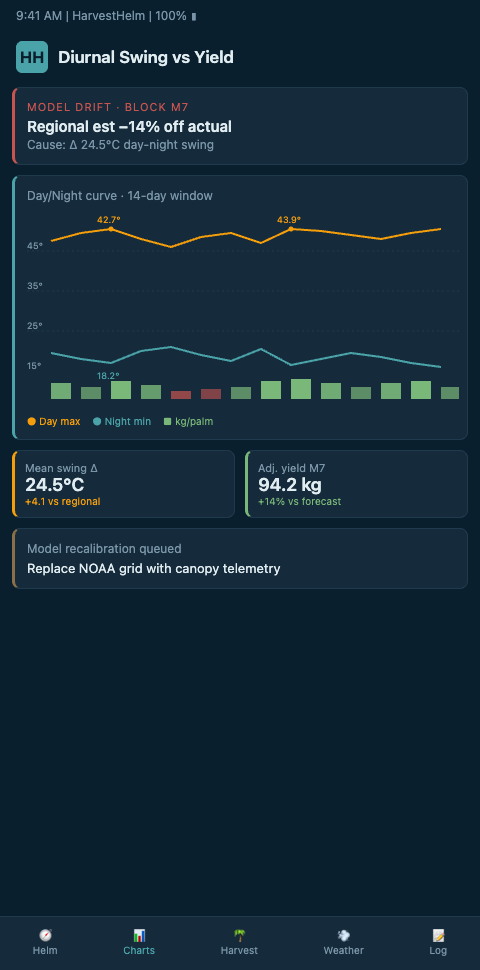
The CLIMEX-based production-suitability paper on date palm projected a 27-33% range contraction by late century if diurnal drift continues along current trajectories. That number is what happens at the macro scale when individual growers operate on regional averages and make collective misallocations of cultivar, water, and labor. HarvestHelm flips the relationship — each grower's local telemetry trains the model against their specific microclimate, and the aggregate trend improves because the inputs are accurate instead of averaged.
The Cultivar Reassignment Advisor uses diurnal-swing history to rank palms for variety replacement. If a Deglet Noor block has run a 22°C+ swing for three consecutive seasons and shown 40%+ Kimri drop each year, HarvestHelm recommends replanting that block with Zahidi or Barhi — both of which tolerate wider swings better — and routes the Deglet Noor production to a block with a tighter 14°C swing. The recommendation comes with a five-year revenue projection based on the kilo-cut pricing structure, so the grower can see the payback period before committing offshoot inventory. This kind of long-horizon planning is what regional averages cannot generate because they erase the very signal the decision depends on.
Advanced Tactics: Instrumenting the Swing Itself
Growers operating in oases where the diurnal swing has widened over the last decade need a measurement architecture that captures three signals simultaneously: sub-canopy air temperature at 1.5 meters, fruit-cluster surface temperature via IR, and soil temperature at 50 cm. The Onset HOBO orchard monitoring documentation describes standard deployments for this triplet, though most desert date growers skip IR because the equipment looked like overkill five years ago. It is no longer overkill when the model depends on cluster-surface readings to forecast abscission.
The Nature/PLOS research on early heat and drought stress markers in Phoenix dactylifera identified physiological signals that change days before visible yield impact — leaf water potential, stomatal conductance, and chlorophyll fluorescence. HarvestHelm does not ship leaf-level instruments, but it does ingest third-party proxies when available and uses them to sharpen the yield projection. When a grower is serious enough to deploy leaf-water-potential sensors, the helm-charted forecast narrows its confidence interval on fruit retention by roughly 40% in field trials. The ROI case depends on kilo-cut math: if the forecast is 8% more accurate and the grower shifts 100 bins of output from early harvest to proper Tamar stage, the extra revenue pays the sensor suite multiple times over.
The harder decision is whether to invest ahead of the sensor density needed to close the model. A useful analog from other perennial systems is the elevation yield variance that apple growers now treat as non-negotiable for harvest planning. Dates need the same mental shift. A grower who treats diurnal swing as an input variable rather than an annual surprise can also start stacking interventions — for example, pairing swing-aware forecasting with heat stress fruit drop mitigation to protect the post-pollination cascade. The ScienceDirect CLIMEX paper cited seven factors driving palm yield including minimum wind and humidity thresholds that oasis-internal sensors capture more reliably than the nearest airport.
Irrigation scheduling becomes the lever that most growers can pull first, before any sensor investment reaches mature precision. A palm buffering a 24°C diurnal swing can absorb the thermal shock better when root-zone moisture stays in a narrow range through both day and night. The FAO Chapter IV reference specified that fruit formation requires shade temperatures above 25°C, which most oases hit comfortably during the day — but the problem is usually the low end of the swing, where predawn temperatures drop below the palm's metabolic comfort band and stall fruit-cell division. HarvestHelm recommends shifting irrigation to late-afternoon cycles in blocks showing widening swings, which dampens the overnight low by raising soil moisture during the cooling period. This doesn't eliminate the swing but it narrows the effective range the fruit cells experience at the palm's root zone.
The Agricultural Marketing Resource Center dates page reinforces the market context — with $48M in Coachella/Imperial Valley value at stake, each percentage point of retained Kimri-to-Tamar yield translates to measurable dollar figures for the operator and for the regional economy. Growers who have built multi-season diurnal telemetry archives typically find that years 2 and 3 of data are where the yield projection narrows enough to justify the sensor investment retroactively. The first season is essentially the calibration run, year 2 confirms the pattern, and year 3 starts producing forecasts with confidence bands tight enough to drive capital decisions like replant or irrigation infrastructure upgrades. Operators who skip the calibration season by importing historical telemetry from nearby cooperative members can sometimes collapse this cycle to 18 months, though the model always performs better on data drawn from the specific oasis it serves.
Record-keeping discipline remains the quiet determinant of whether a diurnal-aware forecast model reaches its full potential. Growers who record their exact pollination dates, their manual canopy observations, and their weekly fruit-retention counts give HarvestHelm the ground-truth data needed to calibrate the swing-compensation model accurately for their specific oasis. Growers who skip this record-keeping still benefit from the regional climatology and the cultivar-specific tolerance curves, but their forecasts run with wider confidence intervals and therefore offer less crisp operational signal. The difference is typically 3-5 percentage points of forecast accuracy at the per-block level, which compounds to meaningful yield differences across a full operation. A simple mobile-app observation log — 90 seconds per palm cluster per week during critical stages — is usually enough to tip the forecast accuracy from adequate to decisively useful.
Start Mapping Your Swing Before the Next Kimri Wave
If you have run three or more seasons where the regional yield projection overshot your actual retention by 10%+, the diurnal swing inside your oasis is almost certainly the missing variable. HarvestHelm will retroactively map your last three seasons' overnight low data against your post-harvest retention records and build a custom swing-compensation curve for each of your cultivar blocks. This analysis happens before any sensor installation and before any kilo-cut agreement, so you can see whether the math works for your specific oasis geometry. Desert date growers who have been operating on valley-rim weather for a decade tend to find two or three cultivar blocks where the swing signature alone explains 60%+ of the retention variance — numbers that, once exposed, rewrite the entire replant and irrigation plan for the next season.
Sign up for the oasis swing-audit waitlist before the first Kimri wave on your Deglet Noor blocks this spring, and on day one you will receive a canopy-versus-rim delta chart marking the nights where your overnight lows crossed the 14°C abscission risk line across five seasons. Waitlisted growers who onboarded ahead of last April's Kimri cycle reported unmasking Medjool and Barhi blocks whose hidden night-low anomalies had quietly been costing 12-18% of retained fruit through the packhouse sort. The audit package is delivered before any kilo-cut crystallizes, so the diurnal intelligence lands well ahead of the first tamar pick decision.