When Night Temperature Drops Override Regional Heat Advisories
The Advisory That Tells You About the Day, Not the Night
Date palms live in a thermal window bounded on both sides. FAO's Chapter IV on climatic requirements documents that growth stops below 7°C, -6°C dries pinnae margins, and -9°C damages outer canopy leaves. The lower boundary matters as much as the upper one, and in desert oases the night-low deviation is what most regional advisories miss. UF IFAS Extension's cold damage on palms describes chilling injury in the 40-45°F range (roughly 4-7°C) causing foliar necrosis even without freezing. Regional heat advisories are issued on daytime maxima; they say nothing about the overnight low that actually drives the palm's circadian stress response.
PMC's review on coping with stress in desert date palm documents diurnal temperature ranges often spanning 30+°C, meaning a day with a 38°C high can still have an 8°C low. The palm is managing both bounds simultaneously, and PMC's work on protein expression plasticity for heat and drought shows circadian-regulated stress responses where acute night-low deviations disrupt daytime tolerance. A block that was heat-stressed the prior afternoon and then sees an unexpected night low at 3°C enters spring with damage that would not have appeared without the night drop.
The regional heat advisory override is the operational concept: HarvestHelm must detect when the local night-low anomaly trumps the regional message. Mixed-cultivar oases amplify this problem because Medjool, Deglet Noor, Barhi, and Zahidi carry different chill-tolerance curves across their bloom, Kimri, and tamar developmental stages, so a blanket regional advisory aimed at the overall province cannot surface the per-cultivar override signals that actually determine which blocks need mitigation tonight.
A Helm-Charted Yield Forecast That Reads Both Bounds
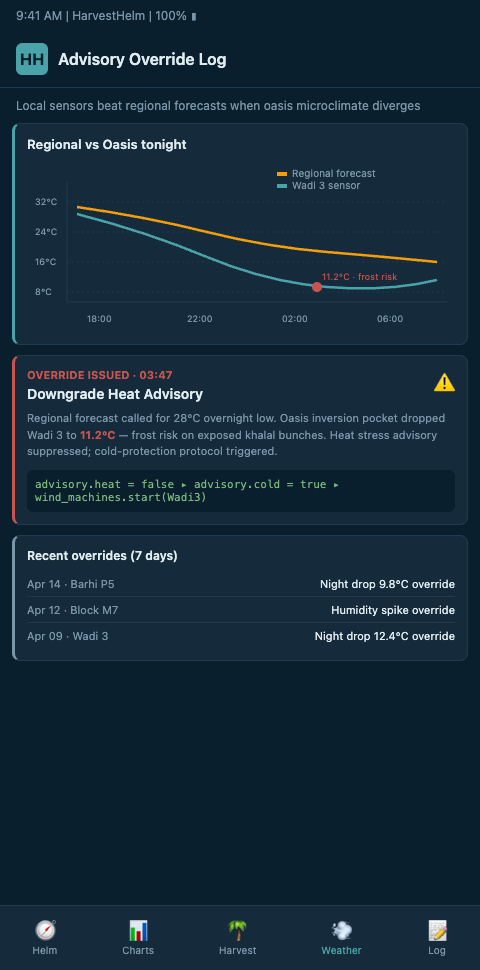
HarvestHelm's oasis night-low anomaly detection runs on the same wadi-level sensor stack that feeds daytime telemetry, but with different thresholds and a different decision tree. The helm-charted yield forecast treats night temperature drops as first-class events that can override daytime advisories — the captain's view flags the override whenever the night-low forecast crosses a cultivar-specific chilling threshold. This is the yacht navigation pattern applied to thermal risk: regional advisories describe the weather in the bay, but the helm steers the palm through both extremes of the day.
The thermal-floor detection layer reads three inputs. The first is 5-minute canopy-interior temperature from sensors in shaded and exposed quadrants. Shaded-quadrant sensors catch the coldest readings where radiative cooling is strongest; exposed-quadrant sensors show the minimum that well-mixed air achieves. When the shaded quadrant drops below the chilling threshold while the exposed quadrant stays above it, the helm flags a differential chill event that a single-sensor-per-block setup would miss.
Differential chill events are the most under-reported risk pattern in desert date grove operations. A block that shows 6°C on its exposed sensor might have pockets dropping to 2°C in the most shaded, wadi-draining quadrants, and the palms in those pockets experience chill damage the block-average readings would never surface. HarvestHelm's sensor-placement guidance specifies at least one sensor in the lowest-elevation shaded quadrant per block, precisely because this is the location most likely to expose the differential chill signal. Operations that historically experienced "random" bud damage on a minority of palms every few winters typically discover after sensor deployment that the "random" pattern was always concentrated in the same cold pockets, which lets the operation target frost-protection interventions rather than treating the grove uniformly.
The second input is the regional advisory feed. HarvestHelm ingests the NWS Dust Storms and Haboobs page as one of several regional feeds; similarly it reads heat advisory, cold advisory, and frost advisory feeds from the relevant regional office. The helm compares the regional message to the local telemetry and flags divergence. When the region says "excessive heat" and the local telemetry says "approaching chilling floor in three blocks," the helm issues a regional heat advisory override notice and promotes the local reading to primary advisory status for the affected blocks. This is the same microclimate-override logic that governs cold-drainage work in drainage overrides NOAA, where terrain-driven cold pooling defeats regional advisories in apple orchards.
The divergence detection also handles the opposite case: when regional forecasts issue frost advisories that do not apply locally because the grove's wind-shelter configuration or thermal mass prevents the predicted cold pooling. Operations responding to every regional frost warning would activate mitigation (wind machines, protective covers) unnecessarily, burning fuel and crew hours on non-events. The helm's bidirectional divergence check means the dashboard is as useful for suppressing false alarms as it is for amplifying missed risks, and over a season the operation avoids 4-8 unnecessary mitigation activations per grove, each of which would otherwise cost hundreds of dollars in fuel and several crew-hours.
The third input is the forecasted night-low trajectory. HarvestHelm runs a 72-hour local forecast by combining regional model data with the block's historical relationship to regional minima. A block that has averaged 3.2°C below the regional minimum across 5 winters will have its forecast adjusted by that factor, with uncertainty bounds. PMC research on climate modulation of the metabolome in date palm leaves documents slight temperature variations triggering osmolyte and antioxidant shifts, meaning the palm's chilling response is sensitive to small forecast errors. HarvestHelm's 72-hour trajectory includes the palm's prior-day thermal stress state as a modifier, because a heat-stressed palm entering a cold night is more vulnerable than a baseline palm.
The modifier also tracks recent wind exposure. Palms that experienced strong afternoon winds often show depressed night-low tolerance because the wind depletes the leaf boundary-layer moisture that normally buffers cold exposure. HarvestHelm's vulnerability score treats the previous 36-hour wind exposure as a risk multiplier on the nominal chill threshold, so a block that sustained 25 km/h winds yesterday afternoon gets an elevated-vulnerability flag tonight even if the forecast night-low itself is within historical norms. This captures the kind of compound-stress failure that single-variable chill-warning systems routinely miss and that post-event damage assessments often blame on "weather this year" rather than on the specific compound pattern that actually caused the damage.
The cold-snap fruit risk assessment produces three outputs the captain sees. First, the block-level chill risk heatmap colored from green (safe) through yellow (marginal) to red (active chilling injury risk). Second, the override-notice banner when regional advisories contradict local conditions. Third, the mitigation-options panel that surfaces available responses — wind-machine activation, irrigation timing adjustment (warm water can buffer root-zone temperature), mobile radiative-protection deployment for high-value blocks. The UF IFAS Sumter County guidance on post-freeze palm recovery provides the assessment protocol HarvestHelm runs after a confirmed chill event, with mobile-app task prompts for the ground crew.
The mitigation options are costed so the captain sees both the risk-reduction and the operational cost per intervention. Wind-machine activation might cost $180 in fuel and reduce chill risk by 40% across two blocks; irrigation-timing adjustment might cost nothing but reduce risk by only 12%; mobile radiative protection might cost $1,200 in setup and crew time but reduce risk by 75% on one high-value block. The captain picks the mitigation mix based on expected crop value at risk and available budget, with the dashboard showing the total expected cost and expected yield preservation for each option combination. This transparent cost-benefit framing is what makes the cold-snap response manageable rather than panic-driven.
Advanced Tactics for Cultivar-Specific Thresholds and Multi-Night Integration
The first advanced tactic is cultivar-specific chill thresholds. Medjool, Deglet Noor, Barhi, and Zahidi have different tolerance curves, and within each cultivar the sensitivity varies with developmental stage. A Medjool block in late bloom has different chill sensitivity than the same block in tamar. HarvestHelm's cultivar module carries per-variety chill tolerance tables, tuned each season against observed damage events. When a Medjool block is forecast to cross its bloom-stage chill threshold while a Zahidi block on the same grove is still safely above its tamar-stage threshold, the helm generates per-cultivar guidance rather than a blanket grove advisory.
The second tactic is multi-night integration. A single cold night is rarely catastrophic; sustained multi-night cold is what damages palms. HarvestHelm's cold-snap detector accumulates chill-hour exposure across consecutive nights and flags the cumulative threshold rather than just the nightly minimum. The cumulative model handles the physiological reality documented in the PMC protein-expression work referenced above, where repeated stress depletes the palm's response capacity. For the adjacent conversation on how diurnal swings in general shape the yield model, see diurnal yield models, which covers the broader thermal-window breakdown that drives planning.
The third tactic is harvest-window linkage. Cold-snap events during tamar finishing can push the optimal pick date forward, because cold-damaged fruit loses moisture faster and degrades in post-harvest handling. HarvestHelm's harvest planning module reads the cold-snap log and re-computes the recommended pick window, connecting directly to night-low harvest windows for the multi-season pattern analysis. The integrated view means a February cold event reshapes the September pick plan automatically, and the packing shed sees the adjusted schedule before it causes downstream conflicts.
Read Both Bounds of the Thermal Window
A regional heat advisory tells you about the afternoon; it tells you nothing about the 3°C shaded-quadrant low that your Medjool block is actually experiencing tonight. HarvestHelm's regional heat advisory override engine reads wadi-level sensors against regional advisories and flags the nights where your local minimum crosses cultivar-specific chill thresholds. Book a cold-season readiness audit and we will pull your prior two winters of ambient data against your observed chilling-damage events to show where the advisory system missed. No upfront cost; the kilo-cut applies only to the harvest delta above your five-year baseline. The palm is managing both ends of the thermal window; your dashboard should be too. Join the night-low override waitlist before the February cold-snap window hits your Medjool and Deglet Noor blocks this winter, and on day one you will see shaded-quadrant differential chill traces with cultivar-specific override flags and costed mitigation options per block.
Waitlisted Arizona and Coachella operators who onboarded ahead of last January's cold event caught three differential chill events that regional advisories missed entirely, activating wind-machine and irrigation-shift interventions that preserved Medjool bud integrity across two blocks where the advisory system would have allowed unnoticed damage. The vulnerability-score modifier that tracks recent wind-exposure and prior-day heat stress is active from day one and runs against your existing cultivar chill-tolerance tables with no manual calibration required. The cold-snap detector also accumulates chill-hour exposure across consecutive nights, flagging the cumulative threshold that single-night models would miss, which matters particularly for Barhi and Zahidi blocks entering tamar finishing with compounded thermal stress. Cooperative managers coordinating mitigation budgets across multiple parcels gain transparent cost-benefit framing for each wind-machine or radiative-protection decision, which converts cold-snap response from panic-driven fuel burn into deliberate capital allocation against expected yield preservation.