Building a Multi-Block Harvest Schedule From Cold Sink Geometry
The Basin Block That Always Picks Last — and Why
A Virginia grower kept wondering why Block 11 at the bottom of the orchard's narrow basin always ran 10-14 days behind Block 3 on the ridge, even though the two blocks shared the same cultivar and rootstock pairing. The answer is geometry: cold air drains downhill at night and pools in the basin, slowing growing-degree-day accumulation by 15-20% relative to the ridge top. MSU Extension's guidance on analyzing farm air drainage is direct on the physics — cold air flows along the ground like water, and growers have three levers for managing it: remove obstacles, improve drainage, or add storage. For pick scheduling, the geometry becomes the schedule.
A University of Utah cold-air-pool study of Peter Sinks measured a 22K potential-temperature inversion in 100 meters of basin depth overnight — extreme, but indicative of how much the geometry matters. The cold-air pool depth directly alters the nocturnal cooling rate at each block, which is why blocks at different positions in the same basin can have different ripening curves even under identical management. A ScienceDirect paper on cool-pool lake effects on nocturnal cooling documented exactly this in orchard experiments: cold-air-pool depth predicts per-block nocturnal temperature and therefore per-block phenology.
The consequence for pick scheduling is direct: a basin block at the cold-pool bottom can accumulate 20-25% fewer growing-degree-days between bloom and harvest than a ridge block only 300 feet higher and 400 meters away. The ridge block hits commercial maturity first; the basin block catches up 10-14 days later. A calendar-based schedule that ignores this offset either picks the basin block underripe or the ridge block overripe — and both failures show up at the packhouse as reduced grade-A percentage.
Building the Helm-Charted Yield Forecast From Basin Shape
HarvestHelm builds the pick schedule from a cold-sink geometry model, not a map sequence. The helm-charted yield forecast ingests a digital elevation model of the parcel, identifies drainage basins by flow accumulation, and ranks each block by its position in the basin hierarchy. Ridge blocks get early pick windows. Mid-slope blocks get middle windows. Basin-bottom blocks get late windows — and also get extra frost monitoring because they carry the highest radiation-frost risk. FAO's fundamentals of frost protection is explicit: site selection by cold-air drainage, slope, and aspect is the single strongest frost control lever available — and that same geometry is the strongest schedule control lever too.
Think of the orchard as a harbor with multiple moorings. The yacht metaphor inside HarvestHelm treats each block as a berth on a chart, with depth soundings (elevation below ridge), bottom type (soil drainage), and exposure (slope aspect) as navigational attributes. The helm-charted yield forecast plots the pick window for each berth and sequences crew passage from ridge to basin so warming conditions are followed. This is not a map sequence — it is a gradient sequence.
Obstacle mapping is a critical input. Rutgers NJAES E363's active frost protection guidance notes that dense woods at a slope base can dam cold air and deepen the pool, which extends the ripening delay of the basin blocks. HarvestHelm's planning view surfaces these obstructions as "cold-air weirs" on the chart and flags blocks downstream of each weir for schedule adjustment. A grower considering removing a woodland strip to improve drainage can preview the schedule shift that would follow.
Sub-basin hierarchy matters too. A large main basin often contains 2-4 sub-basins where cold air pools in distinct depressions before spilling over low saddles into the main basin. HarvestHelm's flow-accumulation analysis identifies these sub-basins from elevation data, and each becomes its own scheduling unit within the larger plan. Blocks inside a sub-basin that drains into a deeper main basin get scheduled later than blocks at the same elevation outside the sub-basin — the local pooling adds 2-4 days of phenology delay even in the middle of a larger drainage.
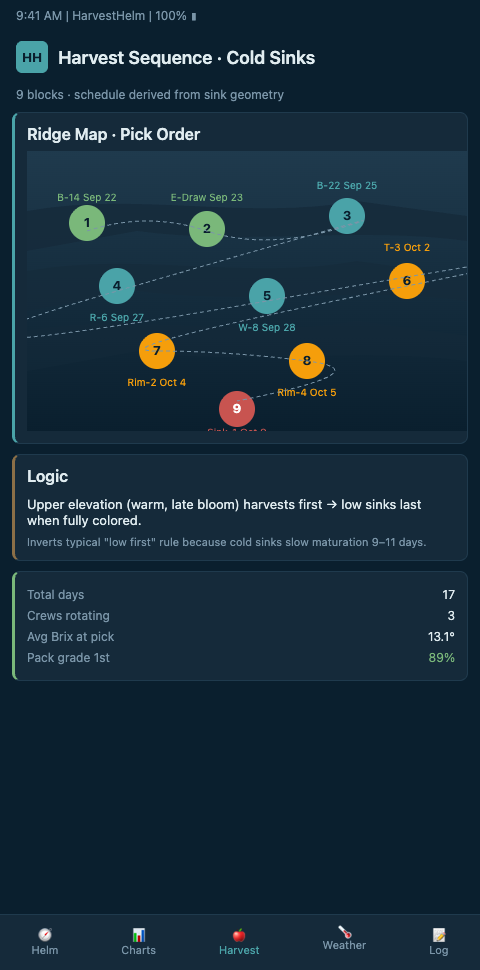
The academic tooling is catching up. A SpringerLink chapter on harvest planning optimization describes block-level schedules that assign daily crews and bins per block to meet ripeness windows — exactly the workflow HarvestHelm operationalizes. And a ScienceDirect paper on the MOKASEO metaheuristic for multi-fruit harvest planning documents how optimization approaches outperform baseline scheduling across small, medium, and large multi-block problems. HarvestHelm uses a similar decomposition under the hood, but the input layer is the basin geometry — not generic block labels.
The scheduling model also needs to handle wet-soil constraints. A basin block that has just received 2 inches of rain can be inaccessible to tractors for 48-72 hours, which forces the schedule to substitute a different block temporarily. HarvestHelm's planner watches the precipitation forecast for each sub-basin and auto-generates a rain-contingency schedule alongside the primary plan. When rain actually lands, the manager can swap to the contingency with a single tap rather than rebuilding the plan from scratch.
Advanced Tactics for Basin-Informed Scheduling
Variability within a basin is the next order of detail beyond the sub-basin hierarchy. Prior-season frost damage patterns often reveal micro-depressions the DEM does not fully capture, particularly where canopy infill has changed airflow since the base elevation model was captured. HarvestHelm's planning view lets growers annotate these patterns, and the routing engine respects them as distinct scheduling units. This ties into mapping orchard variability and soil attributes, which WSU Tree Fruit documents as improving premium packout and smoothing yield variability when blocks are managed as spatial zones rather than uniform plots.
Basin geometry also drives wind machine siting decisions. The cold-sink analysis identifies where air pools deepest, which is exactly where a fan trigger probe should sit. The same work that drives the pick schedule therefore also informs wind machine triggers wired to slope-level temperature data — one geometry layer, two operational decisions. Pairing these means fan operation on frost nights preserves the basin blocks, which then enter their delayed ripening window with less damage.
Long-term orchard redesign decisions sit on the same data. A grower considering a new block expansion can overlay the proposed planting on the basin geometry map and see which blocks would land in high-variance scheduling zones. Blocks planted at sub-basin bottoms without drainage improvement carry inherent scheduling penalty — the data supports pre-planting decisions, not just current-season scheduling. Growers can also model the impact of drainage ditches, wind machine siting, or woodland removal before committing capital, which turns the helm display into a planning tool across 5-10 year horizons rather than just the current season.
Crew staging follows. Basin-bottom blocks with late pick windows also carry the most protection overhead during bloom, so they benefit from repeat visits by the same crew — institutional knowledge about where to walk and which row to start from. Picker staging across bloom waves lays out the crew-routing logic that sits on top of the basin schedule.
The principle generalizes across weather-driven cropping. Tropical mango growers face monsoon pull-forward rather than frost pull-back, but the schedule logic is identical — the weather geometry sets the pick order, not the map. HarvestHelm's sister approach for monsoon-window harvest pull-forward in tropical mango plantations runs the same algorithm against a different threat chart.
The failure mode is assuming the basin geometry is static. A wet year can widen the basin's active cold-pool footprint by 10-15% because damp air cools faster at night. HarvestHelm re-reads the basin shape each season from the current-year probe network, so the schedule evolves with conditions rather than anchoring on a survey from five years ago.
Packhouse coordination is the operational capstone. A basin-informed schedule that delivers early ridge fruit on Tuesdays and late basin fruit on Fridays lets the packhouse plan staffing against the actual arrival curve rather than a blanket weekly peak. Growers who share their HarvestHelm schedule with the packhouse ahead of the pick window often negotiate preferred slot access in exchange for predictable delivery timing — packhouse operators prefer predictable over large when sizing shifts and bin storage.
Multi-parcel operations get a further benefit from basin geometry. A grower with three non-adjacent parcels can stack their pick windows so crews move across parcels as each parcel's basin schedule demands. HarvestHelm's multi-parcel planning view shows the combined schedule across all parcels on a single timeline, so the grower sees exactly when crews need to transition between properties and can pre-position equipment accordingly.
Ready to Sequence Pick Order by Basin Shape Instead of Row Number?
Mountain orchardists running fragmented parcels across ridge, mid-slope, and basin blocks need a pick schedule that respects the thermal geometry of the site. HarvestHelm builds the schedule from your parcel's drainage basins, sequences crew routing by elevation gradient, and keeps the basin blocks protected until their delayed pick window arrives. We take nothing until the packhouse scale clears — kilo-cut only. Join the waitlist, share your parcel boundaries and any known cold-pocket locations, and we will model your first basin-informed pick schedule against last year's ripening log. Pilots signing before bud-swell get the drainage-basin DEM analysis delivered with sub-basin hierarchy and cold-air weir annotations before your pre-season block assignments are locked.
Day-one dashboard views show ridge, mid-slope, and basin blocks color-coded by expected pick window with a 10-to-14-day cold-sink lag drawn against the ridge baseline. Onboarding includes a rain-contingency schedule auto-generated alongside the primary plan so a 2-inch storm over 48 hours does not collapse the basin pick sequence. The kilo-cut contract settles only on tonnage that cleared through the basin-informed pick order, so a Block 11 basin-bottom Honeycrisp block that was scheduled ridge-first would drop our revenue before your packout grade sheet. Multi-parcel growers get a combined timeline showing when crews transition between properties, which pre-positions equipment and prevents the transition-day idle that adjacent-block scheduling usually ignores.