How to Stage Pickers Across Microclimate-Staggered Bloom Waves
The 11-Day Offset That Broke a 14-Block Pick Plan
A Yakima grower built the 2023 pick plan assuming all Honeycrisp blocks would enter commercial pick stage within a 4-day window. Block 14 on the south-facing lower slope hit the fruit starch index threshold on October 2. Block 22 on the north-facing upper terrace did not get there until October 13 — an 11-day offset the calendar-based plan did not anticipate. Crews picked unready fruit from the north blocks and overripe drop from south blocks because the rotation had been locked in August. A Gardening Know How overview of orchard microclimates documents how south and west-facing trees bloom earlier and shift ripening offset by days across a single slope — the same offset that showed up at harvest.
The stakes are large. A USDA ERS analysis of apple picking labor markets reported Honeycrisp labor at 27.9% of total grower costs in 2019, with labor now up to one-quarter of production cost overall. A Stemilt guide to harvesting Honeycrisp notes that the cultivar requires up to five passes per block and a roughly one-month harvest season in Washington, which means mis-sequenced crews compound waste across every return visit. On a 200-acre operation, a 15% crew-inefficiency drag can mean six figures of labor overspend per season.
Crew morale is the hidden cost. Pickers paid piece-rate on underripe fruit earn less per hour because each bin takes longer and fewer clusters are ready to pull. Crews that return to the same block three times in a week because the manager mis-estimated the first pass often leave the operation mid-season for competitors with better routing. The labor market for experienced apple pickers is tight enough that losing a 12-person crew to a competitor's better-run operation is a setback that can cost the grower 15-30% of the remaining pick window's throughput.
Staging Crews Against the Helm-Charted Yield Forecast
HarvestHelm treats crew staging as a routing problem on a yacht-style helm display. Each block is a waypoint on the chart, and the helm-charted yield forecast computes arrival order by bloom-wave offset, cultivar pass count, and crew speed per tree. The planner does not ask "which block is ready Monday" — it asks "given five crews, how do we traverse 14 blocks so each crew hits every block at its peak pick window across the next 21 days." A SpringerLink chapter on harvest planning optimization in Chilean apple orchards documented that a block-sequencing optimization model cut labor costs and income loss by 16% compared to calendar-based plans — and the Chilean orchards in that study had less topographic variation than a Pacific Northwest mountain operation.
The sensor feed is what makes this staging work. Each block carries an in-canopy cluster of probes that drive the helm-charted yield forecast — canopy temperature, fruit starch index from near-infrared spot checks, and growing-degree-day accumulation from bloom. When the combined signal crosses a cultivar-specific pick threshold, the block tile on the HarvestHelm dashboard flips from "watch" to "ready," and the routing engine reshuffles the crew queue in real time. A WSU Tree Fruit guide on apple harvest confirms the underlying agronomy: periphery fruit matures first, and multiple passes per tree are the norm for quality-graded blocks — so the staging plan is not one-pass-one-block but a multi-visit routing problem.
Bloom-wave offset is the variable that ties elevation and aspect together. A south-facing block at 1400 feet elevation can bloom 7-11 days earlier than a north-facing block 300 feet higher on the same parcel. That offset carries through to ripening and pick stage. HarvestHelm loads per-block elevation, aspect, and canopy GDD data during the planning phase and projects the pick window for each cultivar at each block. When crews are assigned, the routing algorithm prefers to keep a crew on adjacent blocks to minimize travel, but it will break adjacency when the next block is 3+ days off peak.
Travel time is a non-trivial optimization constraint. A 200-acre mountain orchard can have 40-60 minutes of gravel-road transit between the furthest blocks, and a crew that moves too often loses an hour per day to repositioning. HarvestHelm's routing engine carries travel-time as a first-class cost, so the algorithm prefers a 2-day adjacency run even if block-readiness timing is imperfect by a day — because the labor saving outweighs the ripeness trade-off when the window is tight. Growers can tune the travel-time weight per parcel based on their road geometry.
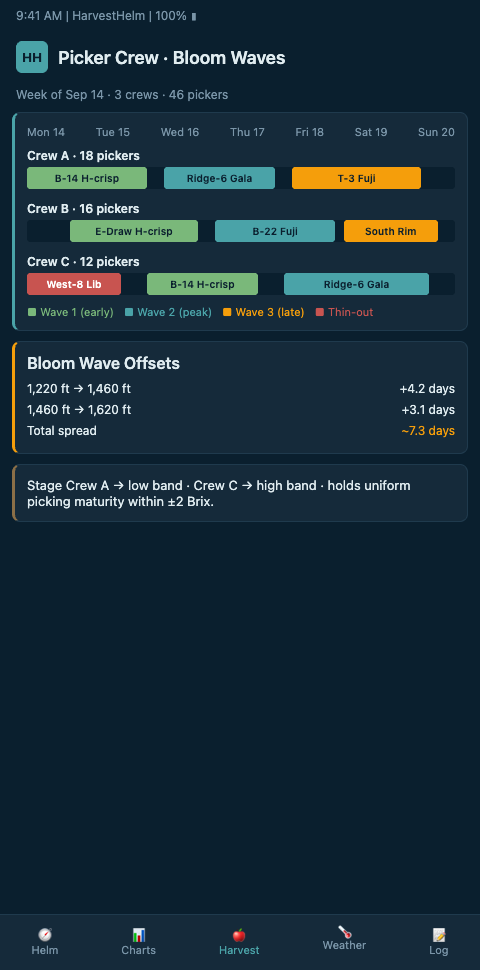
Bench-marking per-block labor throughput unlocks the next level. APAL's strategies for improving harvest efficiency recommends benchmarking labor per block to find bottlenecks and rebalance crews between staggered bloom waves. HarvestHelm logs trees-per-hour per crew per block, then surfaces the bottom-quartile blocks where throughput is dragging — often canyon-bottom rows where trees are closer together or fruit is smaller and pickers take longer per bin. That data feeds back into next year's routing model.
Bin logistics ties the whole picture together. A crew that moves from Block 14 Gala to Block 22 Honeycrisp mid-morning needs the forklift to have arrived at the new block before their first bin is full, or they stand down waiting. The routing engine pre-positions bins based on the crew schedule, and the forklift dispatch schedule rides on the same block-level readiness data. When a block gets re-staged on a weather disruption, both the crew and the bin logistics shift together — no manual re-dispatch required.
Advanced Tactics for Multi-Wave Crunch
The staging model breaks down in predictable ways. One failure mode is what a ScienceDirect study of co-robotic harvest platforms describes as zone-harvesting labor supply/demand imbalance — when three blocks all hit peak on the same day, the planned crew count is short and fruit over-ripens. HarvestHelm's solution is a reserve-crew flag: the routing engine marks days with concurrent peak blocks and recommends a floating crew that can rotate between the two highest-yield blocks rather than splitting committed crews.
Weather disruption is the second failure mode. A forecasted three-day rain stretch can compress the remaining pick window and force a re-stage of every remaining crew. The helm display runs disruption scenarios in the background so the manager can preview what happens to throughput if the rain lands Tuesday vs Thursday. That preview ties into orchard dashboard layout during harvest crunch, where the same tile grid surfaces the live re-stage recommendation when the weather model updates.
Crew size calibration is the third advanced move. A 10-person crew works a typical 4-acre Honeycrisp block in 2-3 days; a 16-person crew works the same block in 1.5 days but crowds the rows. HarvestHelm's routing engine ties crew size to row density and canopy height, recommending smaller crews on densely planted or heavily trellised blocks and larger crews on open-canopy blocks. The match between crew size and block geometry can swing labor throughput by 12-18% across a season — measurable in payroll and in total bins-per-pick-day.
Adjacent tools fill specific gaps. FieldClock's apple orchard labor software handles piece-rate tracking and crew-level payroll, which HarvestHelm imports via API so staging decisions reflect actual picker throughput, not assumed averages. Commercial orchards running both tools get one unified source of truth for what each crew can do per block.
Crew-rotation fairness is a soft issue that hard data solves. When one crew repeatedly gets assigned the hardest blocks — steep ground, small fruit, thick canopy — morale and retention suffer. HarvestHelm logs difficulty scores per crew-block pair and rotates crew assignments over the season so no single crew carries a disproportionate share of low-throughput work. Operations that track this explicitly report better year-over-year crew retention, which further compounds the routing-model gains from the post-season debrief.
The cold-sink-informed multi-block harvest schedule built from cold sink geometry is the geometric layer beneath the staging model — the same basin boundaries that drive frost protection also inform which blocks share bloom timing. And in adjacent niches, the same staging logic handles different threat windows — harvest crew staging during staggered date palm ripening uses the same algorithmic skeleton against a different phenology curve.
Post-season debrief is the under-used closing step. The helm-charted yield forecast captures every routing decision, every crew reassignment, and every weather disruption across the pick window. A 45-minute end-of-season review against the data surfaces which blocks consistently underestimated crew time, which crews handled weather re-stages well, and which routing heuristics failed on particular block geometries. Growers who run this debrief build compounding gains — year two of HarvestHelm deployment typically shows 8-14% better labor efficiency than year one on the same parcel because the routing model has learned the grower's specific conditions.
Ready to Stage Crews by Bloom Wave Instead of Calendar?
Mountain orchardists running staggered Honeycrisp and Gala blocks across a 500-foot vertical stretch are losing labor efficiency to calendar-based pick plans. HarvestHelm maps bloom-wave offset from in-canopy sensor data, routes crews block-by-block at peak pick, and re-stages on weather disruption — all with no cash upfront, just a kilo-cut at packhouse scale. Tell us your parcel boundaries, cultivar mix, and typical pick-window length when you join the waitlist, and we will build your first bloom-wave staging chart against last year's pick record. Pilots signing before August get the fruit starch index baselines captured on each aspect class before first ridge block flips from watch to ready, which is the data that drives per-crew routing accuracy.
Day-one dashboard views show 14 blocks arranged by bloom-wave offset with crew assignments, travel-time weighting, and forklift-bin pre-positioning all on the same tile. Onboarding also integrates the FieldClock or Croptracker piece-rate ledger so actual picker throughput feeds back into the routing engine within the first week instead of running on assumed averages. The kilo-cut contract settles only on graded Honeycrisp, Gala, and Fuji tonnage that cleared through the staged pick windows, so a mis-routed crew that pulled underripe fruit from a north-facing upper terrace drops our revenue before it drops yours. Crew-rotation fairness logs shift difficulty scores across the season so no single crew carries a disproportionate share of the steep-ground, small-fruit blocks, which is where year-over-year retention problems usually start.