Building a Khalal-to-Rutab Ripening Map for Your Palm Rows
Why Row-Level Ripening Windows Matter
Date palm fruit passes through Kimri (green and firm), Khalal (color break and maximum size), Rutab (soft translucent), and Tamar (dry and dark) over a 150-200 day arc from pollination. The agriculture.institute reference on date palm flowering and fruit development laid out this window in detail, and the Frontiers paper on khalal-stage quality preservation defined khalal as the first edible stage with maximum size and weight. Barhi and Hayani sell predominantly at khalal because the crisp-sweet profile commands premium pricing in both export and direct-to-consumer channels. The moment a khalal fruit slips into rutab the cellular structure softens, the sugar profile shifts, and the crate price drops 40-60% depending on market. Timing the harvest to catch peak khalal without letting rutab start is worth serious money per palm, and oasis-level averaging erases the precision needed to capture it.
The catch: a single oasis contains ripening zones that differ by 8-14 days in transition timing. Canopy shade gradients, drip-line moisture, row orientation relative to south, offshoot density, and cold-air drainage all push different palms through the khalal-rutab transition at different rates. Harvest crews working from a calendar instead of a map inevitably over-pick early blocks and under-pick late blocks, losing khalal premium at both ends. The MDPI review of technologies for forecasting tree fruit load and harvest timing covered heat-unit and proximal sensing methods that apply directly but get rarely deployed on date operations because most growers assume their palms ripen together. They don't.
A concrete example: a Medjool grower harvesting for the Tamar market pulled the entire east-facing block on September 26th and found 40% of the fruit still in Rutab. The west-facing block, picked three days later, already had fruit past Tamar into honey-drip loss. Same grove, same cultivar, 6-day ripening spread between rows oriented 90 degrees apart. Without a row-level map that spread is invisible until the grader rejects the crates.
Building the Ripening Map on the Helm-Charted Yield Forecast
HarvestHelm charts the ripening transition as a passage plan — your oasis is the cruising ground, the palm rows are the waypoints, and the Khalal-Rutab transition is the tidal window. Each palm gets a tagged ripening projection updated daily from heat-unit accumulation, canopy shade coefficient, and where available NIR spectral reads against the Frontiers paper on NIR hyperspectral imaging for date cultivar moisture and firmness. The non-destructive NIR Barhi quality paper documented 900-1700 nm spectroscopy predicting Brix, moisture, and firmness across Barhi maturity — which is exactly the signal harvest crews need to sort rows into pick-now, pick-in-3-days, and pick-in-7-days buckets.
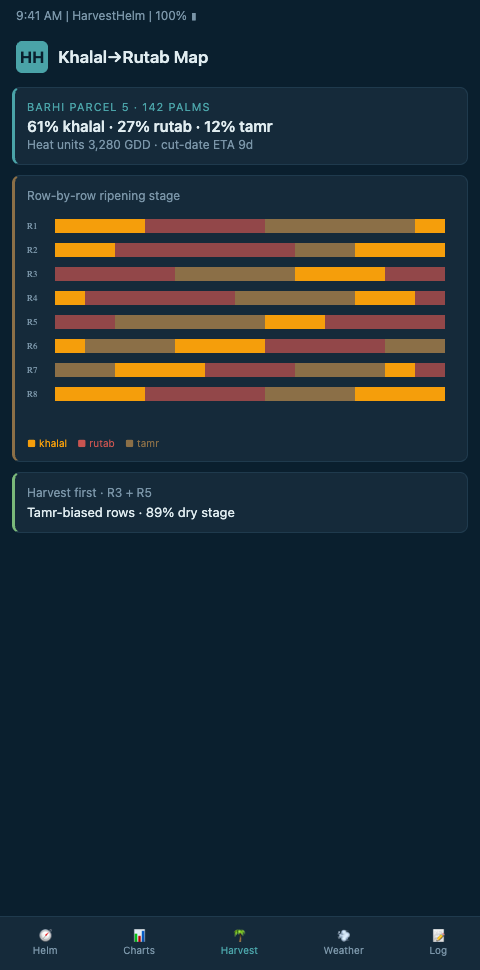
The Pollination Window Countdown Timer from earlier in the season feeds directly into the ripening projection because the exact date each spathe was fertilized determines the heat-unit start clock. Palms pollinated in separate windows — even inside the same row — don't reach khalal on the same day. HarvestHelm's helm-charted yield forecast tracks this cohort timing and outputs a staggered harvest schedule that crews can execute without guesswork. The Diurnal Swing Compensation for Fruit Set also applies at the ripening stage: palms in wadis with wide swings accumulate heat units more slowly during the Kimri-Khalal transition than palms on ridges, even if afternoon highs are identical. The engine captures this and flags the expected 4-8 day offset.
The Cultivar Reassignment Advisor plays a different role at ripening — instead of suggesting replants, it redirects harvest crews across blocks based on transition priority. If the Barhi block is three days from peak khalal and the Medjool block is 12 days from Tamar readiness, HarvestHelm routes crew time to Barhi first regardless of how the schedule was drafted in August. This dynamic rescheduling is what growers running staggered ripening crews describe as the most useful shift — moving from fixed weekly schedules to a helm-driven priority queue.
The Date Fruit Ripening pigment-degradation paper documented the color change pathway from Khalal to Rutab to Tamar. Color is a lagging indicator — by the time the color shift is visible the cellular softening has already begun — but it is useful as a confirmation signal overlaid on the heat-unit projection. Some operators attach fixed cameras to representative palms and let HarvestHelm compute the color-change rate per palm. Others use handheld sampling and log observations through the field app. Both routes feed the row-level ripening map.
Advanced Tactics: Multi-Cohort and Multi-Cultivar Mapping
Oases running multiple cultivars need cultivar-specific ripening curves because Khalal-to-Rutab transitions differ sharply. Barhi transitions fast — sometimes in 4-5 days from full khalal color to rutab softness. Medjool holds at khalal-edge for longer but should be pulled at Tamar for export grade. Deglet Noor dries on the palm naturally and is often harvested at semi-dry. HarvestHelm maintains cultivar-specific transition models and applies them per block, which prevents the common error of treating all late-season fruit as the same harvest target. The Sentinel-2 EVI avocado phenology paper demonstrated satellite vegetation index tracking across flowering, vegetative growth, maturity, and harvest — methodology transferable to dates at coarser spatial resolution, useful for multi-oasis operators coordinating across properties.
The peak-heat connection is where ripening and fruit-set mapping converge. Palms that experienced a thermal stress event during peak-heat fruit set often show delayed ripening because the fruit carries partial parthenocarpy or stress-arrested cell division. HarvestHelm flags these palms during the Kimri stage and adjusts the ripening projection accordingly. Without this cross-stage awareness, crews would pull stress-lagged palms on the same calendar day as healthy cohorts and end up with mixed-maturity crates that cost grading time at the packhouse.
Multi-year data adds precision. After two or three seasons of row-level ripening logs, the helm-charted forecast can project harvest windows for next season from pollination date alone, with confidence intervals tightening by roughly 25% per season as the microclimate signatures get learned. Apple growers have captured the same effect with elevation bloom timing models, and dates follow a similar pattern where historical data becomes load-bearing for the next prediction. The agriculture.institute article anchored the 150-200 day pollination-to-Tamar window that row-level mapping must resolve, and the growers who treat this as a resolvable constraint consistently outperform those who treat it as an unavoidable uncertainty.
Packhouse coordination is where row-level ripening mapping compounds value beyond the orchard. Export-grade packers require consistent fruit at specific maturity stages, and inconsistent input quality forces them to slow throughput for manual sorting. A grower delivering a pallet of mixed khalal and rutab-edge fruit gets a throughput penalty that sometimes pushes the entire delivery into grade-B pricing. HarvestHelm's staggered harvest schedule lets the grower deliver homogeneous maturity pallets — one pallet of pure khalal Barhi Monday, one pallet of khalal-to-rutab transition fruit Wednesday, one pallet of full rutab Thursday. Packhouses pay premium rates for this consistency because their sort lines run faster. Growers capturing this premium through row-level scheduling typically see a 4-8% price lift across the harvest season, which compounds substantially on operations running 1,000+ palms.
Labor economics also shift with row-level mapping. Traditional calendar harvest deployed the full crew on a single multi-day push that ended when the blocks were all picked, regardless of fruit readiness. Row-level scheduling spreads the crew across more days but with smaller teams per day — which lowers peak labor costs and reduces the risk of rushed picking that damages adjacent fruit or damages the palm itself through careless ladder work. Smallholders managing their own crews and larger operators coordinating contract labor both benefit, though the benefit pattern differs. Smallholders gain schedule flexibility that reduces family labor stress during peak harvest weeks; larger operators gain predictable daily labor commitments that improve contract-negotiation positioning with the picking cooperatives that serve the region. Both patterns feed back into the kilo-cut revenue projection because retained grade-A fruit is worth more than rushed grade-B fruit at any operational scale.
Long-distance shipping logistics add yet another scheduling constraint that row-level ripening mapping resolves cleanly. Medjool bound for European export markets needs to arrive at the destination within a specific ripening band — too firm and the consumer perceives the fruit as underripe, too soft and the shipping damage rate rises and shelf-life shrinks. Growers shipping refrigerated containers from Coachella or Siwa can coordinate the per-row ripening forecast with the shipping transit time to deliver fruit that arrives at optimal condition. This coordination matters especially for premium brands building direct-to-consumer programs because consistent arrival condition is how repeat-purchase loyalty gets built. Without row-level mapping, shippers either under-ripe the product to tolerate transit delays or over-ripe it to match ideal consumer firmness — both compromises that HarvestHelm's scheduling eliminates by giving the shipper specific harvest days for each shipping container.
Build the Map Before This Season's Khalal Peak
HarvestHelm will build your first row-level ripening map from your existing pollination log and a single season of canopy-temperature data — no new sensor purchase required for the starter chart. The deliverable shows which of your rows are likely to hit peak khalal on which day across a 14-day harvest window, with a staged crew-dispatch recommendation and a kilo-cut revenue projection for pick-now versus pick-later scenarios. Growers who have been pulling fruit on calendar dates typically find three to five rows where the map uncovers a 7-10 day offset from their current schedule, and capturing that offset translates directly into grade-A premium on Barhi and Medjool crops.
No charges apply until the harvest clears — the row-map work is part of the engagement and pays only through the successful-harvest share. Register for the ripening-map waitlist before your first Barhi khalal color break this August, and on day one you will see a per-row transition date projection with 14-day crew dispatch recommendations keyed to your packhouse throughput cap. Growers who signed up ahead of last September's Medjool tamar pick reported capturing 6-9 additional days of peak khalal Barhi revenue by shifting to cohort-based rather than block-level harvest. The starter map runs from your existing pollination log alone, so waitlist signups costs nothing until export-grade Medjool crates actually clear your packhouse doors.