Offshoot Planting Zones for Long-Term Sandstorm Exposure Minimization
The 25-Year Exposure Decision
Offshoot planting is a compounding decision. The offshoot that survives the first three years will produce fruit for two to three decades, and every year of that productive life carries exposure to the prevailing sand and dust patterns of its location. The Palms journal study on date palm establishment documented offshoot survival rates of 50-80% depending on cultivar, with Medjool notably weaker than Deglet Noor. Those survival rates get worse under high-exposure conditions, and the surviving palms then carry reduced yield potential because the root system spends energy on defense rather than fruit.
The FAO Chapter V reference on date palm propagation stated directly that prevailing wind direction must influence plantation layout to minimize wind damage. This is agronomic bedrock, and yet smallholder plantings regularly ignore it because the offshoot-removal window from parent palms is narrow and the nearest open ground often gets chosen by default. A Siwa Oasis cooperative discovered this pattern after 12 years when they audited yields across 800 palms planted in 2011. The palms on the western exposure corridor — where the main khamsin track deposits sand — averaged 42% lower lifetime yield than palms planted on the sheltered eastern rows despite being the same cultivar from the same parent stock. That 42% compounded year after year once the trees entered full production at years 6-8.
The World Bank MENA sand and dust storms report documented desertification drivers and quantified the economic cost of failing to plan against prevailing dust paths. Strategic planting against the known transport corridors saves billions regionally and translates directly to per-palm lifetime yield at the grower scale. HarvestHelm's offshoot planting-zone module is the farm-level implementation of this regional principle.
Mapping 25-Year Exposure on the Helm-Charted Yield Forecast
HarvestHelm treats offshoot planting as a long-range passage plan. The helm-charted yield forecast runs a 25-year sandstorm exposure projection per candidate planting location using regional haboob climatology, the grower's on-site wind history, and windbreak-growth models for any proposed shelter plantings. The output per candidate site is a cumulative exposure score across the expected productive life, plus a projected lifetime yield delta compared to baseline. Growers comparing three or four candidate zones typically see 20-40% lifetime yield spreads, which is enough to justify moving offshoot placement by 30-60 meters when the alternative zone is available.
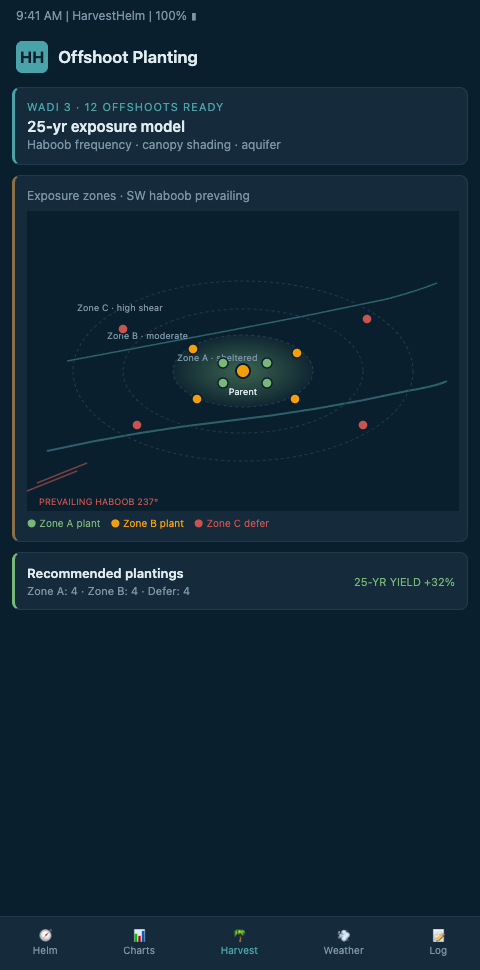
The Sandstorm Spathe Protection Alerts subsystem provides the same functional layer for established palms — but offshoot zoning happens before any spathes exist, so the forecast depends entirely on the climatology and the shelter model. The PLOS One paper on synergistic windbreak efficiency of desert vegetation and oasis shelter forests documented mixed Poplar-Jujube layouts improving windbreak efficiency by 20% over desert vegetation alone. HarvestHelm incorporates these efficiency multipliers into the zone scoring because a candidate site with planned windbreak infrastructure scores differently than the same site without it. The Cultivar Reassignment Advisor plays a design role here — recommending the cultivar most suited to the exposure profile of each candidate zone rather than defaulting to the parent palm's cultivar just because the offshoot came from that stock.
The FAO MENA reference on combating sand and dust storms through tree plantation confirmed targeted tree plantation as a primary MENA strategy. HarvestHelm extends this to the farm scale by treating each offshoot as a 25-year investment decision, complete with kilo-cut payback modeling that shows when the sheltered zone's higher yield recovers the additional labor and infrastructure cost relative to a default-exposure placement. This is where the helm-charted forecast metaphor pays off — captains plan long passages with fuel and provisioning budgets, and long-term orchard decisions need the same explicit ROI framing to justify the extra effort.
The UAEU Date Palm Development Research Unit field planting guidelines specified offshoot size (10-25 kg) and site preparation requirements. HarvestHelm aligns zone recommendations with these guidelines, flagging candidate sites where the soil preparation or water access wouldn't support the required offshoot establishment. Operators planning larger-scale offshoot plantings benefit from coordinating this with sandstorm crew evacuation routing because the planting zones that minimize sandstorm exposure also tend to be the zones where crew access during events is least constrained.
Advanced Tactics: Multi-Cultivar Zone Optimization
The Frontiers paper on field evaluation of tissue culture-derived and offshoot-grown date palm compared offshoot versus tissue-culture performance under various exposure conditions. HarvestHelm incorporates this comparative data when the grower has both options available, because tissue-culture material sometimes performs differently under sandstorm stress than offshoot-propagated material of the same cultivar. For larger cooperatives or export-oriented growers, the decision between propagation methods becomes part of the zone-planning exercise rather than a separate procurement decision.
Multi-cultivar oases gain the most from zone-aware planting because the cultivars differ in sandstorm tolerance. Deglet Noor offshoots have historically established better in higher-exposure zones, while Medjool offshoots need more shelter during the first three years to reach the exposure tolerance of mature palms. HarvestHelm's planting-zone recommendations reflect this by default-assigning Deglet Noor to outer-ring exposure positions and Medjool to sheltered interior positions, with cultivar swaps recommended when the grower has specific market commitments that override the shelter gradient.
Connecting zone planning with hyperlocal sensor placement closes the measurement loop so future seasons of sandstorm data continue to refine the zone model. The model learns the grower's specific transport corridors over time, and year-5 planting decisions benefit from four years of accumulated data that the year-1 decisions lacked. Coastal citrus operators working windbreak row planning against salt-spray exposure have adopted very similar logic, and the translation to sandstorm-shielded offshoot zones is direct — both are long-horizon decisions where the first-year choice determines decades of yield potential.
Smallholders often assume offshoot zoning is a luxury reserved for larger operators with consulting budgets. The kilo-cut pricing model flips this by making the zone-planning analysis free until the palms bear fruit. A smallholder planting 40 offshoots this fall can get a full 25-year exposure chart per candidate site, pick the optimal placements, and pay nothing until the harvest revenue actually materializes 5-7 years later. That payback structure removes the main barrier to long-horizon planning for operations that don't have the cash flow to fund consulting against distant returns.
Cooperative-level planning benefits from aggregate zone modeling across adjacent member parcels. When neighboring smallholders coordinate offshoot placements they can share windbreak infrastructure costs, align shelterbelt species selection, and reduce redundant investment in overlapping shelter coverage. HarvestHelm's multi-grower view lets cooperative managers see the composite exposure map across all member parcels and identify where coordinated planting delivers larger protection benefits than any individual grower could achieve alone. The ancestral oasis pattern in many MENA regions already reflects this coordination from historical practice — modern cooperative planning simply makes the coordination explicit and quantified rather than relying on generational knowledge that may be fragmenting as younger growers migrate away from farming.
The longer view on climate drift adds another layer. As khamsin frequency and intensity trend upward in many MENA production regions, the zones that perform well today may face rising exposure over the planting's productive life. HarvestHelm's climate-trajectory projections blend with the zone model to show expected exposure evolution across the 25-year horizon rather than just projecting current conditions forward uniformly.
Growers making replant decisions today need this forward view because the optimal zone in 2026 conditions may not be the optimal zone in 2045 conditions, and the cost of moving a mature palm is essentially the cost of starting over. Planting in zones that stay sheltered under moderate-drift scenarios avoids a costly relocation decision two decades out. This is the long-passage planning logic that yacht captains apply routinely and that orchard operators are now being asked to apply explicitly. Perennial crop placement is a forecasting problem with decades-long stakes, and orchard owners who approach it that way consistently outperform those treating it as a one-time decision.
Export-grade packers increasingly ask about provenance documentation for traceable dates, and the zone-aware planting records that HarvestHelm maintains serve double duty as provenance artifacts. A Medjool palm planted in a documented sheltered zone with known windbreak infrastructure supports a premium-grade provenance claim more credibly than a palm with no planting-zone history. This is a soft-dollar benefit that compounds across the productive life of the plantings — premium packers pay more for documented provenance, and the documentation cost is essentially free when it flows naturally from the forecast infrastructure already serving operational decisions. Growers preparing for evolving export-market traceability requirements in Europe, Japan, and the Gulf should treat planting-zone records as a long-term commercial asset rather than just an operational artifact.
Map Your Zones Before the Next Offshoot Cycle
If you are planning offshoot plantings in the next 12-24 months and your oasis has experienced meaningful sandstorm events over the past five seasons, HarvestHelm will build a zone-by-zone exposure projection for every candidate planting location on your parcel. The analysis uses regional haboob climatology, your on-site wind history if available, and topographic data to rank each site by expected 25-year cumulative exposure. Smallholders planting 20-40 offshoots and larger operators planting 200+ offshoots both benefit because the per-palm lifetime yield delta compounds across the cohort. No upfront charge — the planting-zone work is amortized against the kilo-cut when the harvests clear in years 6-8 and beyond. Desert date growers making long-horizon replant decisions gain the most when this zone-planning layer operates against the same forecast infrastructure that runs their active-season pollination and ripening work.
Register for the offshoot zone waitlist before the next parent-palm offshoot-removal window opens this fall, and on day one you will see candidate site exposure scores with recommended Medjool, Deglet Noor, and Barhi cultivar allocations per candidate zone across your parcel. Waitlisted cooperatives in Siwa and Coachella that completed zoning ahead of last planting cycle rerouted 38% of intended Medjool placements to sheltered interior rows, a decision projected to preserve an additional 14-20 kilos per palm across the productive life. The 25-year exposure projection uses free regional haboob archives and your existing topographic data, with kilo-cut exposure beginning only when those offshoots reach first export tamar harvest.