Windbreak Row Planning for First-Line Grapefruit Exposure
The First-Line Grapefruit Problem
Fresh grapefruit blocks catch it first — canker pressure climbs sharply on trees exposed to wind-driven rain above a 20 mph threshold, and grapefruit is among the most canker-susceptible citrus cultivars in the Florida mix (UF/IFAS EDIS CG040: Citrus Canker Production Guide). The CREC citrus canker research page documents that canker spreads primarily by wind-driven rain, which is precisely what the first-line grapefruit rows absorb during every coastal squall (UF/IFAS CREC Citrus Canker Research).
Stacked on top is the salt deposition problem. FAO's reference on protection from wind and salt spray notes that coastal zones deposit tons of salt per hectare per year and that vegetation buffers materially reduce inland transport (FAO Chapter 3: Protection from Wind and Salt Spray). So a coastal fresh grapefruit block is simultaneously fighting canker, salt aerosol, and mechanical wind damage — three problems that a well-designed windbreak blunts at once.
The economic calculus favors windbreak investment sharply. Fresh grapefruit targeted at premium-tier export pricing carries per-carton revenue several multiples above juice-plant pricing. A canker outbreak in a first-line block cascades into packhouse rejections, voluntary certification pulls, and sometimes regulatory destruction orders. One severe canker season on a fresh grapefruit block can eclipse a decade of windbreak establishment costs — and that's before salt-driven brix reductions are priced in.
The cascading losses make the case sharper. A fresh grapefruit operation that loses export certification due to canker pressure faces multi-year recovery of the buyer relationship, not just single-season revenue hits. Export markets for Florida grapefruit remain tight and certification-dependent; once a buyer shifts to an alternative source, reclaiming that contract requires years of demonstrated canker-free production. Windbreak investments that prevent a single cascading certification loss can pay back across decades of preserved export relationships, not only single-season yield.
Designing Windbreaks With a Helm-Charted Yield Forecast
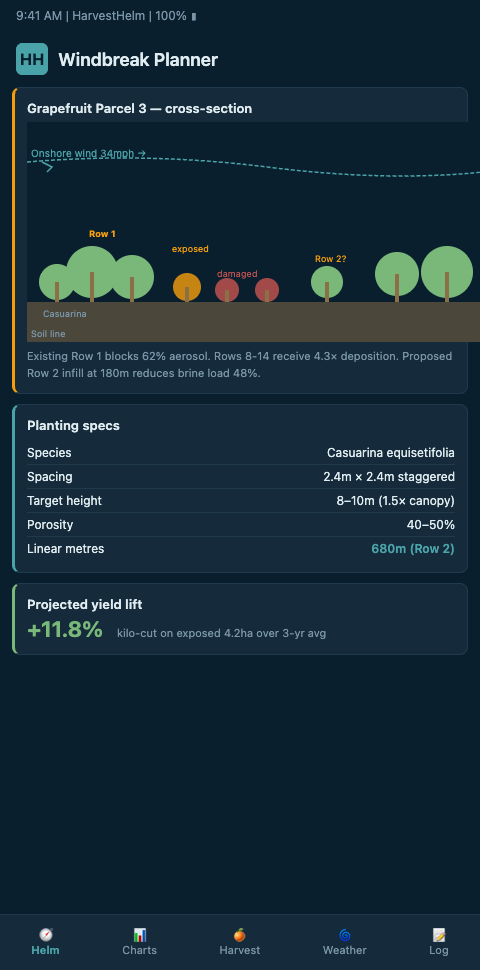
HarvestHelm treats windbreak row planning as a vector-aware charting problem. On the yacht navigation dashboard, the helm-charted yield forecast overlays dominant onshore wind vectors over your block map, identifies first-line rows, and estimates the wind-speed reduction a proposed windbreak geometry would deliver at each inward row. The captain sees a proposed keel adjustment — the windbreak — and the downstream chart shift — the protected rows — together on one display.
UF/IFAS CREC's windbreak guidance anchors the design rule: a windbreak delivers protection at roughly a 1:10 ratio of height-to-protected-distance, so fresh grapefruit blocks need windbreak surrounds on the order of 5 to 10 acres to shelter the interior (UF/IFAS CREC Windbreaks2). The technical establishment guide targets 50-70% density in mature windbreaks for citrus canker control (UF/IFAS CREC Windbreak/Shelterbelt Establishment Technical Guide).
Species selection matters as much as geometry. The UF/IFAS species attribute guide for Florida windbreaks catalogs woody species by growth rate, salt tolerance, and wind resistance (UF/IFAS EDIS FR286: Woody Species for Florida Windbreaks). Eucalyptus grandis and slash pine are common backbones; multi-row layouts pair them with a shorter, denser species in the lee. The shelter design also has to respect the rootstock salt thresholds of the trees it protects, because residual aerosol that makes it past the windbreak still lands on rows whose Swingle, Sour Orange, or Trifoliate rootstocks excrete chloride at different rates. HarvestHelm lets you simulate the 5-year and 10-year canopy profiles for each candidate combination and see how they handle the captain-critical question — which rows are still taking a 3.0 m/s onshore load in year three.
The NRCS Conservation Practice 380 sets the federal standard for windbreak design, density, and establishment — and more importantly, it defines EQIP cost-share eligibility (NRCS Conservation Practice 380 Windbreak/Shelterbelt). The helm chart displays EQIP eligibility as a funding lane on the dashboard, because the economics of planting 5-10 acres of windbreak change substantially when federal cost-share is in play.
A worked example. A 40-acre fresh grapefruit block sitting on the Atlantic ridge, 800 feet from the shoreline, needs a windbreak surround of roughly 8-10 acres to deliver canker-reducing density. At NRCS-standard establishment costs, that project runs into six figures. With EQIP cost-share covering a meaningful share and the helm-chart projection showing canker-driven revenue preservation over a 10-year horizon, the NPV of the windbreak investment moves from borderline to strongly positive. HarvestHelm surfaces the NPV band alongside the design geometry so the captain can see the financial chart and the agronomic chart together.
The yacht navigation metaphor pays off here. When a captain is deciding whether to install a new rigging configuration on the vessel, the decision runs on a combined view of performance improvement, installation cost, and expected service life — not on a single-dimension assessment. HarvestHelm applies the same logic to windbreak planning. The helm chart shows performance (wind-speed reduction per row), cost (establishment plus maintenance), and service life (species-specific multi-decade profiles). The captain steers the decision through the combined view rather than piecing it together from separate documents.
Windbreak maintenance becomes its own chart lane on the helm view. Year-one, year-three, year-five, and year-seven each have distinct maintenance obligations — thinning slow-growth species to preserve density, replacing dead trees in gap-prone rows, selective pruning to maintain the 50-70% density target, and periodic density refresh as mature trees age out. HarvestHelm tracks each windbreak row through its lifecycle and flags maintenance actions on the helm chart before density slips below the canker-control threshold. Growers who use this as a standing workflow rarely experience the year-eight density collapse that unmaintained windbreaks produce.
Advanced Tactics: Year-by-Year Density and Cultivar Alignment
The tactical trap in windbreak planning is designing to year-ten canopy while the trees collapse in year three. Density climbs from plant-out to mature profile on a sigmoid curve; canker pressure doesn't wait. The mitigation is a two-tier planting — interim fast-growth species (Eucalyptus grandis) fronted by a slow-growth, long-life backbone (slash pine) — so the grove sees useful density within 18-24 months and mature protection within 5-7 years. HarvestHelm shows the density-by-year curve alongside the canker pressure curve so the captain can see the gap.
The second tactic is aligning windbreak layout with your rootstock choice. First-line rows still take residual wind and salt after the windbreak, and designing shelter without running the chloride-accumulation math for your specific rootstock combinations risks under-sizing the wall for the trees that need the most protection.
Third, integrate surge-exposure topography. A windbreak designed for wind isn't automatically useful under storm surge. Pair the wind analysis with your storm surge exposure map so you know which first-line rows also sit in the surge zone — those get different species and different spacing.
Offshore parallels matter too. Desert date operators designing offshoot sandstorm zones apply similar first-line logic to wadi-facing rows; the wind physics and the sheltered-zone geometry look familiar. Common windbreak failures coastal growers report:
- Planting a single-species line that catches beetle outbreak and collapses in year seven.
- Under-densifying and letting 30-40% of the onshore wind slip through the canopy.
- Skipping EQIP paperwork and paying full establishment cost out of pocket.
- Placing windbreaks without accounting for prevailing storm winds that arrive from a different vector than prevailing trade winds.
- Neglecting the windbreak's own maintenance schedule — selective thinning, dead-tree replacement, and density refresh.
Multi-parcel operations need an explicit prioritization chart. A grower running fresh grapefruit blocks across three counties can't plant all first-line windbreaks at once, and the helm chart ranks the blocks by combined canker-pressure and salt-aerosol exposure to drive the phasing. Typically the highest-ROI planting is the block sitting closest to water with the most canker-susceptible variety and the lowest existing wind shelter — and the HarvestHelm chart identifies that block in seconds, not after a week of spreadsheet work.
Integration with the rest of the grove's operational chart is where windbreak planning pays off at the margin. A windbreak that sits in a surge zone needs species that tolerate saltwater inundation; a windbreak that sits near a canal needs species that tolerate periodic saturation; a windbreak that fronts a road needs species that tolerate dust and vehicle exhaust. HarvestHelm's chart layers these constraints automatically so the captain's planting decision already reflects the site-specific conditions rather than inheriting them as surprise failures in year three. The iterative refinement saves more project value than any single other planning move.
A final strategic framing: windbreak planning is a decade-long chart commitment that pays back in reduced canker outbreaks, reduced salt aerosol penetration, and preserved premium-tier fruit across multiple storm seasons. Growers who view the windbreak as a cosmetic perimeter miss most of the economic return; growers who view it as the outermost row of an active grove system — with its own maintenance, its own species-specific pruning, and its own density-refresh schedule — capture the full return. HarvestHelm's chart treats the windbreak as a living row rather than a static line, so the grove's ongoing investment in shelter compounds with the grove's ongoing investment in the citrus rows themselves. That integrated view is what turns a one-time planting into a grove-scale resilience asset.
Get Early Access to the Coastal Citrus Grove Dashboard
Fresh grapefruit growers in Indian River and along the Atlantic ridge are working with HarvestHelm on multi-year windbreak chart overlays. If your first-line rows lose production to canker and salt every storm season, the helm-charted forecast combined with EQIP eligibility tagging is for you. Join the Coastal Citrus Grove waitlist with your block geometry, existing windbreak notes, and your target canker-pressure reduction — we'll stand up the planning chart and flag NRCS cost-share candidates for your acreage. Operations onboarding before the summer EQIP application window get their windbreak design paired against Eucalyptus grandis and slash pine two-tier planting schedules, with density-by-year curves overlaid against the 20 mph canker-driven-rain threshold that costs first-line grapefruit rows their export certification.
Day one of your dashboard shows the 10-year NPV band against EQIP-adjusted establishment costs, dominant onshore wind vectors mapped across each first-line block, and year-three density projections so the interim shelter gap is visible before planting. Multi-parcel fresh grapefruit operations across St. Lucie and Martin counties see prioritized planting order ranked by combined canker-pressure and salt-aerosol exposure, with NRCS Conservation Practice 380 cost-share candidates tagged per parcel. Send your packhouse export-contract notes and last-three-season canker-pressure history so the windbreak maintenance schedule — year-one, year-three, year-five thinning and density refresh — gets tied to your documented revenue exposure rather than a generic timeline.