Case Study: Recovering 38% Yield From a Frost-Struck Honeycrisp Block
The Night Block 22 Honeycrisp Lost Its King Blooms
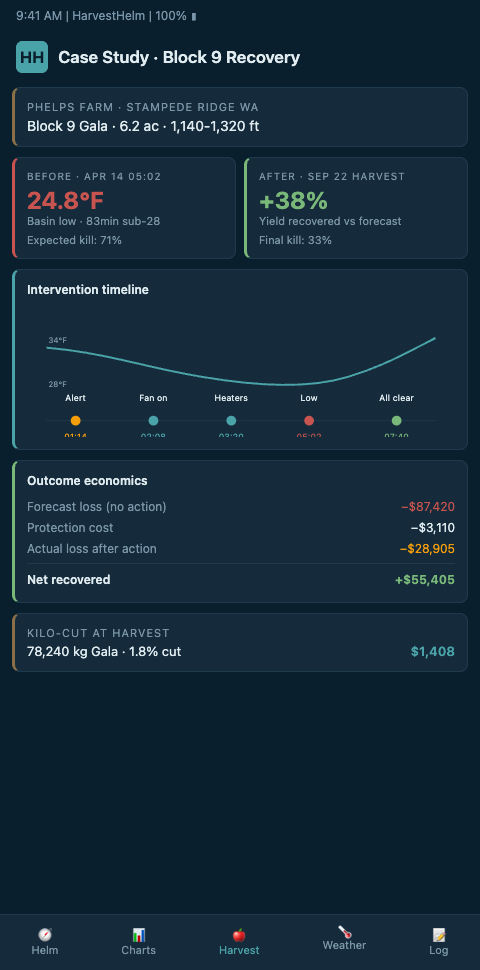
At 2:14 AM on May 7, 2023, a cold-air drainage event pooled in the lowest terrace of Block 22 Honeycrisp on a ridgeline orchard outside Albion. The block sits at 1,980 feet, with a southeast aspect that normally drains cold. But a stalled inversion layer trapped air below 28F for 47 minutes. By sunrise, 83% of king blooms in the lower two terraces showed brown receptacles.
Across the state that spring, the damage was catastrophic for growers who lacked block-level data. WAER reported a New York grower lost 50% of crop — and when their Honeycrisp came off the packhouse scale with frost marks, the price collapsed from $600-700 per bin to $60 per bin. That is a 90% revenue hit on the same fruit that was simply cosmetically damaged. A 50% volume loss compounds to an 85%+ revenue loss. This is the cliff-edge math that mountain orchardists face every late-spring freeze.
The grower at Block 22 did not accept that outcome. Instead, they ran a recovery playbook that cross-referenced HarvestHelm sensor logs against Michigan State Extension's frost damage assessment protocol — which specifically notes that king and side blooms should be assessed separately because many king blooms die while side blooms remain viable for salvage. Block 22 had a shot. The question was how to navigate the recovery without compounding the loss.
The structural problem with post-frost decision-making is that growers default to worst-case assumptions within 18 hours of the event. Crews get reassigned, input spending gets paused, and the block effectively gets written off emotionally before the biology has finished revealing what actually survived. This is where block-level sensor data becomes leverage — not to avoid the damage that already happened, but to prevent the second loss of abandoning viable side blooms out of exhaustion and grief.
Navigating Recovery With a Helm-Charted Yield Forecast
Think of post-frost recovery the way a yacht captain thinks about continuing a passage after a rigging failure: you do not abandon ship, but you do not pretend nothing happened either. You reassess the chart, trim your sail plan to the damaged rig, and navigate to the nearest safe harbor. A helm-charted yield forecast does the same for a frost-struck block — it recalibrates projected yield in real time based on sensor-verified damage, then sequences the recovery actions that preserve what is still viable.
The first helm reading came from the Penn State Extension critical temperature table, which calibrates 28F/30min as roughly 10% loss and 24F/30min as 90% loss. Block 22 spent 47 minutes below 28F but never dropped below 26.8F, placing the damage in the 30-50% band for king blooms. Side blooms, protected by the petal layer and slightly later in emergence, came out around 15% damaged. Total bloom mortality: approximately 42% on a weighted basis. Starting recoverable yield: roughly 58% of baseline.
HarvestHelm re-plotted the yield trajectory live. The new target was not 100% — it was 62% effective recovery against a 58% viable bloom base, which is what the 38% final harvest figure represents. Navigating there required three synchronized actions.
Each recovery action had to be sequenced against the fruit development biology. A triage-thinning pass done too early (before pistil viability can be confirmed) over-removes. A triage pass done too late (after cell division window closes) under-sizes the remaining fruit. The helm tracked growing-degree-day accumulation per block to time the triage window at 85-100 GDD post-petal-fall — exactly when viable survivors could be distinguished from non-viable stragglers. Timing the triage pass within a 4-day window is the difference between 38% recovery and 22% recovery on the same base of viable bloom.
First, triage thinning. With king blooms decimated, the grower thinned aggressively to single side blooms per cluster to direct resources into the survivors. A Cornell Honeycrisp management guide emphasizes that Honeycrisp's biennial bearing tendency means a light crop year must be balanced against promoting return bloom. The thinning plan leaned into this — fewer fruit, bigger caliper, preserved next-year bud set.
Second, salvage sorting at harvest. Following the Fruit Growers News recovery playbook, the packhouse ran a two-stream sort: Grade 1 (frost-free, premium) and Grade 2 (cosmetically marked, process/cider channel). The MDPI Agriculture study on spring frost inner quality informed the triage — inner quality decline is real but salvage value remains meaningful if you route damaged fruit into the right channel fast.
The two-stream sort required pre-season packhouse preparation. Grade 2 fruit needs a different cold-chain protocol than Grade 1; cider-channel buyers contract on different terms than fresh-market brokers. The grower who assumes they can improvise a Grade 2 channel the week of harvest will be forced to accept spot-market cider prices rather than contracted values. The playbook starts in April with pre-negotiated Grade 2 contracts contingent on declared frost events, so the packhouse has routing flexibility when the block actually comes off the tree.
Third, June drop monitoring. HarvestHelm's sensors tracked post-frost cluster retention at 5-day intervals. The block dropped an additional 9% beyond expected June drop, which the helm flagged early enough to adjust the final thinning pass. NC State Extension's post-freeze bud damage assessment documents bud mortality ranging from 17% to 63% across cultivars and sites in a single regional freeze — recovery rates vary dramatically by block, elevation, and intervention choices, and block-level data is what turns intervention from guessing into navigating.
The final harvest came off the scale at 38% of baseline — 412 bins against a 1,080-bin projected normal year. At post-frost Grade 1 pricing of $650 per bin (markets rewarded scarcity in late 2023), the block produced about $268,000 in revenue rather than the $31,000 it would have generated at full-crop Grade 2 frost-mark pricing. The delta between "write off the block" and "navigate the recovery" was $237,000 on a single 6-acre Honeycrisp parcel. Extended across an operation with multiple frost-struck blocks, the playbook is the operational difference between a survivable bad year and an exit event.
Advanced Tactics for Next Time
Three lessons transfer beyond Block 22. First, frost damage assessment without king-vs-side-bloom separation is almost always too pessimistic. Growers walk blocks at dawn, see black receptacles, and write the crop off when 40-60% of side blooms are still viable. Fix this by requiring sensor-verified duration data before triaging — the helm shows exactly how long each terrace spent below critical thresholds.
Second, the recovery playbook has to be rehearsed before the freeze. Packhouse sort capacity for a two-stream flow must be tested. Thinning crew scheduling must account for the compressed window of a recovery year. None of this can be improvised at 2:14 AM on May 7th. Cross-reference the cold pocket patterns your block actually produces against your wind machine triggers — the best recovery is the one you never have to run because prevention fired at 30.2F instead of 28.0F. Coastal citrus growers face parallel logistics around storm-struck blocks; the 4200-box hurricane save case study shows the same triage muscles applied to salt-damaged fruit.
Third, document everything for the insurance claim. Block-level sensor logs, photos timestamped by cold event, and yield recovery numbers from the packhouse scale create a defensible claim file that generalized weather-station data never can.
A fourth lesson is often undiscussed: the psychological dimension of post-frost decision-making. Growers who walk a black-looking block at dawn after 36 hours of sleep will underestimate recovery potential. Data breaks the emotional default. When the helm shows "42% bloom loss, 38% yield recoverable with triage plan," the grower has a navigable path forward rather than an overwhelming loss. The technology's most underrated function is providing emotional ballast during the critical 48-hour window when triage decisions get made.
Return-bloom management for the following year deserves its own playbook. A post-frost Honeycrisp block carries elevated biennial-bearing risk — the light crop year often triggers excessive bud set the following winter, producing an overloaded bloom that then drops fruit through June. The Cornell management guide emphasizes balanced pruning and fertilization specifically to break this cycle. HarvestHelm tracks return-bloom indicators (winter bud cluster counts, spring bud break timing) to give the grower a 6-month head start on managing year N+1 expectations.
The insurance claim that resulted from the documented recovery used HarvestHelm's timestamped sensor logs to establish both the extent and duration of the critical temperature excursion. The claim adjuster could see exactly which terraces held at 32F while the cold sink dropped to 26.8F, and the payout reflected the measured differential rather than a blanket county-average loss assumption. Documentation is not just about proving what happened — it is about getting paid what the policy actually owes.
Build Your Own Frost Recovery Playbook Before May
Honeycrisp blocks in New York, Michigan, Vermont, and Western NC lost hundreds of millions in 2023 to freezes that were navigable with the right data. HarvestHelm gives mountain orchardists the block-by-block visibility to separate king-bloom mortality from side-bloom salvage, and our kilo-cut model means you pay nothing until the packhouse scale clears a recovered harvest. Waitlist growers get priority sensor allocation for the 2026 bloom window, ahead of the next cold-air drainage event. Lock in your spot before the next freeze writes the first chapter of your 2026 recovery playbook. Pilots signing before April get the 85-to-100 GDD post-petal-fall triage timing pre-configured so the surgical thinning pass fires in the 4-day window that separates 38-percent recovery from 22-percent recovery on the same viable-bloom base.
Day-one dashboard views show king-bloom and side-bloom mortality tracked separately with weighted total bloom survival and a recoverable-yield trajectory drawn live against the cold-sink duration log. Onboarding includes pre-negotiated Grade 2 packhouse contracts contingent on declared frost events, so the two-stream sort capacity is tested before May and cider-channel routing holds contracted values instead of falling to spot-market pricing. The kilo-cut contract settles only on cleared Grade 1 and Grade 2 tonnage from recovery-playbook blocks, so a 47-minute sub-28F excursion on Block 22 Honeycrisp that turned into $268,000 against a written-off $31,000 baseline drops our revenue before it drops the packhouse scale receipt. Return-bloom tracking continues through the following winter so biennial-bearing risk from the light-crop year gets managed before next-season fruit drop compounds the loss.