What Comes Next for Digital Sourcing in Architectural Reclamation
The Regulatory and Market Shifts Reshaping Salvage
The Grist investigation into deconstruction policy documented how cities from San Antonio to Pittsburgh have followed Portland's lead in mandating deconstruction over demolition for certain building categories. Boulder, Colorado, requires that at least 75 percent of a building's weight be diverted from landfill through reuse or recycling. San Francisco mandates a 65 percent diversion rate. These policies create a growing supply of salvaged materials entering the market, but they also create documentation and tracking requirements that analog workflows cannot sustain.
The EPA's data on construction and demolition waste reveals that about 85 percent of materials in a typical demolition project could be kept out of landfills, but only about 30 percent currently are. Closing that gap represents both the environmental mandate and the commercial opportunity that will define architectural reclamation's next chapter. Every percentage point of improvement in diversion rates means more materials flowing through salvage operations, more documentation requirements, and more need for digital systems that can track materials from demolition site to retail floor.
The construction industry's broader digital transformation provides context for where salvage is heading. A Deloitte analysis of digital adoption in construction found that each additional technology adopted is associated with a 1.14 percent increase in expected revenue. The salvage sector, which sits at the intersection of construction, preservation, and retail, lags behind the broader industry in technology adoption but faces the same competitive pressures.
The future of salvage marketplace tools will be shaped by three converging trends: regulatory mandates that require digital documentation, buyer expectations that demand provenance verification, and competitive dynamics that reward the dealers with the best sourcing intelligence.
The buyer expectation shift is already visible. Restoration architects increasingly request provenance documentation as a condition of purchase rather than a nice-to-have supplement. Professional contractors need code compliance documentation before they will install reclaimed materials. The International Green Construction Code includes provisions for material reuse documentation that formalize what the market has been moving toward informally. Dealers who cannot produce digital documentation will find themselves excluded from the professional market, relegated to serving only the cash-and-carry retail segment.
Digital Sourcing Infrastructure for What Comes Next
The dealers building digital sourcing infrastructure today are positioning themselves for a market that will look fundamentally different in five years. TabVault represents one piece of that infrastructure: the research and sourcing layer where daily sourcing habits produce a searchable private database of materials, suppliers, and market intelligence.
The architectural reclamation digital transformation extends beyond any single tool. It encompasses inventory management systems, provenance documentation platforms, customer relationship databases, and the sourcing research tools that feed them all. The common thread is that analog processes, paper records, mental notes, and verbal communication, are being replaced by digital systems that capture, index, and retrieve information at scale.
TabVault sits at the beginning of this pipeline, where sourcing intelligence is generated. Every browsing session where a dealer evaluates a demolition listing, researches a building's history, or compares supplier inventories contributes raw material to the operation's intelligence base. Turning chaotic browser sessions into a searchable private database means that raw material compounds rather than evaporating when the browser closes.
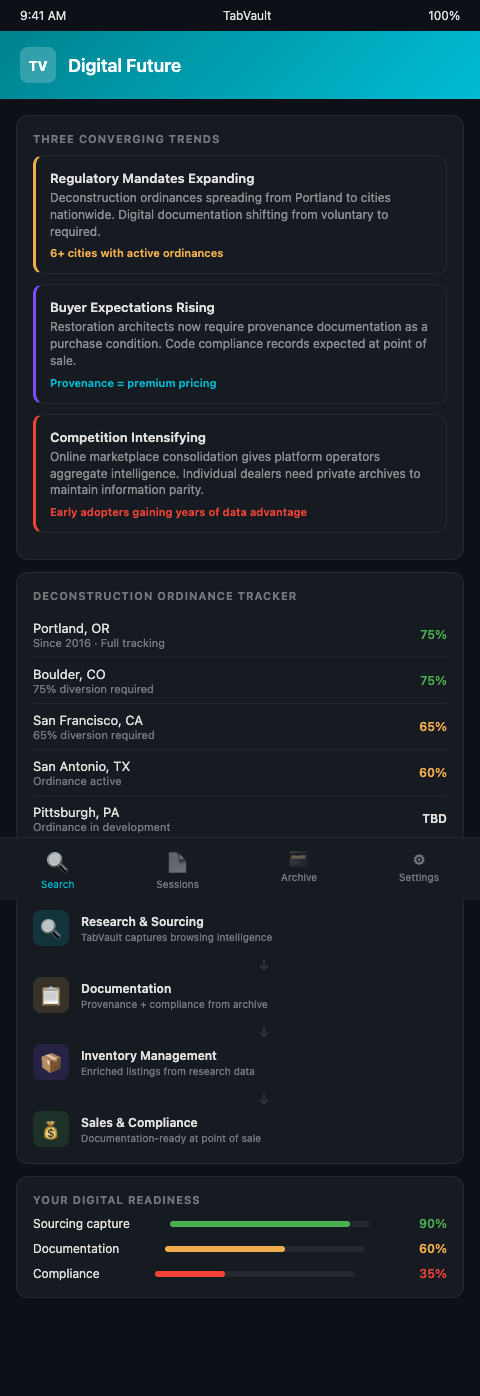
The salvage industry technology trends point toward increasing integration between sourcing research and downstream operations. A dealer who finds a set of reclaimed doors through indexed search should be able to connect that sourcing session directly to the inventory listing, the provenance documentation, and the eventual sale record. The archived research session becomes the foundation layer that subsequent systems build upon.
Market Positioning Through Digital Sourcing
Salvage sourcing innovation will also be driven by the growing sophistication of online salvage marketplaces. As more dealers list inventory online, the volume of browsing required to monitor the market grows proportionally. A dealer who monitors fifteen supplier websites daily generates a browsing volume that only indexed search can manage efficiently. The alternative, manually checking each site and trying to remember what was listed yesterday versus today, breaks down as the market moves online.
For dealers thinking about where browser-based OSINT tools are heading in adjacent industries, the trajectory is clear: full-text indexing of browsing activity is becoming standard infrastructure for any research-intensive profession. The salvage dealers who adopt this infrastructure early will have years of accumulated, searchable intelligence by the time their competitors begin.
The marketplace consolidation trend adds urgency. As online salvage marketplaces grow and consolidate, the information asymmetry between marketplace operators and individual dealers widens. The marketplace sees all transactions, all searches, all pricing data. The individual dealer sees only their own activity. Building a private, local index of market intelligence is the dealer's counterweight to this asymmetry. The dealer who indexes every marketplace visit, every competitor listing, and every pricing datapoint builds a market picture that, while narrower than the marketplace operator's view, is deeper within the dealer's specific territory and specialties.
The environmental policy landscape will also drive digital adoption. The NYS DEC guidance on building material reuse reflects a growing regulatory expectation that deconstruction and salvage operations maintain traceable records. As these policies spread, the dealers with established digital workflows will adapt smoothly while those without them will face a disruptive transition.
Preparing Your Operation for the Digital Shift
Start with the highest-value digital investment: capturing sourcing intelligence systematically. Before investing in inventory management software or customer databases, ensure that the research feeding those systems is being captured. An indexed archive of sourcing sessions provides the raw material that every downstream system will eventually consume.
Build digital documentation habits into existing workflows rather than creating separate documentation processes. The most sustainable digital practices are the ones that capture information as a byproduct of work already being done, not as an additional administrative task layered on top.
Evaluate your current technology stack for gaps where information falls through. The most common gap in salvage operations is between sourcing research and inventory management. A dealer browses and evaluates materials in the browser, then manually re-enters information into an inventory system. The indexed archive bridges this gap by preserving the original research in searchable form.
The complete sourcing playbook for the digital era starts with acknowledging that browsing is research, research is intelligence, and intelligence is competitive advantage. The dealers who treat their browsing activity as a business asset worth capturing and protecting will lead the market through whatever regulatory and competitive shifts come next.
Watch for municipal deconstruction ordinances in your operating territory. Each new ordinance creates both supply, as more buildings are deconstructed rather than demolished, and demand for the documentation and tracking systems that compliance requires. Position your operation ahead of these mandates by building the digital infrastructure before the regulation arrives.
Invest in training your team to treat browsing as a business activity rather than a personal habit. The shift from treating browser history as ephemeral to treating it as a business asset requires a change in mindset. Buyers who understand that their browsing sessions feed into a permanent, searchable archive browse more deliberately, evaluate listings more thoroughly, and document their research more carefully. This behavioral shift, more than any technology adoption, is what separates digital-ready salvage operations from those that will struggle to adapt.
From Sourcing Archive to Sales Advantage
Consider the integration points between your sourcing archive and your sales channels. As online salvage marketplaces grow and buyers increasingly expect detailed product information, the sourcing research archived in TabVault provides the raw material for product descriptions, provenance narratives, and marketing content. A single archived research session can supply the construction date, architect attribution, material composition, and historical context that transforms a generic inventory listing into a compelling sales narrative. The dealer who has been building this research archive for years has a content advantage that competitors cannot replicate quickly.
The long-term trajectory points toward an industry where digital documentation, searchable sourcing archives, and systematic market intelligence are baseline requirements rather than competitive advantages. The dealers who adopt these tools early will set the standard. Those who delay will find themselves adopting under pressure, without the accumulated data that early adopters have been building since the beginning.
Build Your Digital Sourcing Foundation
The future of architectural reclamation belongs to dealers who invest in digital sourcing infrastructure before the market forces their hand. TabVault provides the research capture layer that feeds every other digital system in your operation. Join the waitlist to start building your searchable sourcing archive today.
Deconstruction mandates are spreading. Documentation requirements are tightening. Buyer expectations for provenance verification are rising. The dealers who build digital sourcing infrastructure now -- capturing every browsing session into a searchable, private archive -- will lead the market through these transitions. The dealers who wait will adopt under pressure, without the years of accumulated data that early adopters have been compiling since the beginning. The digital shift in architectural reclamation is not coming. It is here.