The Future of Browser-Based OSINT for Podcast Investigations
OSINT Has Moved From the Margins to the Center
The United States Director of National Intelligence launched its 2024-2026 strategy naming OSINT "The INT of First Resort," and the House Permanent Select Committee on Intelligence created a dedicated OSINT subcommittee in February 2025 (ShadowDragon). That institutional recognition reflects a shift that investigative podcast producers have been living for years: the majority of investigative research now happens in the browser, through publicly accessible sources, using open source intelligence methods.
Bellingcat's Online Investigation Toolkit, launched in collaboration with its volunteer community in fall 2024, catalogs hundreds of browser-based OSINT tools organized by function — geolocation, image verification, social media analysis, corporate records, satellite imagery (Bellingcat). The toolkit's premise is that the browser is the primary investigative environment. OSINT tools come in three forms: desktop applications, command-line tools on platforms like GitHub, and browser extensions. For podcast producers who are not software engineers, the browser-based tools are the accessible entry point — and they are also the hardest to organize and preserve.
The Global Investigative Journalism Network's 2025 top tools list highlighted the tension between OSINT capability and OSINT organization: journalists have access to more open source data and more browser-based research tools than ever before, but the infrastructure for capturing, indexing, and retrieving the results of that research has not kept pace (GIJN). A producer might use 15 different browser-based OSINT tools in a single research session — reverse image search, corporate registry lookups, satellite imagery viewers, social media archives — and close the session with no systematic record of what was found.
This is the gap that defines the future of browser-based OSINT for podcast investigations: not finding information, but retaining it in a searchable, organized form.
The Reuters Institute has documented how AI-generated content is beginning to undermine OSINT's foundational assumptions, with fabricated timestamps, synthetic imagery, and deepfakes entering the open-source information environment at increasing scale. This makes provenance documentation — recording when and where a piece of OSINT evidence was found — more important than ever. A browser-based OSINT workflow that indexes results at the moment of discovery creates the provenance trail that post-hoc research notes cannot reliably reconstruct.
Capturing OSINT Research Before It Disappears
Browser-based OSINT produces ephemeral results. A reverse image search returns matches that may change with the next database update. A satellite imagery viewer shows conditions at a specific date that will be overwritten by the next capture. A social media profile exists until the user deletes it. A government database record is available until the agency redesigns its website and breaks every URL. OSINT research is volatile by nature, and the browser is the worst possible archival medium — tabs close, history expires, and cookies reset.
The structural response is to index OSINT results at the moment of discovery rather than after the fact. This is where turning chaotic browser sessions into a searchable private database becomes an OSINT workflow rather than a productivity tool. TabVault indexes the full text and metadata of every page a producer visits during an OSINT research session, creating a permanent local record that survives the volatility of the sources.
Consider a podcast investigation OSINT workflow for a corporate accountability story. The producer starts with a company name on the SEC's EDGAR database, pulls the annual report, checks the officers listed in the filing, runs those names through state corporate registries, searches for associated property records, and examines campaign finance disclosures. Each step involves a different browser-based tool or database. TabVault indexes every page visited across all of those tools, creating a unified search layer across what would otherwise be a disconnected series of browser sessions.
The scale of available OSINT data makes this retention problem urgent. ShadowDragon's analysis of the OSINT landscape documents over 600 data sources that analysts can access, encompassing social media networks, chat rooms, forums, and historical datasets (ShadowDragon). A podcast producer working a single investigation might touch 20 to 30 of those sources in a week. Without systematic indexing, the results of those searches exist only in browser history — which expires, gets cleared, or becomes unsearchable within days.
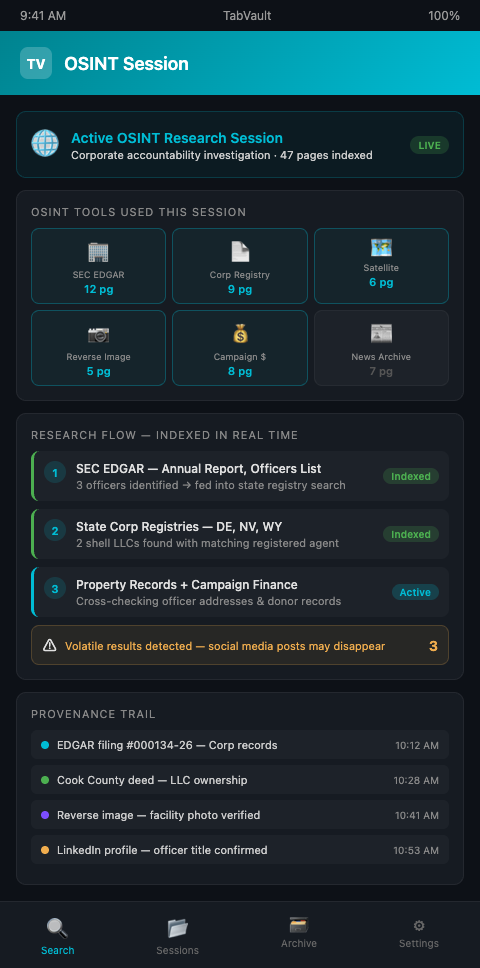
The indexed archive becomes especially valuable for OSINT verification — the process of confirming that information found through one source is corroborated by another. When a producer discovers a connection between a corporate officer and a property record, searching the TabVault archive for both names confirms whether any previously indexed page contains both. This kind of multi-source corroboration is the backbone of responsible OSINT practice, and it is feasible only when the full research corpus is searchable.
The International Center for Journalists identifies OSINT fundamentals for journalists as including verification, geolocation, and network analysis — all of which produce browser-based results that are ephemeral unless captured at the moment of discovery (ICFJ). A geolocation verification that confirms a photo was taken at a specific location produces a result page in a browser tab. Close that tab without indexing it, and the verification is lost. The OSINT tools investigative podcast producers rely on generate evidence that is only as permanent as the system that captures it.
The same indexed-archive approach supports pattern recognition across OSINT research sessions. A name that appears in an OSINT search today might connect to a page indexed three months ago during a different investigation. The archive makes these temporal connections searchable in ways that browser history never could.
For teams building longer-term OSINT capabilities, TabVault's local architecture aligns with browser-based clinical decision support for veterinary toxicology used in emergency medicine: the indexed archive functions as a knowledge base supporting real-time decision-making during active investigation sessions.
OSINT Workflow Tactics for Podcast Producers
Index before you analyze. The temptation in OSINT research is to analyze results immediately — following leads, opening new tabs, chasing connections. Before going deep on any single lead, make sure TabVault is indexing your session. The page you skim past in the first minute might be the page you need in month three.
Use OSINT tools investigative podcast producers actually maintain. Bellingcat's toolkit is comprehensive, but most producers will use a core set of 8-10 tools regularly: a corporate registry search, a property records lookup, a court docket search, a reverse image tool, a satellite imagery viewer, a social media archive, a WHOIS lookup, a campaign finance database, and a news archive. Master those core tools before expanding into specialized ones. TabVault indexes the output of all of them equally, meaning the archived results from a reverse image search are as searchable as the results from a corporate registry lookup.
Build an OSINT session template. For recurring investigation types — corporate accountability, public corruption, environmental violations — create a checklist of databases and tools to consult for each new subject. Run through the checklist systematically so the TabVault archive for each investigation covers the same ground. This standardization makes cross-investigation searches more productive because the indexed corpus has consistent structure.
Preserve volatile results aggressively. Social media posts, archived web pages, and dynamic database results are the most volatile OSINT sources. When a browser-based OSINT tool surfaces a critical result, visit the page immediately so TabVault indexes it. If the source disappears tomorrow, your local archive preserves the content.
Integrate your OSINT archive with the producer's playbook. OSINT research is one input into the larger production workflow. The indexed OSINT archive should feed directly into episode planning, fact-checking, and narrative construction. When the archive is searchable, the transition from research to production becomes a series of queries rather than a series of meetings.
Document OSINT methodology alongside results. As OSINT tools evolve, the methodology used to obtain a result becomes part of the evidence. Note which tool produced which result, and index the tool's output page in TabVault alongside the source data. If a reverse image search produces a match today that disappears from the tool's database tomorrow, your indexed copy of the result page preserves both the finding and the methodology. This documentation practice also supports decision support workflows where prior research informs real-time investigative decisions.
Cross-reference OSINT findings with traditional public records. The most powerful OSINT results are those that connect digital-native sources (social media, web registrations, domain records) with traditional public records (property deeds, court filings, corporate registrations). When both source types are indexed in the same TabVault archive, a single search bridges the digital and traditional record environments — a capability that no single OSINT tool provides on its own.
The Archive Is the OSINT Infrastructure
Open source intelligence browser tools will continue to proliferate, and AI-assisted analysis will accelerate pattern detection. But the foundational infrastructure question remains the same: where does the research go after the tab closes? TabVault gives investigative podcast producers a private, local, searchable archive of every OSINT session — the future of OSINT research tools includes better discovery and better retention. If your OSINT workflow produces more data than you can organize, join the waitlist and start building the archive that makes every session permanent.
A corporate accountability investigation that touches SEC EDGAR filings, state corporate registries, property records, campaign finance databases, and reverse image searches in a single week generates research across 20 to 30 browser-based OSINT sources. Close those tabs and the evidence trail evaporates. TabVault indexes the output of every OSINT tool you use -- from satellite imagery viewers to social media archives -- creating a unified local archive where a name search returns results from corporate filings and Instagram profiles alike. As AI-generated content makes provenance documentation more critical than ever, the indexed timestamp on each page becomes your proof of when and where the evidence was found. Join the waitlist and give your OSINT workflow the retention layer it lacks.