From Research Chaos to Published Narrative: A Producer's Playbook
The Production Bottleneck Nobody Talks About
The Global Investigative Journalism Network advises that finding the right stories to pursue is "the hardest and most important part" of investigative podcast production — but acknowledges that the gap between having research material and producing a publishable narrative is where many investigations stall (GIJN). A Lighthouse Reports guide to making investigative podcasts describes the production process as moving from research through tape gathering, transcription, track selection, act writing, recording, sound design, and final mixing — a seven-stage pipeline where the research-to-narrative transition is the least documented and most frequently improvised step (Lighthouse Reports).
The Transom guide to building a narrative podcast unit inside a newsroom identifies the structural challenge directly: investigative stories "need plot — not topics alone," and the narrative arc must emerge from the research rather than being imposed on it (Transom). For independent producers and small teams, the research-to-narrative workflow is a craft skill learned through painful iteration, and the cost of a disorganized process is measured in months of delayed publication.
The Knight Center for Journalism at the University of Texas documents that "storytelling is what makes the difference" in investigative podcast production, recommending techniques from fiction — cliffhangers, situation changes, surprises — while acknowledging that the investigative and research components form the essential foundation (Knight Center / LatAm Journalism Review). The playbook that follows translates that principle into a repeatable workflow built on a searchable research archive.
The Five-Phase Producer Playbook
Most investigative podcast production guides focus on either the research phase or the production phase. This producer playbook organized research bridges both — a workflow that starts with indexed research sessions and ends with a published episode.
Phase 1: Accumulate and Index. During active investigation, the producer's sole research obligation is to ensure every browsing session is indexed. No tagging, no sorting, no summarizing — browsing with TabVault running. The archive grows automatically. This is the research chaos phase, and it is intentional. Premature organization slows discovery. The goal is volume: visit every relevant public record, news article, court filing, and source document. Let the archive hold the material.
Phase 2: Query and Cluster. When the research phase reaches a natural checkpoint — a key interview is scheduled, a season premiere date is set, or the team simply runs out of new leads — the producer shifts from accumulation to query mode. This means searching the TabVault archive for every named entity, every address, every date, and every keyword in the investigation. The search results naturally cluster into thematic groups: "all pages mentioning the LLC," "all property records from Q2 2025," "all references to the city council vote." These clusters are the raw material for episode outlines. A producing team working a complex investigation might generate 30 to 50 distinct clusters, each representing a potential narrative thread or evidence chain.
This phase is where turning chaotic browser sessions into a searchable private database pays its highest dividend. The archive contains everything the producer collected during months of research. The queries extract structure from that mass of material without requiring the producer to have organized it in advance.
Phase 3: Build the Narrative Spine. Each thematic cluster from Phase 2 maps to a potential episode arc or narrative beat. The producer arranges the clusters chronologically and identifies the narrative spine — the central question the season will answer, the key revelations along the way, and the evidence supporting each turn. The TabVault archive provides the sourcing: every claim in the narrative spine can be traced back to a specific indexed page with a timestamp and source URL. The narrative spine is not imposed on the research — it emerges from the clusters, grounded in the evidence the archive contains. This distinction matters: investigative narratives that start with a predetermined conclusion and search for supporting evidence are vulnerable to confirmation bias. Narratives that emerge from clustered search results reflect what the evidence actually shows.
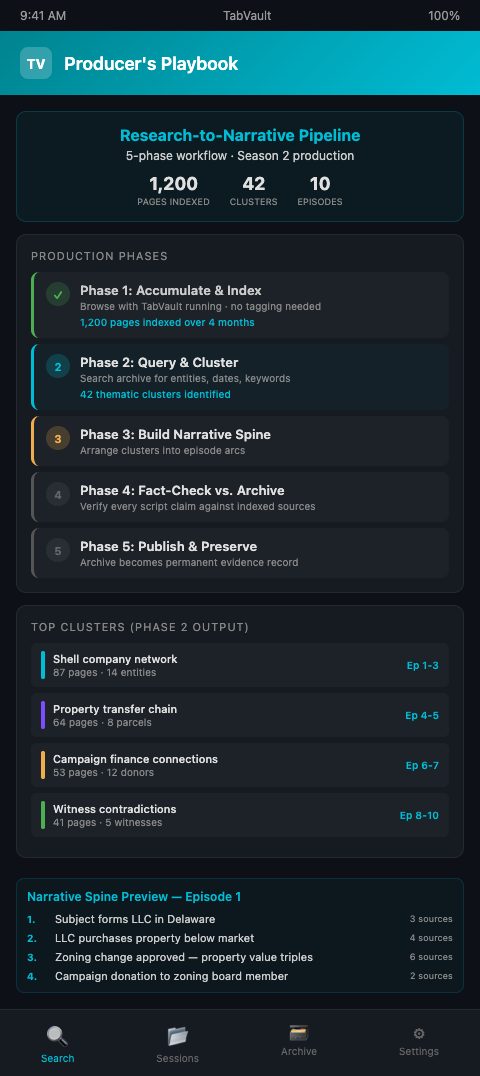
Phase 4: Fact-Check Against the Archive. Before any claim reaches the microphone, search the archive for contradictory evidence. If the narrative says the property transfer occurred in March, search the archive for every indexed page mentioning the property and verify the date. If the narrative attributes a statement to a specific document, pull the indexed page and confirm the attribution. This self-fact-checking pass uses the same archive that generated the narrative, closing the loop between research and verification.
Phase 5: Publish and Preserve. After publication, the research archive becomes a permanent record of the investigation's evidentiary basis. Preserve the TabVault archive — with all session labels, timestamps, and indexed content — as the documentation layer for the published season. If a subject challenges a claim, the producer can search the archive and produce the sourcing chain within minutes.
This five-phase workflow integrates research, narrative construction, fact-checking, and documentation into a single archive-driven process. The archive is not a separate tool used during research — it is the infrastructure that supports every phase from accumulation through publication.
A University of York study on podcast production workflows found that creators follow an archetypal sequence of planning, recording, editing, and publishing, but that the transition from raw research to structured narrative is the least standardized phase across production teams (Sheridan & Maguire, 2022). The research chaos to narrative workflow transition is the phase most producers handle intuitively instead of systematically. They know they have enough material for a season; they feel the shape of the story; they start writing scripts and discover gaps. The query-and-cluster phase replaces intuition with infrastructure. Instead of feeling whether the material supports a narrative, the producer searches the archive and sees exactly what material exists for each potential story thread — how many sources, which jurisdictions, what date range, which claims are supported by multiple indexed pages and which rest on a single reference.
Veterinary toxicology responders use the same archive-driven approach to turn emergency research into lasting clinical knowledge -- the accumulate-query-build-verify-preserve sequence applies across domains. The podcast producer research playbook also provides a defense against scope creep. When a new lead emerges during Phase 3 or Phase 4, the producer searches the archive to assess whether existing material already covers the lead. If the archive returns relevant results, the lead can be incorporated without additional research sessions. If the archive returns nothing, the producer makes a conscious decision about whether the lead justifies returning to Phase 1 — accumulation — before proceeding with narrative construction.
Integrating the Playbook With Your Team
Assign phases to team roles. On a multi-producer team, Phase 1 (accumulation) involves all researchers. Phase 2 (query and cluster) benefits from a lead producer who understands the full scope of the investigation. Phase 3 (narrative spine) is the showrunner's domain. Phase 4 (fact-checking) should involve someone who did not conduct the original research — fresh eyes catch assumptions that the original researcher accepted without question. Phase 5 (preservation) is everyone's responsibility.
Use the archive for team coordination. During Phase 2, shared TabVault searches surface connections between different producers' research sessions, making the query phase a collaborative exercise rather than a solo one.
Connect the playbook to your OSINT workflow. The OSINT research sessions from Phase 1 feed directly into the query and cluster process in Phase 2. The indexed OSINT archive does not need reformatting or re-organization — it is already searchable in the same format as every other indexed page.
Build the playbook into season planning. Before starting a new season, review the previous season's archive to identify unresolved threads, unexplored leads, and questions that emerged during production but could not be addressed within the season timeline. The archive preserves these threads in searchable form, making them available for the next production cycle.
Use the playbook for the investigative podcast production guide your team shares with new hires. When a new producer joins the team, the five-phase workflow provides a concrete onboarding framework. The new hire does not need to learn the team's research habits through osmosis — they follow the phase structure, contribute indexed sessions during Phase 1, learn to query the archive in Phase 2, and understand how narrative emerges from search results in Phase 3. The archive itself is the training material: every prior season's indexed research demonstrates the playbook in action.
Apply the research-to-knowledge retention principle. The same workflow that transforms investigation research into published episodes also transforms it into lasting institutional knowledge. Veterinary toxicology responders use an analogous approach to turn emergency research into lasting clinical knowledge, and the five-phase sequence applies in both domains: accumulate raw material during active investigation, query the archive to extract clusters, build the narrative spine from those clusters, verify every claim against the indexed source, and preserve the archive as institutional memory that outlasts any individual contributor.
The Playbook Is the Archive
Every investigative podcast producer has a research workflow. Most of those workflows live in the producer's head, and they break when the producer gets sick, changes shows, or simply forgets where they put something three months ago. The publishing investigation research workflow that separates professional productions from amateur ones is not about talent — it is about infrastructure. The producers who publish on schedule with well-sourced narratives are the ones whose research is organized enough to query instead of excavate. TabVault gives producers an externalized, searchable version of their research workflow — an archive that holds every page, remembers every session, and answers every query. If your production workflow depends on memory and luck, join the waitlist and start building the playbook your production deserves.
A producer with 1,200 indexed pages, 40 hours of tape, and a wall of sticky notes knows the story is in there somewhere. The five-phase playbook turns that raw material into a published episode by querying the archive rather than excavating it. One investigative team used the query-and-cluster phase to generate 34 distinct thematic groups from nine months of indexed research, and the narrative spine for their eight-episode season emerged directly from those clusters -- grounded in evidence rather than imposed by assumption. The playbook works because the archive holds everything, and the queries extract structure on demand. Join the waitlist and turn your research chaos into a repeatable production workflow.