Turning Emergency Research Into Lasting Clinical Knowledge
The Knowledge That Evaporates by Morning
At 2:14 AM on a Wednesday, Dr. Reyes treats a four-month-old puppy presenting with hemolysis, icterus, and acute kidney injury. The owners report the puppy chewed apart a decorative item hours earlier. Dr. Reyes suspects zinc toxicosis — pennies minted after 1982 are 97.5 percent zinc — and begins researching treatment protocols. Over twenty-two minutes, she reads the ASPCA Animal Poison Control Center's zinc toxicosis profile, a Merck Veterinary Manual entry on heavy metal poisoning, a VIN discussion thread from a board-certified toxicologist describing chelation timing, and a PubMed case series on zinc-induced Heinz body formation in dogs.
She finds the critical detail in the PubMed paper: aggressive fluid diuresis must begin before chelation therapy, because chelation without adequate renal support can worsen acute kidney injury. She adjusts the treatment plan accordingly. The puppy survives.
By 7 AM, when the morning shift arrives, Dr. Reyes can remember that she treated a zinc case and that fluid support was important. She cannot remember which of the four pages contained the fluid-before-chelation detail. She does not remember the PubMed citation. The VIN thread's specific discussion points are already blurring. Her browser history shows four URLs, but URLs do not tell the next clinician which page held which critical information.
This pattern repeats across emergency veterinary practice every night. The Journal of Veterinary Emergency and Critical Care publishes research on cognitive performance under fatigue, and the findings are consistent: memory consolidation degrades significantly during overnight shifts. The research that informs life-saving decisions at 2 AM is the research most likely to be lost by morning.
The scale of the loss is difficult to measure but easy to illustrate. A practice with four emergency veterinarians, each handling two to three toxicology cases per overnight shift, generates roughly twelve intensive research sessions per night. Over a year, that is more than 4,000 research sessions — each one containing specific clinical knowledge that was relevant enough to find, important enough to influence a treatment decision, and then lost to the combination of browser impermanence and human memory limitations.
The National Institutes of Health has published extensively on how sleep deprivation affects memory formation. Emergency veterinarians working twelve-hour overnight shifts are performing cognitively demanding research under exactly the conditions most hostile to long-term memory retention. The information they find is used once and then forgotten — not because it lacks value, but because the systems they work within make no effort to preserve it.
Capturing Crisis Research as Permanent Knowledge
The transition from ephemeral emergency research to lasting clinical knowledge requires one structural change: the research must be captured and indexed at the moment it happens, not reconstructed from memory after the fact. This is the fundamental principle behind clinical knowledge capture in emergency vet practice — preserving the full content of every page consulted during a case, automatically and without requiring any action from the clinician.
TabVault implements this capture automatically. When Dr. Reyes reads the PubMed case series on zinc-induced Heinz body formation at 2:31 AM, the full text of that paper is indexed locally. When she reads the VIN thread about chelation timing at 2:38 AM, that thread is indexed too. By the time she finishes treating the puppy, her entire research trail is preserved — timestamped, full-text searchable, and permanently available to every clinician at the practice.
The crisis research long-term value becomes apparent the next time a zinc case arrives. Instead of recreating the research from scratch, the attending clinician searches the practice's TabVault archive for "zinc chelation fluid diuresis" and finds the exact pages Dr. Reyes consulted. The critical detail about fluid support before chelation is right there, in context, from the same PubMed paper. Emergency research lasting clinical knowledge means that Dr. Reyes's twenty-two minutes of 2 AM research benefits every zinc case the practice handles going forward.
This is what it means to turn chaotic browser sessions into a searchable private database of clinical knowledge. The chaos is not just the number of tabs — it is the mismatch between the intensity of the research and the ephemerality of the medium. Critical clinical insights discovered during emergencies deserve the same persistence as the medical record itself.
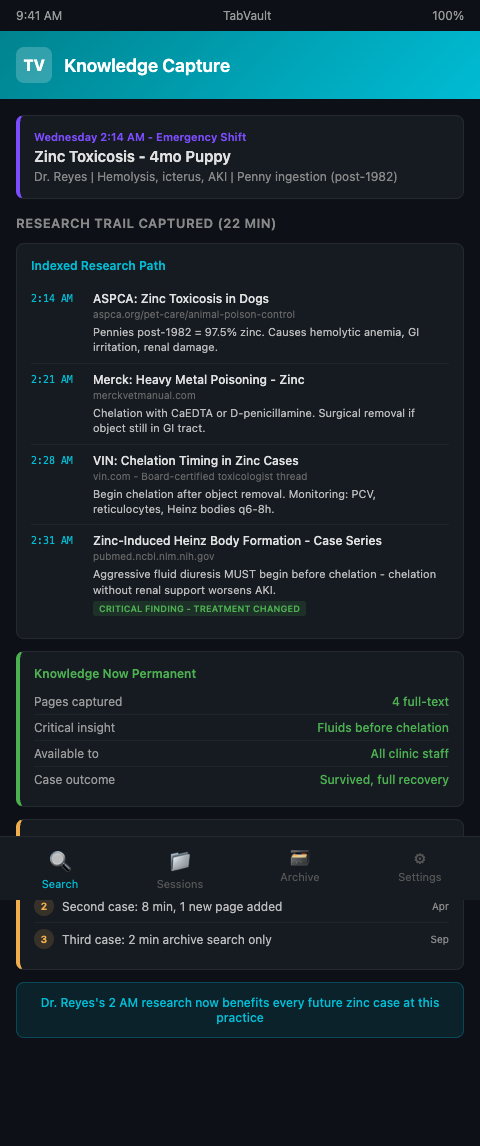
Veterinary toxicology knowledge retention improves when the system captures not just what the clinician found but the full context of how they found it. The indexed archive preserves the search path — which pages were viewed, in what order, and at what time. This path itself is clinical knowledge. It shows how an experienced clinician approached a diagnostic puzzle, which resources they consulted first, and which page ultimately provided the decisive information.
The future direction of clinical decision support tools will build on exactly this kind of archived clinical reasoning. But even without AI-assisted features, the raw indexed archive delivers immediate value: poisoning case learning retention that does not depend on any clinician's memory surviving an overnight shift.
TabVault's indexed archive also functions as a longitudinal record of institutional knowledge development. A practice can trace its collective expertise over time — from the first zinc toxicosis case, when the research took twenty-two minutes and required reading four pages from scratch, to the twentieth zinc case, when a two-second archive search retrieved the definitive protocol. The knowledge trajectory is visible in the data.
Strategies for Maximizing Knowledge Retention
Tag high-impact sessions. When a clinician feels they found a particularly important resource during an emergency — the page that changed their treatment plan, the detail that resolved a diagnostic uncertainty — a quick tag marks that session as high-value. Future searches can prioritize tagged sessions, creating a curated layer of the practice's most important research discoveries.
Conduct morning debriefs using the archive. Research on veterinary communication in emergency settings has shown that information loss during clinical handoffs is a persistent challenge, with the complexity of cases often exceeding what verbal summaries can reliably convey. During the shift handoff, the overnight clinician can pull up their indexed research from the previous shift and walk the incoming team through significant cases. The archive replaces fatigued memory with a precise record of what was found and where. This debrief process turns individual crisis research into shared poisoning case learning retention.
Build a complete guide to browser-based sourcing from indexed patterns. Over time, review the most frequently accessed pages in the archive. Pages that appear across dozens of different cases represent the core references your practice relies on most heavily. Compile these into a prioritized reading list for new hires and continuing education programs.
Review research efficiency for common toxins. Compare the number of pages indexed per case for a given toxin across different time periods. If zinc toxicosis cases in the first quarter required an average of six indexed pages per case, but cases in the fourth quarter required only two (because clinicians found what they needed faster through the archive), that trend quantifies the knowledge retention benefit.
Preserve departing clinicians' research. When a veterinarian leaves the practice, their accumulated indexed research stays in the archive. This is clinical knowledge capture emergency vet practice should systematize: an explicit offboarding step that confirms the departing clinician's indexed sessions are included in the shared archive. Their years of clinical research become a permanent asset rather than a departing individual's lost expertise.
Connect research to outcomes. When possible, annotate indexed sessions with case outcomes. A zinc toxicosis session tagged with "patient survived, full recovery" tells future clinicians not just what resources were consulted but that the resulting treatment plan worked. This outcome linkage transforms the archive from a reference library into an evidence base for clinical effectiveness.
Your 2 AM Research Deserves to Last
Emergency veterinarians generate some of the most valuable clinical research in the practice — under pressure, late at night, for the hardest cases. That research should not disappear with the browser session. TabVault captures it all: every page, every timestamp, every critical detail, preserved and searchable for every future case and every future clinician. Join the waitlist to turn your team's emergency research into the lasting clinical knowledge it was always meant to be.
Dr. Reyes saved a puppy's life at 2 AM with a detail about zinc chelation and fluid diuresis timing she found in a PubMed case series. By morning, she could not remember which paper held that detail. With TabVault, the paper is in her archive — indexed at 2:31 AM with every word of the methods, results, and discussion sections fully searchable. The next zinc case the practice handles, whether it arrives tomorrow or eight months from now, starts with a two-second search instead of a twenty-two-minute research scramble. Every emergency shift adds another layer of preserved clinical intelligence to the archive, turning the most cognitively demanding hours of veterinary practice into the most productive ones for building lasting institutional knowledge.