The Salvage Dealer's Complete Guide to Browser-Based Sourcing
The Scope of Browser-Based Salvage Sourcing
The EPA estimates that 600 million tons of construction and demolition debris were generated in the United States in 2018, with the recycling of C&D materials supporting 175,000 jobs as of the agency's 2016 economic report. The salvage dealers who capture the highest-value materials from that stream are the ones with the best sourcing intelligence. And sourcing intelligence, in practice, is browsing intelligence.
A complete salvage sourcing workflow touches multiple information streams each day. Demolition schedules from municipal building departments signal upcoming supply. Auction house catalogs from estate liquidators and bankruptcy proceedings reveal one-time acquisition opportunities. Supplier inventories from other dealers and salvage yards provide wholesale sourcing channels. Building history databases from county assessors, historical societies, and preservation organizations support provenance research that justifies premium pricing. Market price references from completed sales and competing listings inform bidding and retail pricing.
Each of these streams generates browsing sessions. According to the Grand View Research analysis of the reclaimed lumber market alone, the global market was valued at $54.34 billion in 2022 and is projected to reach $78.16 billion by 2030. As this market grows, the volume of online sourcing activity grows proportionally. The dealer who browses systematically and retains that browsing history in searchable form operates at a fundamental advantage over the dealer who browses and forgets.
The problem most dealers face is not lack of browsing effort. It is lack of browsing infrastructure. Hours of research evaporate when the browser closes. A listing evaluated Tuesday is forgotten by Friday. A building history researched last month requires full re-research this month. The browser-based architectural salvage workflow needs a retention layer that captures research output as a permanent, searchable asset.
The retention gap becomes visible at the worst possible moments. A high-value buyer calls with a specific request. The dealer remembers seeing exactly that item on a listing last week but cannot find the page. By the time the dealer relocates the listing through fresh searches, the buyer has moved on or the item has sold. A single missed connection like this, repeated a few times per month across a year, represents lost revenue that dwarfs the cost of any sourcing tool.
The Complete Browser-Based Sourcing System
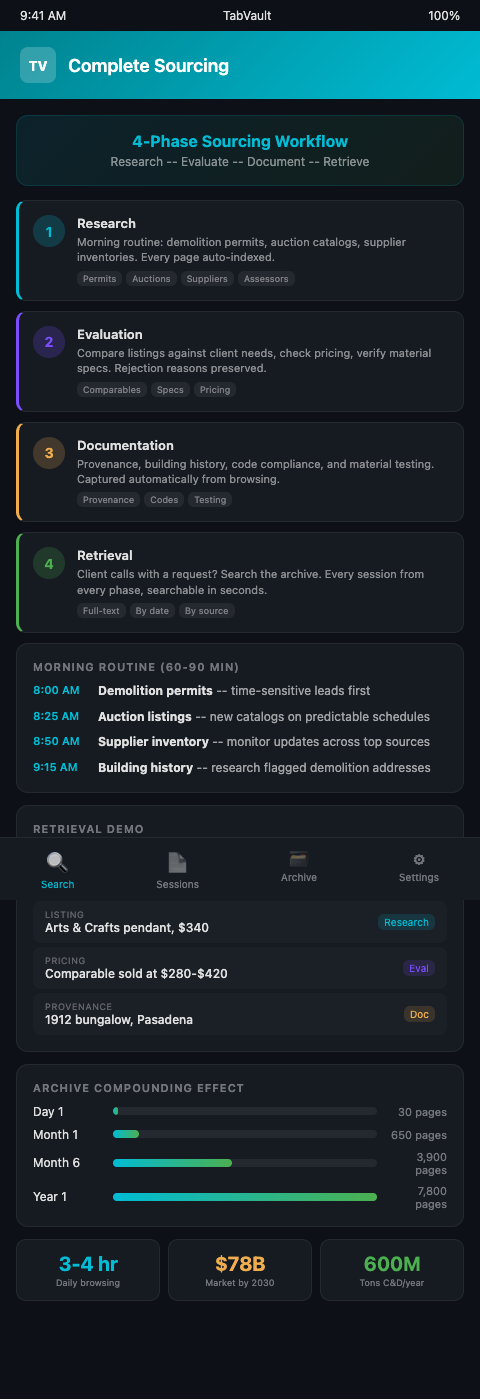
TabVault provides that retention layer by turning chaotic browser sessions into a searchable private database. Every page visited during sourcing activity becomes permanently indexed with full-text content, session context, and timestamp. The complete salvage sourcing workflow built on this foundation has four phases: research, evaluation, documentation, and retrieval.
Phase one: research. The dealer's morning routine begins with browsing the day's information streams. Municipal building department portals for new demolition permits. Auction listing sites for new catalogs. Supplier websites for inventory updates. Each session is automatically indexed. The dealer does not change how she browses. She changes what happens to the data after she browses.
Phase two: evaluation. As listings surface, the dealer evaluates materials against current client needs, inventory gaps, and market pricing. This evaluation happens through additional browsing: checking comparable sales, researching material specifications, and verifying provenance. Each evaluation session enters the archive, creating a record of not just what was found but how it was assessed.
Phase three: documentation. For materials that advance past evaluation, the dealer conducts the provenance and compliance research required for reclaimed architectural elements. Building history, material composition, code compliance, and testing requirements are all researched through browsing sessions that TabVault captures automatically. The documentation phase produces the records that buyers, contractors, and code officials require.
Phase four: retrieval. This is where the system pays dividends. Every session from every phase is searchable by content. A client calls asking about Craftsman-era lighting fixtures. The dealer searches the archive for "Craftsman lighting" and retrieves every session where those terms appeared: the original listing, the evaluation research, the provenance documentation, and the comparable market data. The response time drops from hours of re-research to seconds of search.
The salvage dealer digital sourcing strategy built on this four-phase system compounds over time. Each day's browsing adds to the archive. Each addition makes future searches more productive. After six months, the dealer possesses a comprehensive reclamation sourcing system containing thousands of indexed sessions covering suppliers, materials, pricing, provenance, and compliance across the entire operating territory.
The digital future of salvage sourcing depends on this kind of systematic capture. As the market grows and competition intensifies, the dealers with the deepest, most searchable sourcing archives will outbid, out-document, and out-sell those who rely on memory and scattered bookmarks.
For operations scaling across multiple locations, this same four-phase system applies across the entire organization. Each buyer at each location follows the same workflow, contributing to a shared archive that reflects the organization's total sourcing activity.
The system also protects the dealer during disputes. When a buyer claims that a piece was misrepresented, the archived research sessions document exactly what the dealer knew, when she learned it, and which sources informed her description. This audit trail, built automatically from browsing activity, provides legal protection that manual records cannot match in completeness or credibility.
The compounding nature of the archive deserves emphasis. A dealer starting today captures sessions from a single day's browsing. After one month, the archive contains hundreds of sessions. After one year, it contains thousands. Each session makes every future search more productive because it adds another potential match, another supplier reference, another pricing datapoint to the searchable index. The dealers who start earliest build the deepest archives, and the depth of the archive directly correlates with sourcing speed, pricing accuracy, and documentation quality.
Advanced Workflow Optimization
Morning routine structure. Allocate the first sixty to ninety minutes of each day to structured browsing. Check demolition schedules first, as these generate time-sensitive opportunities. Then review auction listings, which typically post new catalogs on predictable schedules. Finally, browse supplier inventory updates. This sequence prioritizes time-sensitive leads over ongoing market monitoring.
Weekly review cadence. Every Friday, run a set of standing searches against the archive: your top ten most-requested material types, your top five client-specific needs, and your three highest-margin product categories. The weekly review surfaces listings that accumulated during the week but did not trigger immediate action. A listing that seemed marginal on Tuesday may match a client request that came in on Thursday.
Quarterly knowledge audit. Review the archive's coverage across your operating territory and material specialties. Identify regions or categories where browsing activity has been sparse and redirect effort toward those gaps. The research-chaos-to-published-narrative producer's playbook used in investigative podcasting applies equally to salvage: systematic coverage outperforms reactive browsing.
Supplier relationship development. Use the archive to identify which suppliers have consistently provided high-quality inventory over time. A search for a specific supplier name returns every session where the dealer evaluated their listings, creating a longitudinal record of inventory quality, pricing trends, and reliability. Share this intelligence with your buying team to build consensus around preferred supplier relationships.
The NPS Secretary of the Interior's Standards remind us that preservation work requires matching replacement features to historic originals in material, design, scale, color, and finish. The salvage dealer's role in this process is finding those matches. The complete browser-based sourcing workflow described here turns that matching process from an act of memory into an act of search.
Client request tracking. When a client describes a need, immediately run a search against the archive. The material they need may already exist in a listing you browsed weeks ago. If the archive does not return results, document the request as a standing search term. Future browsing sessions that match the request will surface during the weekly review.
Competitive monitoring. Use the archive to track competitor activity over time. Browse competitor websites and online listings as part of your routine. The archive captures their inventory changes, pricing adjustments, and new material categories. A search for a competitor's name returns every session where you evaluated their listings, creating a longitudinal view of their business that informs your own positioning.
Seasonal preparation. Review the archive at the start of each season for patterns from the same period in previous years. Spring demolition season generates predictable material flows in most markets. The archive from the previous spring shows which material types became available, which suppliers were most active, and which price points the market supported. This historical perspective, built from last year's browsing sessions, informs this year's sourcing strategy with data rather than memory.
The salvage dealer digital sourcing strategy outlined here does not require technical sophistication. It requires one decision: to stop treating browsing as a disposable activity and start treating it as the business intelligence operation it already is. Every page you browse during sourcing activity contains information that has value beyond the moment you view it. The question is whether that value is captured or lost.
Build Your Complete Sourcing System
The salvage dealer browser-based sourcing guide does not require a technology overhaul. It requires one foundational change: capturing the browsing you already do in a searchable, permanent form. TabVault makes that change automatic, indexing every session without disrupting your existing workflow. Join the waitlist to turn your daily browsing into the comprehensive sourcing system your business depends on.
Three to four hours of daily sourcing generates your most valuable business intelligence -- and most of it vanishes when you close the browser. TabVault changes that equation permanently. After thirty days, your archive holds a month of research, evaluation, and documentation sessions searchable by any keyword. After a year, it holds thousands of pages spanning every material category, every supplier, and every market your operation touches. The complete browser-based sourcing system described here requires one foundational change: treating your browsing as the business asset it already is and capturing it accordingly.