Beyond Keyword Search: Why True Crime Needs Full-Text Indexing
The Name That Was on the Page but Not in the Title
A true crime podcast producer investigating a cold case homicide remembered reading a witness name — "Delacroix" — in a police incident report she had accessed through a county records portal weeks earlier. She searched her browser history. Nothing. She searched her bookmarks. Nothing. She typed the name into Google to try to re-find the page. The results were useless — hundreds of unrelated hits for the surname. The problem was not that the page was gone. The problem was that "Delacroix" appeared only in paragraph eight of the incident report's body text. It was not in the page title, not in the URL, and not in any metadata that browser history or bookmarks could have captured.
This is the limitation that kills investigative leads. Browser history and bookmark-based search are keyword searches operating on metadata — page titles and URLs. They are blind to body content. For true crime research, the critical details are almost never in the title. A witness name buried in a court transcript, a phone number appearing once in a FOIA response, a street address mentioned in the fourth paragraph of a news article — these are the details that connect dots and break cases open.
Edison Research found that 19.1 million Americans listen to true crime podcasts weekly, and the investigations behind those shows depend on exactly this kind of granular detail retrieval. The IRE resource center maintains thousands of tipsheets on investigative methodology, and a recurring theme across those resources is the importance of being able to locate any specific detail from any point in an investigation. Keyword search against titles and URLs cannot deliver that. Full-text search can.
The scale of the problem grows with the investigation's scope. A multi-episode true crime series might generate 200 or more research pages across court systems, news archives, government databases, and FOIA portals. Searching old research tabs by title alone leaves the vast majority of their content invisible to retrieval.
Full-Text Indexing Changes What You Can Find
Full-text search crime investigation means every word on every page you visited during research becomes searchable. Not titles alone. Not URLs alone. Every paragraph, every table cell, every sidebar, every footnote. The index treats your collected research the way a search engine treats the web — except the corpus is private, local, and composed entirely of pages relevant to your investigation.
TabVault applies this principle by indexing the full rendered text of every page you visit during a research session. The index lives on your machine, turning chaotic browser sessions into a searchable private database. When you search for "Delacroix," it returns every indexed page where that name appears — the incident report, a property record listing the same surname, and a local newspaper article about a neighborhood dispute you barely glanced at during a background research session.
For true crime podcast tools, full-text indexing transforms what is possible during script writing and fact-checking. Instead of relying on memory or manual notes to connect a detail from one source to a mention in another, you search once and see every occurrence across your entire research archive. The connections surface automatically.
Consider the practical difference in a digital investigation research workflow. A producer working a fraud case needs to trace a shell company across multiple jurisdictions. The company name appears in a secretary of state filing (as the primary subject), in a PACER docket (mentioned in a motion), in a FOIA response (referenced in an email chain), and in a news article (buried in a quote from a source). Title-based search would find only the secretary of state filing, where the company name is likely in the page title. Full-text search finds all four, revealing the breadth of the company's appearance across the public record.
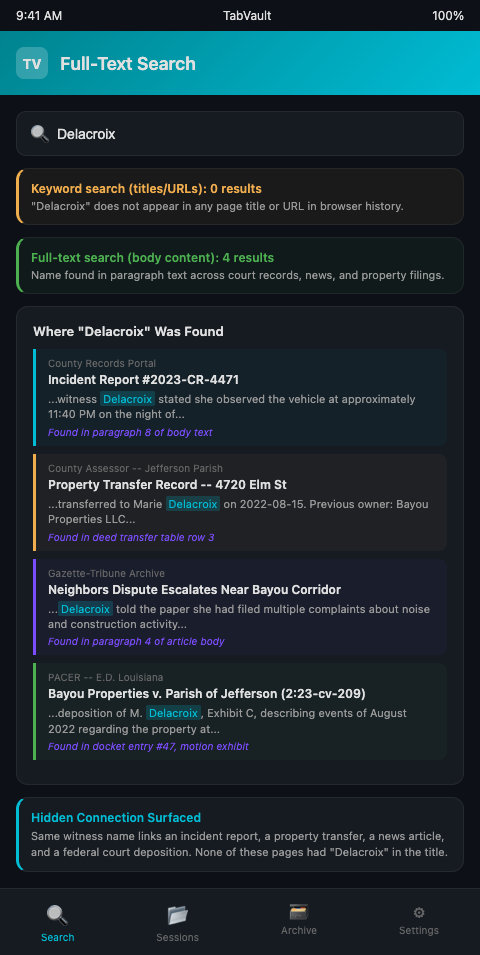
This capability compounds with the size of your archive. After six months of indexing, your true crime research tab search spans thousands of pages. A witness name buried in a property record you skimmed in week two becomes the key connection when that same name surfaces in a court filing during month four. Searching old research tabs with full-text indexing means nothing you read is ever truly lost.
The same indexing approach benefits fields far from true crime. Architectural salvage dealers use full-text browser indexing for inventory search where the details they need are buried in item descriptions, not page titles. The underlying principle is identical: body content holds the most valuable information, and only full-text indexing makes it retrievable.
Organizing your research management workflow around full-text search also means you can trace the provenance of any fact. When a fact-checker asks where a specific claim originated, search for the exact phrase and find the source page. Every indexed page carries a timestamp showing when you visited it, creating a research timeline you can reference throughout production.
The difference between keyword search and full-text search matters most at the moments that matter most: when you are on deadline and need to verify a claim, when a source provides a new name and you need to check whether it appeared anywhere in your prior research, and when you are writing a script and need the exact language from a document you read weeks ago. In each case, keyword search against page titles fails because the relevant information is in the body. Full-text search succeeds because it treats every word on every page as a potential match.
True crime podcast tools that rely on bookmarks or tag-based organization still require the producer to have manually categorized every page. The strength of full-text indexing is that it requires no manual effort. You browse. The index builds. Every word is captured. The organizational work happens at search time, not at browse time — and that is exactly when you have the context to know what you are looking for.
Advanced Tactics for Full-Text Crime Investigation Search
Search for phrases, not single keywords. Single-word searches return too many results in a large archive. Use two- or three-word phrases to narrow results. Searching for "Delacroix witness" or "Greenfield Holdings payment" filters noise and surfaces the specific pages where those terms co-occur.
Search for numbers. Case numbers, dollar amounts, phone numbers, dates, and addresses are among the most useful search terms in a true crime investigation. Full-text indexing captures them all. Searching for a specific dollar amount — "$47,500" — can connect a payment record to a contract to a court judgment across three different sources.
Build a running search list. Maintain a document listing every name, entity, address, and key phrase in your investigation. Periodically search your index for each term to see if new connections have emerged from recently indexed pages. This systematic approach prevents you from overlooking a connection that formed when a newly indexed page matched an older one.
Search for misspellings and variations. Government records are inconsistent. A name might appear as "DeLacroix," "Delacroix," "De La Croix," or "DELACROIX" across different portals. Run variations to ensure comprehensive retrieval. The National Institute of Standards and Technology's guidance on digital evidence preservation emphasizes that thoroughness in retrieval is a function of search strategy, not archive completeness alone.
Combine full-text search with date filtering. When you need to find something from a specific research period — "What did I read about the defendant during the first two weeks of the investigation?" — filter by session date and then search within that range. This narrows a six-month archive to a two-week window without losing the full-text advantage.
Use full-text search to prepare interview questions. Before interviewing a source, search your archive for every mention of that person or the topics you plan to discuss. Review the indexed pages to identify specific details you can ask about, discrepancies you can probe, and claims you can verify during the conversation. This preparation, powered by full-text retrieval, produces sharper interviews than generic background reading.
Search for absence as much as presence. When a name or detail that should appear in your research archive does not, that absence is a finding. If a company claims to have filed with a state agency but your indexed pages from that agency's portal contain no mention of the company, the gap itself may be part of the story. This absence-detection capability is foundational to public record case file construction, where documenting what you did not find is as important as documenting what you did.
Your Research Already Contains the Answers — Make Them Searchable
The details that break true crime cases are already in the pages you visited. They are in paragraph eight of an incident report, in a footnote of a court filing, in the third column of a property record table. Full-text indexing with TabVault makes every one of those details searchable across your entire research archive. If you are building investigations from public records and web research, join the waitlist and stop missing the connections hiding in your own browsing history.
A missing persons investigation might generate 200 research pages in six weeks -- court filings, property records, news archives, and social media profiles. The witness name buried in paragraph eight of an incident report connects to a corporate filing on page 147 of your archive, but only if both pages are full-text indexed. TabVault captures every word on every page you visit, making that paragraph-eight detail as searchable as a page title. One cold case producer traced a key suspect connection through a name that appeared exactly once, in a county assessor record visited three months earlier. Full-text indexing found it in four seconds. Join the waitlist and make every detail in your research retrievable.