How Uncatalogued Research Tabs Become an Investigation's Weakest Link
The Tab Graveyard That Almost Killed an Episode
During pre-production for an episode on a wrongful conviction case, a true crime podcast team accumulated over 70 browser tabs across two laptops — court dockets from PACER, witness interview transcripts hosted on a county clerk's site, news articles from three local papers, and a forensic lab's accreditation records. Nobody catalogued them. The lead producer relied on spatial memory: "The DNA stuff is in the left window, the trial transcripts are in the right." Two weeks before recording, one laptop's hard drive failed. Half the research vanished, and the team spent 11 days reconstructing what they could from memory and bookmarks that led to moved or deleted pages.
This pattern repeats across investigative podcasting. Edison Research estimates that 19.1 million Americans listen to true crime podcasts weekly, triple the figure from 2019, and the shows feeding that audience depend on meticulous research. Yet the research itself sits in the most fragile container available — uncatalogued browser tabs that no one has organized, backed up, or made searchable.
The Society of Professional Journalists Code of Ethics requires journalists to "verify information before releasing it" and to "use original sources whenever possible." Verification demands that you can locate the original document you are citing. When your research tabs are uncatalogued — scattered across browser windows with no index, no tags, no search — that verification step depends entirely on your ability to re-find a specific page among dozens or hundreds of tabs. One crash, one accidental close, one browser update, and the page you need to verify a claim is gone.
A Carnegie Mellon study on tab behavior found that about 25 percent of participants had experienced browser or computer crashes caused by having too many tabs open (Carnegie Mellon University, 2021). For podcast producers managing investigation research organization across weeks or months, that is not a matter of if but when.
Cataloguing Research Through Automatic Indexing
The core problem with uncatalogued research tabs is not laziness — it is that manual cataloguing does not scale. No producer is going to pause mid-research to copy a URL, write a description, and paste both into a spreadsheet for every page they visit. The friction is too high, and the research momentum is too valuable to interrupt.
TabVault removes that friction by indexing automatically. Every page you visit during a research session gets its full text captured and stored locally — turning chaotic browser sessions into a searchable private database. You do not stop to catalogue anything. You browse court records, news archives, government portals, and forensic databases the way you normally would. The index builds itself.
This changes the calculus of true crime research management fundamentally. Instead of maintaining a fragile system of open tabs as your organizational layer, you maintain a durable, searchable archive that grows with every session. Close any tab at any time. The content persists in your index. When you need to verify a claim before recording, search for the specific phrase or name. The indexed page appears whether you visited it yesterday or three months ago.
The automatic nature of the indexing matters because investigation research organization failures almost always stem from the gap between intention and execution. Producers intend to organize their research. They plan to create bookmark folders, maintain spreadsheets, and write session notes. But under production deadlines, these tasks get deferred, and the deferral becomes permanent. An automatic index eliminates the intention-execution gap entirely — the organization happens whether the producer remembers to do it or not.
Consider case file organization for a multi-episode series. A wrongful conviction investigation might span pre-trial motions, trial transcripts, appeals court opinions, forensic lab reports, witness statements, police reports obtained through FOIA, news coverage from the original trial, and follow-up reporting from years later. That is easily 100 or more distinct pages across a dozen different websites. With uncatalogued tabs, finding a specific forensic detail means scrolling through every open tab or guessing which bookmark folder you used. With TabVault, you search "luminol" or "blood spatter" and every indexed page containing those terms surfaces instantly.
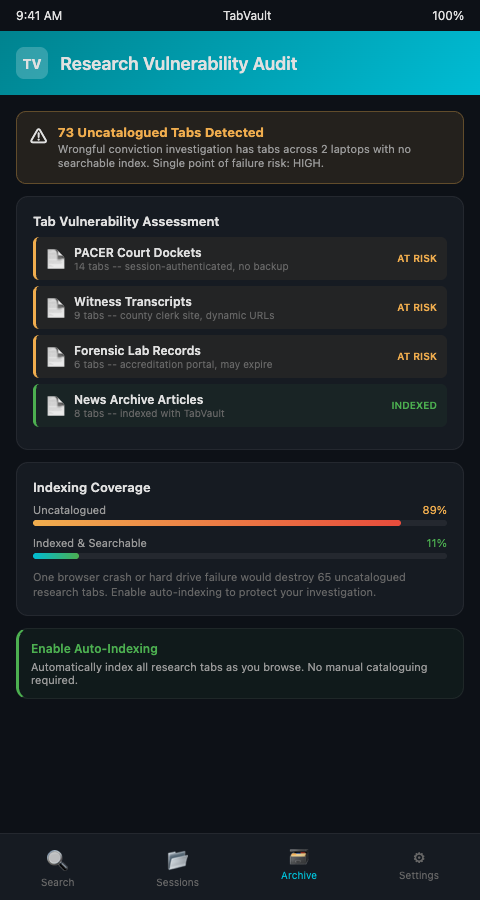
The indexed archive also protects against the volatility of online sources. Court dockets get updated. News articles get edited or paywalled. County clerk websites get redesigned, breaking old links. Because TabVault indexes the rendered text at the time of your visit, your archive preserves a snapshot of what you actually read — not what the page currently shows. Other research-intensive fields face the same risk: veterinary toxicology responders have documented how emergency protocols vanish from browser history when hospital databases update their interfaces.
Building toward a system of organized digital research starts with automatic indexing. Once the index exists, every other organizational practice — tagging, filtering, exporting citations — becomes possible. Without it, you are building on sand.
The risk of uncatalogued research extends to legal exposure. The Society of Professional Journalists Code of Ethics requires that journalists verify information before releasing it and identify sources clearly. If a fact in a published episode is challenged, the producer must be able to locate the original source document. When that document was one of 70 uncatalogued tabs on a failed hard drive, verification after the fact becomes impossible. A searchable archive transforms compliance from a scramble into a routine search query.
Investigation research organization also determines how effectively a team can respond to corrections. When a listener or subject of a story challenges a specific claim, the team needs to retrieve the source material within hours, not days. An indexed archive makes that retrieval immediate. An uncatalogued collection of tabs — if it survives at all — makes it a guessing game.
Advanced Tactics for Eliminating Research Weak Points
Audit your tab count weekly. If you have more than 30 uncatalogued tabs open, you have a vulnerability. Every open tab is a piece of research that exists only in your browser's session state. TabVault eliminates the risk, but awareness of your tab count helps you recognize when an investigation's research is outgrowing your organizational system.
Separate primary sources from secondary sources in your workflow. Court documents, FOIA responses, and official records are primary sources. News articles, blog posts, and commentary are secondary. When searching your index, knowing which type of source you need speeds retrieval. Structure your source privacy protections around this distinction as well — primary sources containing sensitive information warrant stricter handling.
Build verification checkpoints into your production schedule. Before recording any episode segment that relies on a specific fact, search your index for the original source. Read the indexed text to confirm the detail. This habit catches errors that would survive into the final episode unchallenged. The IRE resource center recommends systematic verification protocols for investigative stories — a searchable archive makes those protocols practical rather than aspirational.
Index early, index everything. The biggest gaps in research archives come from the first few sessions of an investigation, when producers are still exploring and have not yet committed to a system. Start indexing from the very first search query. Background reading, initial source identification, and preliminary document review all generate pages worth preserving. What seems like casual browsing in week one turns out to be the foundation of a breakthrough in week eight.
Use your archive to identify what you have not researched. A searchable index makes gaps visible. If you search for a key name and get zero results, you know you have not yet researched that person's public records. If you search for a date range and find only news articles but no court filings, you know where to focus next. The absence of results in a comprehensive archive is itself a research signal.
Create a research completeness checklist for each episode. Before marking an episode as research-complete, run a standard set of searches against your archive: every named person, every named entity, every key date, every location. Confirm that your archive contains primary-source documentation for each. Gaps in coverage become immediately visible and can be addressed before recording begins.
Treat your archive as institutional memory. If your podcast has multiple seasons or a rotating team, the indexed archive preserves research knowledge that would otherwise leave with departing team members. A new producer joining mid-season can search the archive to understand what has already been researched, what sources have been consulted, and what leads have been explored.
Your Investigation Cannot Afford a Single Point of Failure
Uncatalogued research tabs are a single point of failure in any investigation. One crash, one update, one accidental close, and weeks of work disappear. TabVault eliminates that vulnerability by automatically indexing every page you visit into a private, local, full-text searchable archive. Your case file organization becomes as strong as your research is deep. Join the waitlist and close the weakest link in your investigative workflow.
A wrongful conviction investigation that loses its research archive to a browser crash does not lose a few bookmarks -- it loses the evidential chain connecting forensic lab reports to witness statements to appellate rulings. TabVault prevents that loss by indexing every page as you browse, with zero manual effort. One true crime team catalogued 847 pages across a six-month cold case investigation, and when opposing counsel demanded documentation of their research process, they produced a timestamped archive covering every source consulted. Start indexing from your first research session and eliminate the single point of failure that uncatalogued tabs represent.