The Case for Searchable Browser Archives in Veterinary Emergencies
Thirty Minutes and a Closed Tab
A Labrador Retriever presents at an emergency veterinary clinic with acute coagulopathy after ingesting a second-generation anticoagulant rodenticide. The attending clinician remembers reading the specific vitamin K1 dosing protocol on the ASPCA Animal Poison Control Center website three days ago — but the tab is closed, the browser history shows only a generic URL, and the page title gives no indication of which rodenticide class it covered. According to the ASPCA, their Animal Poison Control Center handled over 401,000 cases in 2024, making it the single most consulted resource for veterinary poisoning emergencies in the United States.
The problem is not a lack of information. The problem is retrieval. Emergency veterinarians routinely research toxins, decontamination protocols, and antidote dosing across multiple sources — the ASPCA database, the Merck Veterinary Manual, PubMed case reports, state poison control hotline summaries, and manufacturer Safety Data Sheets. A single emergency case can generate ten to twenty browser tabs across these sources. When the case resolves, those tabs close. When the next similar case arrives days or weeks later, the clinician starts from scratch.
Browser history compounds the problem rather than solving it. A study from Carnegie Mellon University found that users routinely keep tabs open specifically because they fear losing information that took significant effort to find — yet closing those tabs makes the content effectively irretrievable through standard browser history, which indexes only URLs and page titles, not page content (Carnegie Mellon University, 2021). For emergency vet protocol retrieval, this limitation is acute. The URL "aspca.org/pet-care/animal-poison-control/toxic-and-non-toxic-plants/lily" tells you nothing about the specific renal biomarkers, treatment timelines, or prognosis data the page contained.
The veterinary poison control workflow demands better. When minutes determine outcomes, a clinician should be able to type "brodifacoum vitamin K1 dosing dog" and retrieve every page they have ever read on the subject — not just a list of URLs they once visited.
Turning Emergency Research Into a Searchable Private Database
The structural fix is to stop treating browser sessions as disposable and start treating them as the raw material for a permanent, searchable archive. This is the core shift: turning chaotic browser sessions into a searchable private database where every toxicology page, every dosing chart, every ASPCA lookup is captured, indexed, and retrievable by content rather than by URL.
TabVault applies this principle to the emergency veterinary context. As you research a poisoning case — pulling up the ASPCA toxin page, cross-referencing the Merck Veterinary Manual entry, checking a PubMed case report on the same compound — TabVault indexes the full text of each page locally on your machine. Close the tabs when the case resolves. The content persists in your searchable browser archive, and you can query it by any term that appeared on those pages.
Consider what this means for toxin database browser search in practice. Three weeks after treating that brodifacoum case, a cat arrives with suspected anticoagulant rodenticide exposure. You type "anticoagulant rodenticide feline" into TabVault's search bar. Every page you previously indexed containing those terms appears — the ASPCA page with species-specific dosing, the PubMed case report describing feline sensitivity differences, the Merck entry on coagulopathy monitoring. You are not starting over. You are searching your own research history.
This retrieval capability matters because veterinary toxicology is a field where the same toxins recur but the clinical details vary by species, dose, and time to presentation. The Merck Veterinary Manual documents hundreds of toxic substances across companion animals, livestock, and exotics. No clinician memorizes every protocol. The practical reality is that emergency vets re-research the same toxins repeatedly, and each time they do, they risk not finding the exact page that had the specific detail they need.
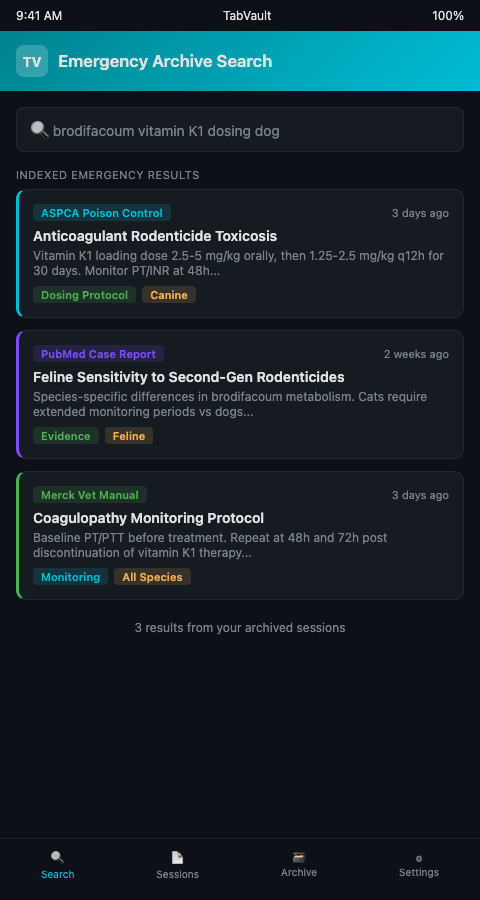
TabVault also addresses the problem of building a personal toxin reference library passively. Traditional reference-building requires deliberate effort — bookmarking, note-taking, filing. An indexed archive builds itself as a byproduct of normal clinical research. Every case you work adds to the library. After six months, your archive contains a comprehensive record of every toxicology page you consulted, organized not by folder but by searchable content.
The full-text search capability is what distinguishes this from bookmarks or browser history. Bookmarks save URLs. Browser history saves URLs and titles. An indexed archive saves the actual text of every page, making it searchable by any word or phrase that appeared in the content. When you need to find a specific LD50 value, a particular decontamination timeline, or a species-specific contraindication, you search for those exact terms.
Compounding Clinical Value Over Time
The value compounds with each shift. A clinician who indexes during every emergency case accumulates a longitudinal record of her clinical research — not just what the internet says today, but what specific pages said on specific dates when specific treatment decisions were made. If the ASPCA updates a dosing recommendation, the archive preserves both the old and new versions, giving the clinician a comparative view that no single-source reference provides. If a PubMed article is retracted or a Merck entry is revised, the indexed snapshot from the original research session persists as a record of what information was available at the time of treatment.
The veterinary poison control workflow also benefits from cross-source search unification. Most emergency research sessions span three to five different websites. A local index collapses all of them into one search layer — query once, get results from every site visited during any session. This cross-source capability reveals connections between cases that separate source searches would miss. A search for "hepatotoxicity delayed onset" might return pages from a xylitol case, a sago palm case, and an acetaminophen case — three different toxins with a shared clinical pattern, visible in one result set.
Researchers in other evidence-heavy fields have adopted the same approach. Genetic genealogy cold case researchers, for instance, build searchable archives from their DNA research sessions — the underlying need for durable, query-ready web research transfers directly to veterinary emergency medicine.
Advanced Tactics for Emergency Archive Building
Once the indexing habit is established, these strategies maximize the archive's clinical value.
Index during every case, not just unusual ones. The temptation is to index only rare toxin exposures. Resist it. Common exposures — chocolate, xylitol, lily ingestion — recur frequently, and the specific dosing thresholds and monitoring parameters vary enough between sources that having your previously reviewed pages instantly searchable saves meaningful time during triage. The Pet Poison Helpline catalogs hundreds of common household toxins, and your indexed sessions build a personalized subset filtered by cases you have actually treated.
Tag sessions by species and toxin class. When you research a feline permethrin toxicity case, the session context is different from a canine NSAID overdose. Consistent tagging by species and toxin category makes later searches more precise. Searching "feline permethrin" retrieves only the relevant subset of your archive, not every page that mentions either term independently.
Use the archive for shift handoffs. Emergency veterinary medicine runs on shift work. When you hand off a pending toxicology case to the next clinician, the ability to share a search query that surfaces every page you consulted during your shift is more complete than a verbal summary or a hastily written note. The archive becomes a clinical communication tool as well as a reference tool.
Re-index key sources quarterly. Organizations like the ASPCA update their toxicology database as new research emerges. A page you indexed six months ago may contain outdated dosing guidance. Periodic re-indexing ensures your archive reflects current recommendations alongside historical snapshots, giving you a comparative view when protocols change.
Build institutional knowledge over time. The same indexed-archive approach used by genetic genealogy cold case researchers applies here: durable, query-ready web research compounds over time. A solo practitioner's archive captures one clinician's research patterns. A clinic where multiple veterinarians use the same indexing approach builds a collective toxicology reference that grows with every case seen by any team member — an organic, case-driven knowledge base that no textbook replicates.
Start Building Your Emergency Archive
Your browser was built to display web pages, not to serve as a veterinary toxicology reference system. Every closed tab is a protocol you may need to find again at 2 AM when the next poisoning case arrives. TabVault gives emergency veterinary professionals a private, local, full-text searchable archive of every toxicology page they visit. Join the waitlist and stop losing the research that keeps your patients alive.
TabVault runs silently in your browser while you work a rodenticide case at midnight or review an ASPCA antifreeze protocol between appointments. Every page you open — from ethylene glycol dosing calculators to PubMed studies on delayed-onset xylitol hepatotoxicity — gets indexed locally without interrupting your workflow. Within weeks, you accumulate a private toxicology reference that mirrors your actual caseload rather than a generic formulary. When a Beagle arrives seizing after a suspected snail bait ingestion and you need the metaldehyde tremor management protocol you read last month, one search brings it back instantly.