The Business of Long-Running Actual Play: Listener Lifetime Value
Why Listener Lifetime Value Is the Right Metric for Actual Play
IAB U.S. Podcast Advertising Revenue Study 2024 — IAB documents that podcast ad revenue reached $2.4B in 2024, representing 26% year-over-year growth. Long-running shows command premium CPMs because advertisers recognize that habitual listeners have higher attention and trust than casual ones. But CPM-based monetization is a ceiling that grows slowly. The business model that scales with actual play's structural advantages is listener lifetime value — the cumulative revenue a single subscriber generates across their entire relationship with the show.
The retention case study documents what near-perfect retention looks like from a production discipline perspective — the same structural choices that drive retention drive LTV. A show that keeps 70% of its audience across season transitions is building a fundamentally different business than one with 30% retention.
Patreon Podcast Revenue Jumps 33% to $629M — Tubefilter reports 7.6 million paid podcast memberships on Patreon, with podcast creators representing 14.8% of Patreon payouts despite being only 7.66% of creators. That asymmetric payout performance is driven by shows with highly loyal audiences — which is the output of the structural storytelling discipline this post addresses.
Revenue Streams for Actual Play Content — Saving Throw Show provides a producer-level breakdown of how sponsorship, Patreon, and merchandise revenue streams interact in an actual play business. The pattern that emerges: shows with strong narrative structure convert a meaningfully higher share of their free subscriber base to paid tiers, because the story investment listeners make in following a long-running arc creates a natural commitment escalation toward financial support.
How Narrative Structure Drives Listener Lifetime Value
The transit map metaphor maps directly onto the LTV equation. A listener who boards the feed at episode one and follows a show through three seasons has traveled a complete narrative journey — multiple arcs resolved, dormant stops reactivated, character arcs from Lord Thadderon to Kaelith reaching meaningful stations. That journey creates the kind of investment that converts to Patreon membership, merchandise purchases, and word-of-mouth referrals.
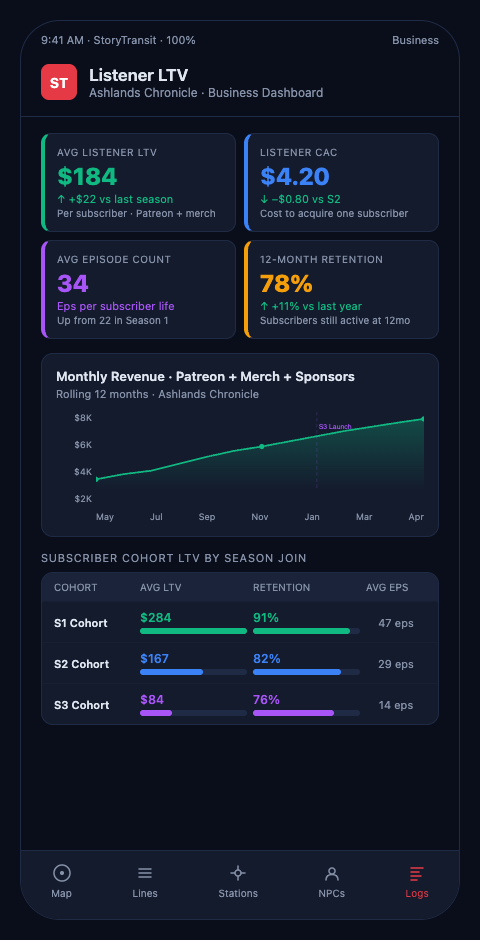
A listener who boards at episode one and leaves at episode 12 usually left because the narrative system failed them — they lost track of what they were following, a cold open didn't give them enough context, or a dormant arc came back without sufficient re-orientation. Each of those failure modes is a structural problem, not a content quality problem. And each one represents a significant LTV loss: Top Podcast Monetization Strategies 2025 — Content Allies puts subscription conversion rates at 0.5-8% of active listeners for most shows, with long-running shows reaching the higher end of that range. The difference between 0.5% and 8% conversion is largely a function of how long listeners stay in the active audience — which is a retention question.
StoryTransit addresses the structural causes of early listener departure. When every active transit line is explicitly maintained, when cold opens orient mid-series listeners, when show notes document thread status, the show gives each subscriber a reason to stay through the next arc's station arrival — and then the one after that. That compounding retention is the actual play business model.
Patreon's $629M Podcast Machine — eMarketer confirms that the listener-funded model is driving LTV for long-running shows specifically — the podcasts punching above their weight on Patreon are those with habitual listener bases, not large one-time download spikes. An actual play show that has built its narrative infrastructure well enough to retain 70% of subscribers across two season transitions is operating at a fundamentally different LTV ceiling than one with 30% retention between seasons.
Podcasting's $7B 2024 — Sounds Profitable documents that the global podcast economy hit $7.3B in 2024, with the subscription and ad revenue mix increasingly favoring established long-running shows. The implication for actual play producers: the structural work of narrative thread management is not separable from the business case for the show. The transit map is the business infrastructure.
Advanced Monetization Strategy for Long-Running Shows
Tier the LTV by arc investment. Not all subscribers have equivalent LTV potential. A listener who has been following the show since episode one and participates in community discussions has demonstrated arc investment — they're a strong conversion candidate for premium Patreon tiers that offer extended content or early access. A listener who arrived at episode 45 through cross-promotion is still in the onboarding window and should be treated as a retention priority before a monetization target.
Use narrative arcs as conversion moments. The moments immediately after a major arc resolution — a season finale, a long-anticipated station arrival for a character like Kaelith — are the highest-conversion windows in an actual play feed. Listeners who just experienced a payoff for three seasons of investment are maximally engaged and receptive to Patreon pitches that promise more of that experience. Those arc completion windows are visible in the transit map as terminal stations — and they should be planned as monetization inflection points in the production calendar.
Supercast: Podcast Subscription Platform tracks LTV, churn, and ARPU per subscriber for podcast subscription shows, making it possible to measure how narrative arc completion correlates with conversion and retention rates. For actual play producers who haven't yet connected their narrative metrics to their business metrics, that correlation is where the business case for structural narrative management becomes concrete.
The actual play business case for back catalog monetization. Long-running podcasts with strong back catalogs have a monetization lever that short-run shows don't: back catalog discovery. A listener who discovers the show at episode 60 and binges backward through three seasons is generating listen-throughs across dozens of ad placements and building the arc investment that converts to Patreon membership. That back catalog monetization pathway is only viable if the catalog is structurally accessible — if new listeners can orient themselves in the feed and feel pulled toward both older and newer episodes simultaneously. The transit map that maintains narrative thread state across seasons is also the infrastructure that makes back catalog discovery a meaningful LTV driver rather than a passive archive.
Merchandise timing as an arc metric. Actual play merchandise sells best when characters have achieved narrative weight — when a listener has followed Kaelith through three seasons of development and wants a physical representation of that arc. The audience value created by long-running structural narrative is what makes a character T-shirt purchase feel emotionally motivated rather than transactional. Producers who track which characters generate the most Discord discussion and community art tend to find that those same characters are the ones whose transit lines have been most actively maintained — multiple visible arc advances across the season, clear station moments that gave the character definition, and narrative commitments the production has honored consistently. The monetization strategy that accounts for this treats character arc maintenance as a direct driver of merchandise revenue, not just a creative choice.
The local to national scale analysis addresses how these metrics change when audience size grows and production infrastructure needs to scale with it. For the long-term campaign economics context from the homebrew DM perspective, the campaign economics post documents how the same long-horizon thinking about narrative investment applies in a private campaign context where the "audience" is the players at the table.
Structural Narrative Quality Is an Asset, Not Just a Creative Standard
The business of long-running actual play is ultimately a retention business. Advertisers pay premium rates for habitual listeners. Patreon tiers fill when subscribers have sufficient arc investment to convert. Merchandise sells when characters have enough narrative history to make fans want physical representations of them. All of those revenue streams flow from the same source: structural narrative quality that keeps listeners engaged across seasons and arcs.
StoryTransit makes that structural quality a production discipline rather than an aspiration. The transit map that tracks every active and dormant thread is the same system that drives the retention, conversion, and lifetime value metrics that make a long-running actual play show financially viable.
Actual play podcast producers building for the long term — multiple seasons, growing subscriber bases, and meaningful monetization — are exactly who this system was built for. Join the Waitlist for Actual Play Producers and get early access to StoryTransit, where every transit line you maintain becomes a compounding investment in the audience value your show is building.