Scaling an Actual Play From Local Show to National Network
The Gap Between Local Audience and National Scale
Dimension 20 sold out Madison Square Garden in 2025 — a show that started as a Dropout streaming experiment for a niche audience. It started with friends at home. Now D&D is in its stadium era — NPR documents how actual play moved from home games to arena events within a decade. Dropout itself nearly doubled subscribers in 2023 and doubled show output in the same year, according to Dropout Subscribers and Content Double — Variety.
The infrastructure decisions that work for a 200-listener local show actively work against a 20,000-listener national audience. At local scale, the GM holds most narrative continuity in memory. At national scale, that memory is a single point of failure — a missed detail in episode 47 generates listener feedback threads, timestamp corrections, and trust erosion that would never have surfaced in a smaller feed.
Podcast scaling strategy, when applied to actual plays specifically, has two components that rarely get discussed together: the production layer (audio quality, release cadence, show expansion into social channels) and the narrative layer (thread management, continuity documentation, mid-series listener onboarding). Most shows that plateau have solved the first and neglected the second.
The Transit Map as a Scaling Infrastructure Tool
What a transit map provides at national scale is a shared system of record for narrative state. In a small local show, the GM and editor can sync on continuity over a single conversation. Once a show has a production team of four or five people — editor, social manager, show notes writer, guest coordinator — verbal sync breaks down. Threads get described differently in show notes than in episode audio. The social manager flags a storyline in a promo post that the GM marked as dormant two episodes ago.
StoryTransit solves this by treating each plot thread as a transit line with a definable current state: active, approaching a station, dormant, or terminated. Every production team member sees the same map. When Kaelith's redemption arc reaches the confrontation with Lord Thadderon, that station appears on the line — and every downstream production decision (show notes copy, social hooks, recap language) draws from the same documented stop.
Why Cross-Promotion Drives Podcast Audience Growth — Podgagement identifies cross-promotion as one of the only tactics that consistently drives new subscriber acquisition for podcasts. That matters for actual play scaling because cross-promotion consistently delivers mid-series listeners — people arriving at episode 30 or 45 who need fast orientation to the active arcs. A show without documented transit lines hands those new arrivals a feed with no map.
The Four Phases of Podcast Growth — Podcast Marketing Academy describes how each growth phase requires different production disciplines. Local shows in early growth phases can operate on instinct. National-scale shows in late growth or plateau phases require systematized processes — and narrative thread management is one of the last systems most producers build, usually only after a continuity failure has already cost them listeners.
Advanced Scaling Tactics for Actual Play Shows
Patreon Podcast Revenue Jumps 33% — Tubefilter reports that 47,000+ podcasters now earn from patrons, with podcast creators representing 14.8% of Patreon payouts despite being only 7.66% of creators. That asymmetric monetization performance is driven almost entirely by shows with loyal long-term audiences — which requires the structural retention discipline that transit map documentation supports.
The podcast scaling strategy gap shows up most clearly in show notes. A local-scale show can write show notes from memory. A national-scale show with four production team members writing alternating episodes produces inconsistent show notes — threads get described using different terminology, dormant arcs get mentioned in one episode's notes and ignored in the next, and new listeners scanning the feed for orientation find contradictions rather than coherence. Standardizing show notes through a shared transit map is a scaling intervention that most producers implement only after audience growth has already exposed the inconsistency.
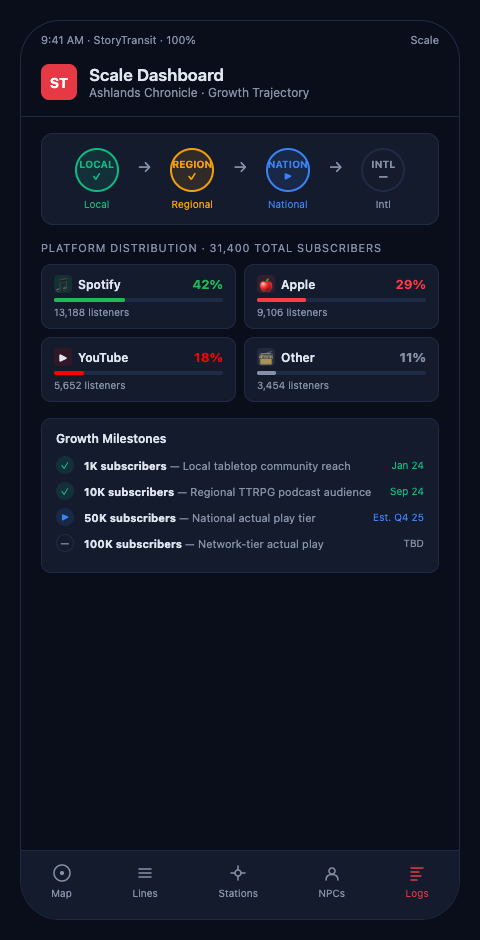
Actual play growth at national scale also changes how the back catalog functions. A local show with 200 listeners has a back catalog that maybe a dozen people explore. A national show with 50,000 subscribers has algorithmic discovery surfacing older episodes to new audiences constantly — which means continuity errors buried in episode 20 get surfaced to first-time listeners in 2026. Narrative documentation built during local-scale growth is the only protection against back-catalog continuity becoming a liability as audience size expands.
Show expansion into video streaming formats introduces an additional scaling wrinkle. Many shows scaling from local to national add video production alongside audio — Dimension 20's move to Dropout, for example, meant the same session content had to serve both audio podcast listeners who had been with the show for years and new video subscribers who discovered the show on streaming. A shared transit map that defines the canonical narrative state enables the production team to write show descriptions, clip titles, and video chapter markers that are consistent across both formats without requiring separate documentation systems.
At national scale, the actual play growth engine typically has two tracks running simultaneously: new listener acquisition and long-term subscriber retention. Cross-promotion brings new listeners in at the top of the funnel. Narrative clarity keeps them past episode 10. The shows that scale four to twenty in the adjacent play-by-post space face a structurally similar challenge — adding participants requires adding documentation infrastructure, not just production capacity.
For shows considering expansion into multi-show network formats, the homebrew to published transition post addresses one of the most common inflection points in actual play growth — the moment when a show's original world needs to interface with licensed settings that carry their own continuity constraints.
Show expansion into national network territory also changes the audience's relationship to the back catalog. New listeners at national scale arrive through recommendations, algorithm surfacing, and cross-promotion — and they enter the feed at random points. A show that has mapped its transit lines can point any new arrival to the nearest active station without requiring a full back-catalog binge.
The business metrics that matter at national scale — subscriber retention rate, Patreon conversion, premium tier uptake — all correlate with the same underlying factor: whether listeners feel the show has a coherent narrative system they're part of. The listener lifetime value framework is where those metrics converge into a single growth signal.
Scale the Narrative System First
The podcast scaling strategy that works for actual play shows is not the same as the one that works for interview podcasts or news shows. Serialized narrative podcasts have a structural dependency that interview formats don't: every new episode adds complexity to the existing story system, and every new listener arrives at a different point in that system.
Local-to-national scaling requires building the narrative infrastructure before you need it — not after your first continuity error shows up in listener reviews. StoryTransit gives producers the transit map that makes that infrastructure concrete, sharable, and production-ready.
If your actual play feed is starting to outgrow the systems you built for a smaller audience, the waitlist for actual play podcast producers is open. Join the Waitlist for Actual Play Producers to get early access to StoryTransit and start mapping the narrative architecture your growing show depends on.