Transitioning an Actual Play From Homebrew to Published Setting
Why the Homebrew-to-Published Transition Is Structurally Risky
Actual Play — Wikipedia documents that WotC has published sourcebooks based on Critical Role and Acquisitions Incorporated — shows that built substantial audiences in homebrew environments and then developed proprietary or licensed IP frameworks around them. The Kickstarter RPG space raised $64M in 2024 according to Worldwide TTRPG Market 2024 — RPG Drop, with licensed and branded settings driving major commercial interest. The actual play pivot to published settings is increasingly common as shows look to commercial partnerships and licensing deals that require operating within a defined canon.
For the local-to-national scaling context that often precedes a licensed setting pivot, the local to national scale post covers the production infrastructure decisions that prepare a show for commercial partnerships — including the transit map documentation that makes a licensed setting migration legible to a larger team.
The structural risk in that transition is not the setting change itself — most actual play audiences are flexible about world shifts, especially between seasons. The risk is what happens to the active transit lines: the character arcs, faction storylines, and long-running plot threads that were built in the homebrew world and now need to map onto a published setting with its own rules, named NPCs, existing lore, and canon constraints.
A show where Kaelith has a three-season arc built around a homebrew faction structure doesn't simply port that arc into the Forgotten Realms or Exandria. The specific lore relationships, political structures, and narrative commitments that define the arc need to be reconciled against the licensed setting's canon — some will translate directly, some will need modification, and some will need to be retired or quietly retconned.
The Transit Map as a Setting Migration Tool
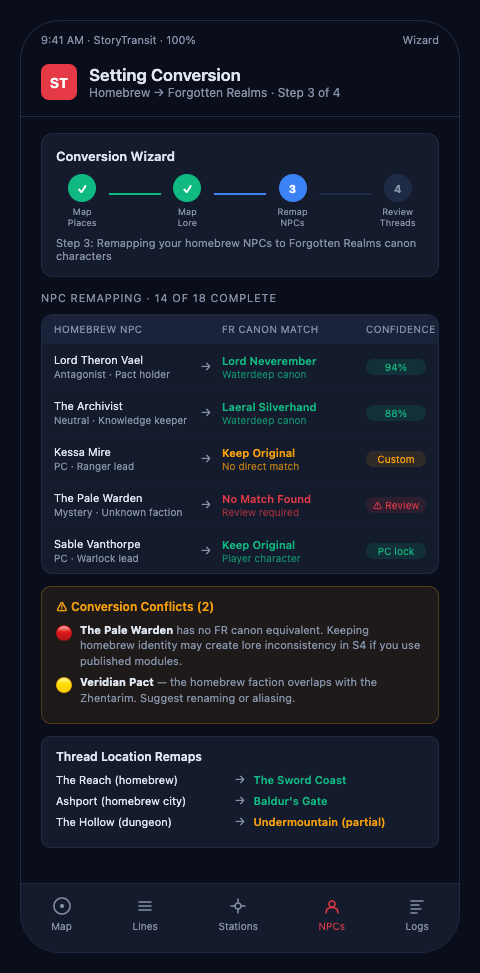
StoryTransit's transit map framework makes the homebrew-to-published transition legible by treating each plot thread as an independent line that can be evaluated separately during the world migration. The question for each active line is: does this thread's logic survive intact in the new setting, does it need adaptation, or does it require closure before the transition happens?
Hook, Plotline, and Sinker — Meeple Mountain provides the foundational framework for managing campaign continuity when adapting between homebrew and published worlds. The key principle is that character relationships are more portable than world-specific lore — a character arc about loyalty and betrayal survives a setting transition more intact than a plot thread specifically tied to a named homebrew faction that doesn't exist in the published world.
Narrative Continuity: Technique & Themes — StudySmarter establishes that narrative continuity principles for managing setting transitions require treating audience immersion as the primary constraint. Listeners who have followed a show for three seasons have emotional investments in specific character arcs, specific relationships, and specific narrative commitments the show has made. The setting transition that ruptures those investments without narrative justification loses listeners; the one that honors them while migrating the world gains audience confidence.
World Anvil: RPG Campaign Manager provides wiki, timeline, and NPC tools that help GMs migrate and reconcile homebrew lore against published setting canon. The documentation layer that StoryTransit provides — explicit thread state, station history, planned next stops — is the complement to worldbuilding documentation: it captures the narrative momentum that needs to survive the world migration, not just the lore.
RPG Session Prep Techniques — Troy Press covers structured session prep methods that support smooth setting pivots in ongoing campaigns. For actual play producers, the prep discipline needed for a setting transition is more extensive than a standard session prep — it's essentially a production-level mapping exercise where every active arc gets evaluated against the new setting's constraints before recording begins.
Advanced Tactics for the Setting Transition
The arc compatibility audit. Before announcing or executing the setting transition, audit every active transit line against the published setting's canon constraints. For each line: is the core conflict portable (yes/no)? Are the specific lore elements portable (full/partial/no)? Does the planned next station still make narrative sense in the new world? This audit produces a migration plan before any recording decisions are made.
The transition episode as narrative infrastructure. The episode that moves the show from homebrew to published setting is the production's most important structural investment in the transition. It needs to accomplish three things simultaneously: close or suspend the threads that don't survive the world migration, establish the active lines that will continue in the new setting, and orient listeners — including new ones who may discover the show at this high-publicity moment — to the narrative state entering the licensed world.
Listener communication through show notes. The setting transition is a moment when explicit show notes communication matters more than usual. A brief description of which arcs are continuing, which are closing, and what the new setting's relevant canon context is gives mid-series listeners — who may have limited familiarity with the published setting — the orientation they need to stay engaged through the pivot.
The world migration communication problem. Licensed settings carry pre-existing audience expectations that homebrew worlds don't. Listeners who are fans of the Forgotten Realms or Exandria will bring their own canon knowledge to the production — and some of them will be vocal when the production's use of that canon diverges from their expectations. Proactive show notes communication about how the production is using the licensed setting reduces that friction. Framing the licensed world migration as "our characters moving through this world, not a canonical account of it" sets appropriate audience expectations for a show that is using the published setting as a backdrop rather than a strict simulation.
Setting transition as a discovery moment. Shows that are moving from a homebrew world to a well-known licensed setting often experience a subscriber bump at the transition — fans of the licensed IP discover the show at the moment it enters familiar territory. That bump brings mid-series listeners in at maximum narrative complexity, which means the transition episode's orientation function is doubly important. The world migration is doing two jobs at once: maintaining continuity for existing subscribers and onboarding new ones who arrived specifically because the licensed setting drew them in.
The multi-show shared lore framework addresses the related challenge of maintaining narrative coherence when a show's lore intersects with other shows in a network — a challenge that intensifies when the shared setting is licensed rather than homebrew. For parallel methodology in the tabletop campaign space, the edition transition migration guide covers how dungeon masters migrate long-running homebrew campaigns across ruleset editions — a structural analog to the licensed setting transition that involves many of the same arc continuity challenges.
The Transition Is an Arc Itself
The homebrew-to-published setting transition, handled well, becomes part of the show's narrative rather than an interruption of it. The world changes around the characters — and that change can be a season-defining arc moment if the production maps it as one. The transit lines that survive the migration arrive at the new setting's first station with established momentum. The lines that close do so with narrative weight. New lines that open in the licensed world begin with the audience trust that three seasons of good storytelling have built.
StoryTransit makes the migration visible and manageable — a transit map that shows exactly which lines are crossing over, which are terminating, and which new routes are opening in the new world.
Actual play podcast producers preparing for or considering a setting pivot are exactly who this system was built for. Join the Waitlist for Actual Play Producers and get early access to StoryTransit — the platform that makes licensed setting migration a production asset instead of a continuity liability.