Running a Multi-Show Actual Play Network With Shared Lore
Why Shared Lore Networks Fail
The idea is appealing: two or three actual play shows set in the same world, with characters who occasionally reference each other's events, lore that compounds across shows, and an audience that rewards listeners who follow the whole network. Critical Role has done it. Dimension 20 has done it. Several regional TTRPG podcast networks are attempting it.
The failure mode is consistent. Show A introduces a political faction in episode three. Show B references the same faction in episode eight, but the name is slightly different and the leader's motivation is inverted. Nobody caught it because both shows are using the same shared world doc from eight months ago that nobody has updated since the initial lore brainstorm.
Shared universes require a series bible and central coordinator to prevent continuity conflicts across shows. Shared universes need a central editor to manage timelines and resolve lore conflicts. These principles are not aspirational — they're operational requirements. A multi-show network that treats shared lore as a creative gesture rather than a managed system will produce continuity errors that erode audience trust in both shows simultaneously.
The actual play market is saturating, and multi-show shared lore networks offer competitive differentiation. The shows that execute shared lore well create a distinct audience proposition. The shows that attempt it and fail create a liability.
The timing of lore failures is also worth noting. Shared lore networks typically launch with strong cross-show energy — the two GMs have planned the world together, the initial lore is coherent, and the shows feel genuinely interconnected. The failure happens six to twelve months later, when both shows have been running independently and the lore maintenance work has quietly stopped. The shared world doc becomes a founding document rather than a living system, and the divergence accumulates until a listener catches a contradiction and posts about it.
The Shared Lore Transit Network
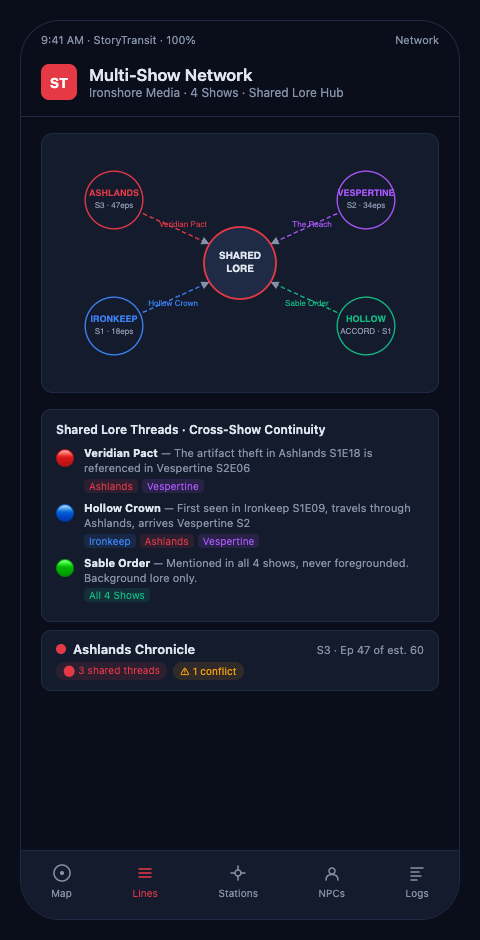
StoryTransit models a multi-show network as a transit authority — multiple lines running on the same underlying infrastructure, governed by a shared schedule and a unified track system. Individual shows are lines. The shared world is the network. The lore coordinator is the transit authority.
This model clarifies what "shared lore" actually requires.
The network lore map. Every significant element of the shared world — factions, locations, historical events, named NPCs that appear across shows, established rules of the world — exists on a central lore map maintained by the coordinator. This is not a creative document; it's an operational one. The lore map is what both shows consult before introducing any element that touches the shared world. Updates to the lore map require coordinator sign-off. New lore additions from one show automatically become canon that the other show must respect — which means they need to be communicated and documented in real time, not retrospectively.
Show-specific route profiles. Each show maintains its own arc and episode documentation, exactly as it would for a standalone podcast. The difference is that when a show's arcs interact with shared lore elements, those interactions are logged against the lore map as well as the show's own documentation. A faction that was merely mentioned in Show A's episode four becomes a lore entry that Show B must honor when they reference that same faction. The faction's name, leadership structure, and goals become locked facts — not creative suggestions.
Cross-show junctions. Points where two shows' storylines explicitly intersect — a character from Show A appearing in Show B, events in one show being referenced in another — are treated as junction stations on the transit map. These junctions require advance coordination: both shows need to agree on the narrative facts of the junction before either airs the relevant content. A surprise cross-show cameo that hasn't been lore-checked is a risk, not a feature.
The lore reconciliation log. When a continuity conflict is identified — either before airing (ideal) or after (damage control) — it's logged with the conflict description, the resolution, and the lore map update that prevents the same conflict from recurring. Maximum Fun's multi-show network demonstrates audience loyalty transfer across shows through consistent brand and story management. Consistent lore is a core component of that consistency, and a reconciliation log creates accountability for keeping it consistent.
Operational Practices for Multi-Show Lore Management
The transit authority model defines the structure. The following practices define how it runs week-to-week.
The lore coordinator role. This is a dedicated responsibility, not a shared one. Multi-show podcast networks need centralized brand and lore strategy to avoid cross-show contradictions. The coordinator reviews pre-session briefs from all active shows, flags potential lore conflicts before they're recorded, approves new lore additions, and maintains the central lore map as the system of record. For small networks, this role might be part-time; for networks running three or more active shows, it becomes a significant time commitment. The lore coordinator is the person who says "Show B can't use that name for the faction because Show A established it means something different" — and who has the standing to make that call stick.
Cross-show lore review cadence. Schedule a recurring lore review (monthly for active networks) where the coordinator and GMs from all shows compare upcoming story intentions against the shared lore map. The goal is conflict prevention, not creative restriction. Cross-promotion within a network drives audience crossover; shared lore deepens that value for listeners. The lore review is the production mechanism that makes cross-promotion credible — listeners will only follow across shows if the world feels genuinely coherent.
The inter-show event protocol. When a show wants to reference a real event from another show in the network, the protocol requires: (1) verifying the event's documented facts against the lore map, (2) drafting the reference and submitting to the coordinator for accuracy review, (3) logging the cross-reference in both shows' documentation. This prevents the most common failure mode — a well-intentioned reference that gets the details slightly wrong.
Lore versioning. When the shared world evolves — a faction changes, a historical event gets recontextualized, a key NPC's role shifts — the lore map update should be versioned with a timestamp and a note about which show's episode generated the change. This version history allows the coordinator to resolve disputes ("which show established this first?") and allows GMs to trace where specific lore elements originated.
Audience-facing lore transparency. For networks with high-engagement communities, some producers choose to publish a simplified version of the shared lore map — a wiki or a "world guide" that audience members can reference. This serves both a community engagement function and a practical function: attentive listeners often catch lore inconsistencies before the production team does. A world guide gives listeners a reference to compare against, and their feedback can surface conflicts that internal review missed. The published guide is always a subset of the full lore map — some details are production-only — but its existence signals to the audience that the shared world is a deliberate construction, not a loose creative gesture.
TTRPG podcast networks face differentiation pressure, and shared lore is a key strategy for cross-show identity. The operational rigor of the lore management system is what makes that differentiation sustainable rather than a one-time novelty.
The multi-show network context connects naturally to the scaling questions that precede it and the tool investments that support it. Future podcast tools covers how narrative coordination tooling is evolving for exactly the kind of network-level complexity described here. Local to national scale addresses the production and audience development journey that brings a show to the point where a multi-show network becomes viable. Producers with experience in shared world contexts from tabletop will find direct parallels in how multiple parties shared — managing multiple player groups in a single homebrew world — creates the same lore consistency demands at the GM level that a multi-show network creates at the production level.
Shared Lore Is a Competitive Advantage, Managed
A multi-show actual play network with coherent shared lore is one of the strongest audience retention structures available to independent TTRPG podcasting. Listeners who are invested in the shared world have a reason to follow all the shows — and a reason to stay subscribed to any show that's running, even when one is on hiatus.
That advantage only exists if the lore is actually consistent. Inconsistent lore doesn't just fail to add value — it actively undermines the trust that makes a network audience possible. When a listener catches a contradiction between shows, their reaction isn't usually to shrug and continue — it's to question whether the production team is paying attention. That question is hard to recover from.
StoryTransit's multi-show network tools — the central lore map, the cross-show junction tracker, the lore reconciliation log — are built for production teams managing this complexity at scale. The system keeps shared lore as a live operational document rather than a founding artifact that drifts out of date.
Actual play podcast producers building or running a multi-show network can join the waitlist now. Join the Waitlist for Actual Play Producers to get early access to the network lore management tools before launch.