Connecting Multiple Adventuring Parties in a Shared Homebrew World
When Two Parties Arrive in the Same City
Group A finished their session last Tuesday. They negotiated a tense alliance with the Brenhorn Village militia, killed the local crime boss, and let a cult informant escape. They left the city in a fragile but functional state.
Group B arrives in Brenhorn Village this Saturday. They've never been there before. What do they find?
If you're running connected campaigns in a shared homebrew world, the answer to that question determines whether your multi-party setup feels like a living world or a series of disconnected sandboxes with coincidentally similar geography. The crime boss is dead — does Group B know that? Does anyone in the city acknowledge it? Did the militia alliance hold, or did it fracture after Group A left? What happened to the cult informant?
Most DMs answer none of these questions before Group B's session because they're tracking Group A's session log, not a shared world state. The session log is the wrong document for this purpose. It records Group A's experience and information — which is not the same as what is objectively true in the world. Building the world state document is what separates multi-party setups that feel coherent from those that feel like two disconnected campaigns happening to use the same map.
Wikipedia's analysis of shared universe structures identifies how professional shared worlds manage this: structured continuity editors and reference bibles prevent inter-author contradictions. The analogy maps directly to multi-party D&D. You're not just a DM — you're the continuity editor for a world that multiple groups are actively changing.
Multi-author book series consistency research confirms what DMs running multiple parties already know from painful experience: without shared authority frameworks and enforced timelines, contradictions accumulate until the world stops making sense to anyone playing in it.
VTT adoption grew from 29% to 48% of players between 2020 and 2024 — a shift that dramatically increased the number of DMs running concurrent online groups in the same homebrew world, making multi-party coordination tools a growth area in the TTRPG ecosystem.
The D&D multi-party problem isn't unusual anymore. It's become standard for DMs running multiple groups of friends who all want to play in the same world.
The Shared World Transit Network
A city's transit network has one map. Multiple lines run through it, operated by different drivers on different schedules — but they all share the same stations, and what happens at a station affects every line that passes through it.
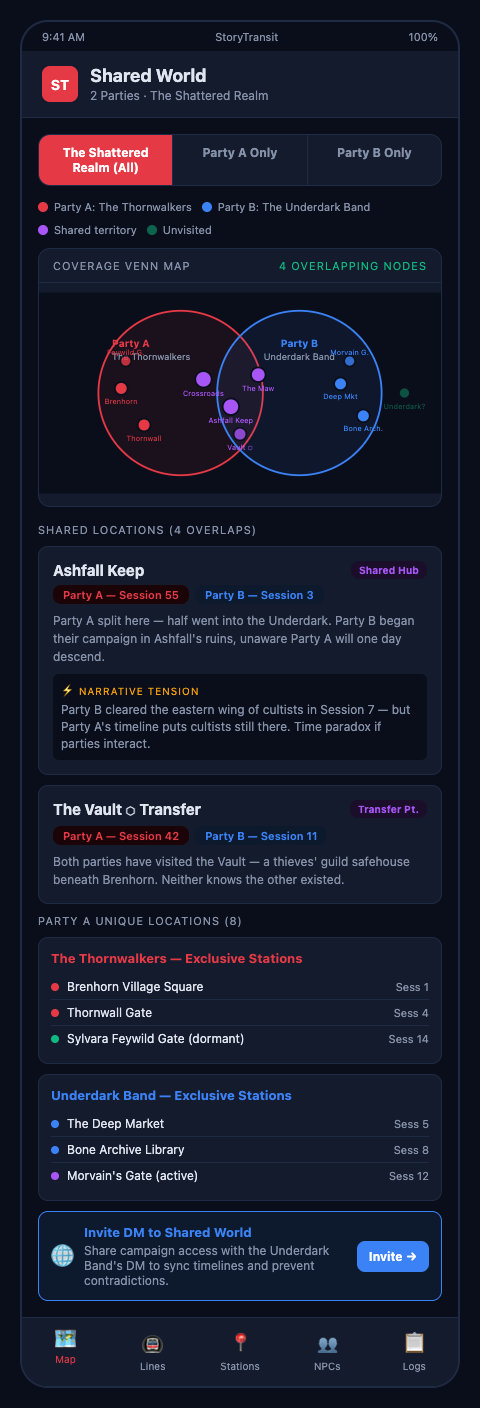
Your shared homebrew world is that network. Each adventuring party is a different line. They run on different schedules, serve different neighborhoods, and carry different passengers. But when any line passes through a shared station — Brenhorn Village, the merchant guild headquarters, the lich's sanctum — what they do there affects every line that visits next.
The key structural element is the world state document. This is separate from any party's session notes. It's the authoritative record of what has actually happened in the world, regardless of which party caused it. Every significant world event gets logged here: faction status changes, NPC deaths, political shifts, location changes. Before Group B's Brenhorn session, you consult the world state document — not Group A's session log — to determine current conditions.
This separation protects against the most common multi-party failure: accidentally revealing one group's secrets to another. Group A's session log contains their information state — what they know, what they suspect, what they were told. The world state document contains ground truth. Group B gets access to the world state through in-world discovery, not through DM knowledge leakage.
For the most complex version of this challenge, west marches threads create rotating multi-party scenarios where players from different groups sometimes run together, sometimes run separately, and the world state must remain consistent across all configurations. The world state document is non-negotiable in that format.
Multi-table scaling at the mega-campaign level creates the ultimate version of this challenge — dozens of players, multiple concurrent groups, and a single DM (or small GM team) maintaining a shared world through structured documentation disciplines.
StoryTransit's world state layer tracks cross-party events and automatically updates the shared world log when either party's sessions are recorded, keeping both transit lines operating on accurate information.
Building Your Connected Campaign Coordination System
Dungeon master coordination across multiple parties requires three distinct documents: a world state log, a faction status board, and an NPC continuity sheet.
The world state log is chronological. Every significant in-world event goes here in temporal order, tagged by which party caused it. You consult it before every session of every group, looking for anything in the relevant region that has changed since that group's last session.
The faction status board tracks each major faction's current disposition, resources, and goals. Factions change based on what parties do to them — and factions don't pause between one group's sessions and the next. If Group A weakened the cult by eliminating three cells, the cult is weaker when Group B encounters it, and the faction status board records that degradation.
Kanka's campaign management tools are purpose-built for multi-party TTRPG campaigns with quest systems, calendars, and character management — a practical implementation of the world state and faction tracking disciplines described above.
The NPC continuity sheet is the most labor-intensive element but the most rewarding. Every NPC who might interact with multiple parties gets their own sheet: current status, current location, commitments made, information held, and any unresolved threads. The Brenhorn Village militia captain who allied with Group A will behave very differently toward Group B if they walk in without credentials — the NPC continuity sheet is what ensures that difference is consistent with the captain's actual personality and situation, not just random hostility.
Collaborative worldbuilding in RPGs requires shared authority frameworks to sustain narrative coherence — and the DM running multiple parties is effectively a collaborative worldbuilder with multiple simultaneous contributors.
The world state log also protects against a subtler continuity failure: the DM's own knowledge bleeding into NPC behavior. You know what Group A did in Brenhorn Village. When you're running Brenhorn for Group B, that knowledge shapes how you portray NPCs — even unconsciously. The world state log forces you to tag every piece of information as "Group B knows" or "Group B doesn't know yet," creating a formal barrier between what you know and what the NPCs in Group B's session are permitted to reference. This discipline is harder to maintain than it sounds, and failing at it is one of the most common continuity problems in multi-party connected campaigns.
Set a cross-group communication policy before launching multiple parties in the same world. Decide explicitly whether players from different groups can discuss what their characters discovered. Some DMs treat cross-group information sharing as part of the game's fun — Group A warns Group B about the cult before their Brenhorn session. Others prefer strict separation, preserving distinct information states as a feature of the shared world design. Either approach works; the mistake is having no policy at all, which leads to accidental information leakage that undermines both groups' experiences.
Advanced Tactics for Multi-Party World Coherence
Consequence lag. Not all world state changes are immediately visible. If Group A destabilized the merchants' guild on Wednesday, Group B arriving Friday might not see the full consequences yet — rumors are spreading, but the leadership hasn't publicly responded. Build consequence lag into your world state log by tagging events as "occurred," "spreading," or "publicly known." This creates natural variation in what each party discovers and prevents both groups from having identical information states.
Cross-party echoes. Look for opportunities to let one party discover evidence of the other's work without either group knowing the other exists — or without breaking the fiction that each group is the protagonist of their own story. Group B finds a cult safehouse already ransacked and notes left in an unfamiliar hand. Group A's style is recognizable to you, but not to Group B. These echoes make the world feel inhabited without requiring the parties to actually meet.
Scheduled world advancement. Every two weeks of real-world time, regardless of how many sessions you've run, advance the world state for all factions. Factions that neither party has interacted with recently continue pursuing their own agendas. This prevents the world from freezing between party interactions and creates new plot developments that surprise both groups equally.
Multi-show actual play networks face the same structural problem at production scale — the multi-show shared lore challenge requires the same world state documents and NPC continuity disciplines that multi-party DMs use at the table.
The best worldbuilding tools for GMs include several options for tracking NPCs, factions, and lore across interconnected campaigns — the choice of tool matters less than the commitment to maintaining the world state document consistently between every group's sessions.
Connected campaigns in a shared homebrew world pay off when both groups feel they're playing in a living world that remembers them and responds to them. That's achievable. The documentation overhead is real but manageable — and the moment Group B stumbles into consequences of Group A's choices without any meta-knowledge of what happened, you'll understand why the work is worth it.
Your World Is Bigger Than One Party
The homebrew world you've built can support more than one group of adventurers — but only if you're willing to maintain it as a shared, living system rather than a series of isolated play experiences. Build your world state document, your faction status board, and your NPC continuity sheets before you introduce a second party, and run both groups from ground truth rather than memory.
The world state document is the one that most DMs skip, and it's the one that does the most work. Session logs capture each party's experience — what they did, what they were told, what they chose. The world state document captures what actually happened, regardless of which party caused it. That distinction is what lets you run Group B's Brenhorn session from an accurate baseline without accidentally revealing what Group A did last Tuesday. Start the world state document as a simple chronological list: date, event, which party caused it, and current status. Even ten entries covering Group A's first session gives Group B's DM prep a grounded starting point rather than reliance on memory of the other group's session log.
StoryTransit was built for homebrew D&D dungeon masters running the full complexity of connected campaigns in shared worlds. Join the waitlist and stop improvising continuity between your groups — your players deserve a world that actually remembers what both of them did.