Running West Marches Games With Dozens of Active Plot Threads
The Sandbox That Ate Itself
Session 47. A group of three players head to the eastern marshes and discover a cult encampment that references a faction another group found three months ago. You know this because you remember running that other session — but do you remember exactly what that group discovered, what they reported to the world, and what the faction status was when they left? The current group asks the right questions. You improvise answers that feel plausible but may contradict what your Tuesday group established.
Ben Robbins' original West Marches design from Ars Ludi is explicit about the structural requirements: no regular party, no regular plot, player-driven sandbox with a rotating cast. What Robbins didn't fully document was the DM-side infrastructure required to maintain world state coherence as the sandbox accumulates active plot threads across dozens of rotating sessions with different player combinations. The seven-year case study of a long-running homebrew with complete subplot retention shows what that infrastructure looks like at full build — a directly relevant model for any DM setting up West Marches play.
Global Role-Playing Games Market research from Expert Market Research puts the RPG market at $28 billion in 2024, with sandbox and open-world formats as the fastest-growing subcategory. West Marches campaigns represent the purest expression of that open-world design philosophy — and also the most demanding version from a DM documentation standpoint.
ScienceDirect research on working memory and multitasking establishes that individual working memory capacity is the primary limit on effective multi-thread tracking without external systems. A West Marches game with 30 active plot threads across rotating player groups isn't just a documentation challenge — it's beyond the cognitive capacity of any DM to manage from memory alone.
Game Developer's analysis of open-world storytelling basics frames the structural solution: open-world narrative transforms predetermined plot into dynamic, player-responsive story through system design. The system design isn't just game mechanics — it's the DM's documentation and world state tracking infrastructure.
The West Marches Transit Network
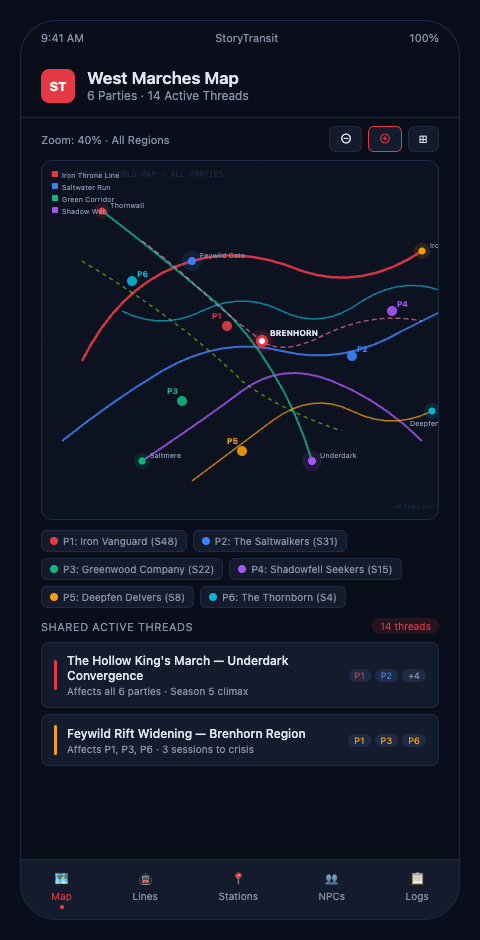
A West Marches campaign is a transit network with hundreds of stops, multiple active lines, and no fixed schedule. Different groups of passengers board different trains on different days and visit different parts of the network. The network's state — which stations are operational, which have been changed, which have new construction — must be accurate regardless of which train arrived most recently.
The world state document is the network map. Every plot thread is a line on that map. Every session where players interact with a thread advances that line's status. Every faction action that happens between sessions — whether players are present or not — updates the relevant station records.
The critical operational difference between West Marches and standard campaign management is that threads advance on faction time, not party time. The cult in the eastern marshes doesn't wait for a party to arrive. Their timeline runs whether any player group visits this month or not. The world state document must reflect those faction clock advances after every real-world week of play, regardless of which threads were actually touched by sessions.
Multiple parties in a shared homebrew world face a bounded version of this challenge — typically two to four groups sharing a world. West Marches scales this to potentially unlimited group permutations, which means the documentation discipline must be more rigorous, not less. The longevity of successful West Marches campaigns is attributable to documentation infrastructure, not just storytelling instinct — a DM who cannot maintain world state coherence across rotating groups will see the sandbox collapse into contradictions within 20 sessions.
Simultaneous themed subplots in LARP events represent the live-action equivalent of West Marches management — multiple player groups experiencing different aspects of a shared world simultaneously, with organizers maintaining world state coherence across all of them at once.
StoryTransit's West Marches mode treats each rotating player group as a separate transit line operating on the same network, automatically updating world state records after each session and surfacing threads that haven't been touched in too long.
Building Your West Marches Documentation System
The West Marches documentation system has five interdependent layers.
Layer 1: The Master Thread Registry. Every active plot thread gets a unique ID, a brief description, a region tag, a faction tag, a current status, and a last-touched date. At any point, you should be able to answer: how many active threads are there, which region has the most, which faction is most active, and which threads haven't been touched in three or more real-world weeks.
Layer 2: The World State Log. A chronological record of all in-world events, tagged by which player group caused them (or "faction-driven" if no group was present). Before any session in any region, consult the world state log for that region. Every significant development since the last session there is your current conditions briefing.
Layer 3: The Faction Clock Board. Each major faction has a clock with four to six segments. Advance each clock by one segment every real-world week regardless of session activity. When a clock fills, the faction achieves a goal that changes the world state. Player groups either prevented it, witnessed it, or discover its aftermath. The faction clock board is what makes your world feel like it runs independently of player attendance.
Layer 4: The Session Debrief Protocol. After every West Marches session, update three records immediately: the master thread registry (status changes), the world state log (what happened), and any relevant NPC continuity sheets (what NPCs said, promised, or discovered). Letting debrief lag longer than 24 hours means the details fade and your world state accuracy degrades.
Layer 5: The Thread Activation Queue. Any thread that reaches five weeks without player contact gets flagged for forced activation. Force activation means a faction clock advance, an NPC action, or an environmental change that makes the thread visible to the next group to pass through the region. Threads that sit dormant indefinitely in a West Marches game eventually feel like set dressing rather than living plot — the activation queue prevents that.
The Alexandrian's node-based prep philosophy recommends node-based prep over linear plots to keep open-world campaigns responsive without losing narrative coherence — the documentation layers above are the infrastructure that node-based prep requires to scale to West Marches complexity.
Game Developer's sandbox gameplay theory describes sandbox design as relying on emergent gameplay from interlocking systems, with GMs tracking events by metonymic time. The faction clock board operationalizes that principle — each faction is an interlocking system, and the clock is the metonymic time tracker.
Westmarches.games' dedicated campaign tools provide purpose-built infrastructure for managing rotating player pools and parallel active plot threads — a specialized implementation of the five-layer system above.
Advanced Tactics for Scaling West Marches Plot Management
Thread retirement discipline. Not all 30 active threads deserve to stay active. Every 20 sessions of total play (across all groups), audit your thread registry. Retire any thread with no player contact in eight or more weeks that has no faction clock forcing it forward. Retired threads don't disappear — they become dormant stops that can reactivate if players later seek them out. But they stop consuming your weekly faction clock attention.
Player-generated thread documentation. West Marches players often create threads through their own actions that you didn't plan — they started a war, founded a guild, left a monster trapped in a dungeon room. Every player-generated thread goes into your registry with the same documentation discipline as DM-planned threads. The world doesn't distinguish between authored and emergent threads, and neither should your registry.
Cross-group information asymmetry. Different player groups have different information states about the same world. Group A knows the eastern cult has connections to Brenhorn Village. Group B has never been to Brenhorn Village. Group C thinks the cult was eliminated two months ago. Tracking these asymmetries in your world state log — tagging each piece of information as "known by [group ID]" — prevents the information from bleeding between groups via DM behavior.
The public thread board. Many West Marches campaigns benefit from a player-facing "rumors and threads" board — a curated list of known hooks and developing situations that players can consult when planning expeditions. This distributes your thread activation work partly to the players themselves. When players chase hooks, they're doing your activation queue management for you.
The dungeon master scaling challenge in West Marches games is fundamentally a documentation capacity problem. Your creativity scales naturally with the format — emergent sandbox play feeds creative improvisation well. Your documentation capacity does not scale without deliberate system design. Build the five layers, run the faction clocks, maintain the debrief protocol, and your 30-thread West Marches game will feel like a living world instead of an overwhelming to-do list.
A World Big Enough for Everyone, Organized Enough to Run
West Marches campaigns are the most ambitious form of homebrew open-world design — and also the most rewarding when they work. Dozens of players, rotating groups, emergent stories building off each other across months of play. What makes them work isn't the sandbox design philosophy; it's the documentation infrastructure underneath it. Build the layers, trust the faction clocks, and let your world run itself while you focus on making each session great.
StoryTransit's open-world tracking tools were built for homebrew D&D dungeon masters running the full complexity of West Marches campaigns with dozens of simultaneous active threads. Join the waitlist and give your sandbox the operations center it needs to keep running, session after session, regardless of which players show up.