Running Themed LARPs With Dozens of Simultaneous Subplots
What Goes Wrong With Simultaneous Subplots
Festival LARPs can feature hundreds or thousands of players in competing factions with a central storyline and dozens of simultaneous subplots running across the venue. Live action role-playing game – Wikipedia The multi-theme LARP event format creates something that single-thread events do not: subplot convergence pressure.
Subplot convergence happens when multiple independent story threads require the same NPC, the same location, or the same runner attention at the same time. A poorly segmented themed LARP collapses when subplots converge on the same NPCs, causing player queue frustration as multiple groups wait for the same costumed volunteer to finish one scene before the next can begin. Themed LARP Failure Modes — Brandes Stoddard This is not a narrative problem — it is an infrastructure design problem.
The second failure mode is runner overload at subplot intersections. When two subplots converge unexpectedly — Plot G players arrive at the same location as Plot R players, and both are mid-scene — the runner who was monitoring one subplot suddenly needs to manage both simultaneously, often without briefing on the second. The runner cannot make good calls about either subplot because they do not have enough information to navigate the intersection.
Parallel storylines require tracking systems, modular elements, and flexible plot points for handling unexpected player actions. Parallel storylines – Storytelling for Film and Television Most LARP documentation systems handle the tracking and flexibility requirements reasonably well. The modular element design — building subplot components that can operate independently or connect to other subplots based on player action — is where most themed LARP design falls short.
Consider a themed LARP with eight faction-specific subplots running across a sixty-acre venue. At the design stage, each subplot has its own costumed volunteers, its own plot stations, and its own narrative arc. By Saturday afternoon, however, players have made choices that pulled three of those subplots toward the same physical space at the same time. The NPC who was scripted for Subplot C is now being sought by players from Subplot D and Subplot G simultaneously. Your runner handling Subplot C is fielding calls from runners on D and G who need to know what the NPC is going to say to players from other plot threads.
This is subplot convergence pressure. It is not a story problem — it is a scheduling and segmentation problem. The story is working exactly as designed: factions are interacting. The infrastructure failed to account for the physical and human resource constraints that emerge when themed LARP plot design produces genuine simultaneous subplot activity.
Transit Architecture for Parallel Subplot Management
StoryTransit treats each subplot as a transit line: a named route with its own stations, its own passenger set (the players engaged with that thread), and its own scheduled stops. In a themed LARP with dozens of simultaneous subplots, the transit map shows you not just where each line is going, but where lines share track — the intersection points that require coordination.
The architectural principles for managing this at scale:
Segment subplots by NPC pool first, then by theme. The most common subplot management error is designing by theme — grouping subplots that fit the same narrative register — without checking whether they draw on the same NPC pool. Two subplots that share three costumed volunteers are not truly parallel: they are sequential subplots wearing parallel clothing. Before finalizing your subplot structure, map each subplot's NPC requirements against your available volunteer roster. Separate subplots that would compete for the same volunteers into different time windows. LARP Design: Factions and Goals – Brandes Stoddard
Design faction goals as subplot engines. Faction-level goals create recurring activity across a themed LARP without requiring constant runner injection. The Narrative Experience When all players follow act-structure themes, story emerges almost on its own from parallel interactions. Design each faction's goals to generate two or three active subplots as natural byproducts of faction activity — information gathering, alliance negotiation, resource competition. These organic subplots run with minimal runner support and free up your runner capacity for the high-complexity simultaneous subplots that do need active management.
Build subplot intersection protocols into the station records. For every station that exists on two or more subplot lines simultaneously, write an explicit intersection protocol: what each arriving faction sees, which subplot takes priority if both arrive at the same time, and which runner has authority over the intersection. When Plot G and Plot R both arrive at the same location, the runner does not need to invent a protocol mid-scene. They open StoryTransit, find the intersection station, and execute the pre-written protocol.
Use scene-setting techniques to guide simultaneous plot threads without micromanaging. Structured scene-setting methods let organizers shape what players encounter in a space — environmental details, NPC positioning, written materials — without requiring a runner to be physically present for every subplot activation. Sceneing and Storying This distributes subplot management across the venue rather than concentrating it at runner bottlenecks.
LarpManager supports themed world-builds with branching subplots and faction tracking for dozens of concurrent threads. LarpManager — Themed Event Tools For subplot management specifically, the branching subplot structure — where each subplot has a primary path and at least one alternate branch — is the minimum design standard for a themed LARP that needs to absorb unexpected player actions.
Strong runner coordination is the prerequisite for parallel subplot running at scale. Without a coordination system that shows every runner what every other runner knows, subplot intersections become coordination failures. The infrastructure for multi-plot logistics at large events — venue segmentation, NPC deployment, runner handoffs — is what makes the story architecture executable rather than theoretical.
Advanced Tactics for Multi-Theme LARP Events
Once the architectural foundation is set, the following practices improve parallel subplot management across the full event weekend.
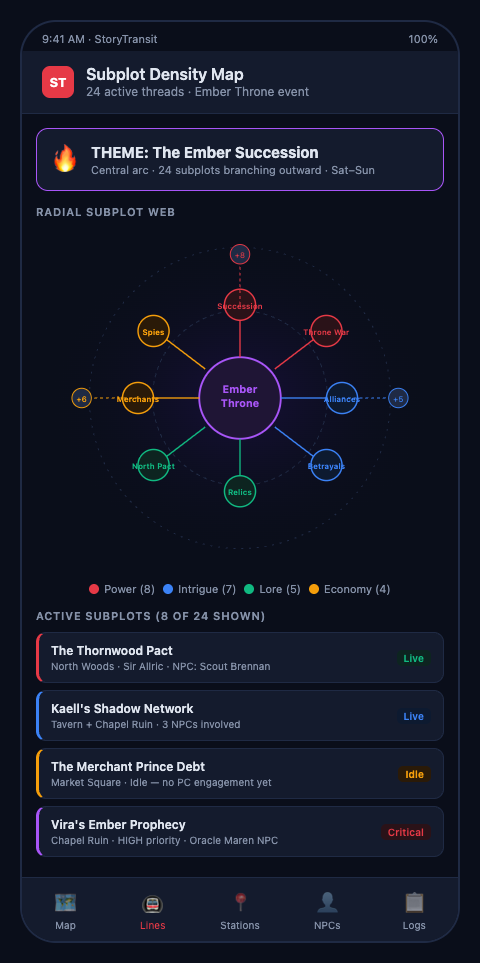
Run a subplot density map alongside the station map. A subplot density map shows, for each location on the venue and each time window in the event, how many active subplots are scheduled to be present. High-density intersections are your risk points — those are where subplot convergence pressure is highest. Use the density map to stagger subplot timing rather than discovering convergence during runtime.
Assign subplot stewards for high-complexity threads. For the most complex or story-critical subplots, designate a specific runner as the subplot steward — their primary job is monitoring that one subplot across the full event, watching for convergence pressure, and escalating to the head runner if the subplot needs rerouting. This is the equivalent of assigning a dedicated line operator to a high-volume transit route. Other runners can observe and report on that subplot, but the steward owns it.
Cap simultaneous subplot activations per time window. Identify the maximum number of subplots that can be actively running simultaneously given your NPC count and runner team. Hard-cap activations at that number. When a new subplot activates, another must be in a passive state — players are advancing it through character-to-character interaction without NPC facilitation. This prevents the scenario where every subplot is trying to fire at peak time and the NPC pool cannot cover the demand.
The challenge of running west marches threads in an open-world tabletop campaign is the structural equivalent of simultaneous subplot management — dozens of active threads that players can enter from any direction, with no central authority controlling the sequence. The techniques developed for that format — modular beats, dormant stops, player-driven activation — transfer directly to themed LARP subplot design.
Design for Density, Not Just Variety
A themed LARP with dozens of simultaneous subplots is not made or broken by the quality of any individual thread. It is made or broken by whether the subplot infrastructure can handle the density of concurrent activity across the full venue and the full runtime.
The most important pre-event question for themed LARP plot design is not "how many subplots can we write?" It is "how many simultaneous subplots can our NPC pool, runner team, and venue actually support at any given time?" Most themed LARP failures can be traced to an honest but unexamined mismatch between the number of subplots designed and the number that could realistically run in parallel. The subplot map that looks comprehensive in a spreadsheet becomes unmanageable at runtime when the resource constraints become visible.
Use StoryTransit's transit map to run a capacity check before the event. For each time window, count how many subplots are scheduled to be active simultaneously. Measure that count against available costumed volunteers and runner attention. If the count exceeds capacity, stagger or delay subplot activations rather than running the event under-resourced. A themed LARP with sixteen well-executed simultaneous subplots produces a better weekend than one with twenty-four subplots where a third of them fire incorrectly.
StoryTransit gives LARP event organizers a themed subplot management dashboard that tracks subplot density, NPC pool conflicts, and intersection protocols in one live view. If you are designing a themed LARP with parallel subplot running across a weekend event, join the waitlist for LARP organizers and get early access to the tools that make simultaneous subplot management operationally sound.