Coordinating Multiple Plot Lines With Multiple Game Runners
Why Coordination Fails When More Runners Join
At a single-runner event, the plot bible lives in one person's head. They know which story beats have fired, which NPCs are in play, and which of the twenty-three parallel plotlines are behind schedule. Add a second runner and that knowledge now needs to live in two heads simultaneously — and they are physically separated across a sixty-acre venue, communicating by radio.
By the time you have a team of four or five runners at a large multi-runner LARP event, coordination failure is the dominant risk. Research on project teams confirms that 80% of parallel-track projects experience resource conflicts as the primary failure mode, and teams on fragmented platforms spend nearly a third of their workday searching for decisions made elsewhere. Pitfalls in Effective Knowledge Management In a LARP context, that search happens during runtime — while players are waiting for a story beat to fire.
The specific failure pattern is predictable. Runner A activates a story beat on Plot C at 2 p.m. Runner B, unaware of that activation, sends an NPC to trigger the same beat at 3 p.m. A plot thread intended to run once fires twice, creating a confusing echo. Or the reverse: both runners assume the other is handling a critical beat, and it never fires at all. Large LARPs require multiple control tools and the GM-to-player ratio drives coordination complexity — but the tools only work when they share a common state. Live Action Role-Playing Games (ResearchGate)
There is also a less obvious failure mode: the knowledge gap that opens when one runner improvises a plot decision during a busy period and does not communicate it to the rest of the team. Every unrecorded decision is a time bomb. The next runner to interact with those players or that plot thread is operating from a false premise — the state they believe is current is not the state that actually exists after the improvised decision. At a sixty-acre venue with radio as your primary coordination tool, these gaps accumulate faster than any single runner can track.
A Transit Architecture for Multi-Runner LARP Events
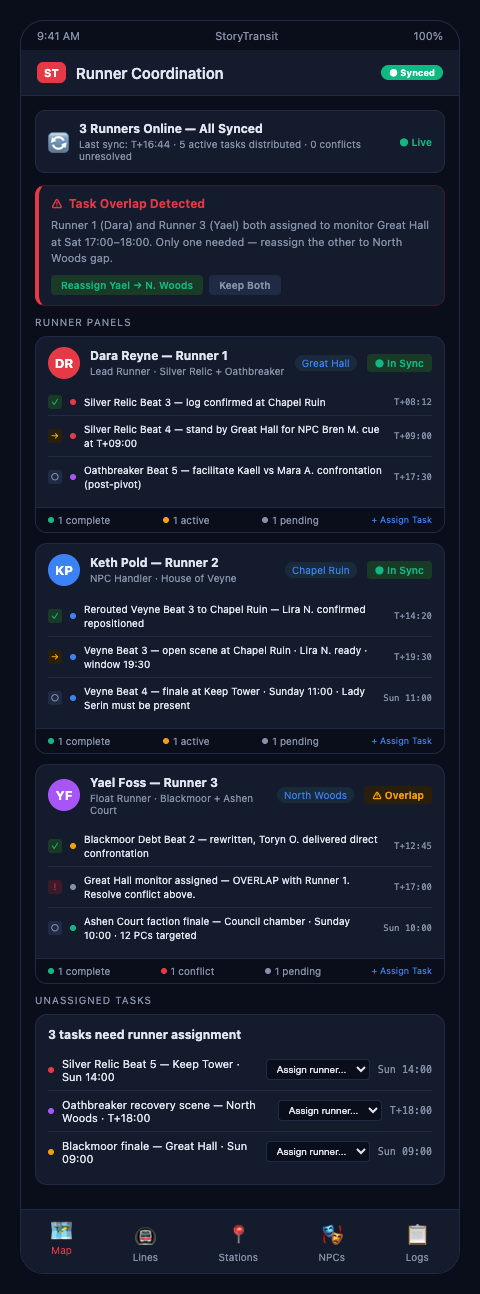
StoryTransit structures the coordination problem the way a transit authority structures multi-line operations. Each runner is a line operator — responsible for the status of specific routes and the stations on those routes. The shared plot dashboard is the control room: every line operator sees the full map, but each is accountable for their own lines.
This division of responsibility is the foundation of runner team management on large events.
Assign runners to plot lines, not to geographic areas. Geographic assignment — "you cover the eastern camp, I cover the northern keep" — feels intuitive but creates coordination problems when plot lines cross areas. A plot line that begins in the east and resolves in the north spans two territories and two runners. Assign runners to specific plot lines instead. Each runner owns the story beats on their lines regardless of where those beats occur physically on the venue.
Create a shared status protocol for cross-line interactions. When a player action affects a beat on a line another runner owns, the runner who observes the action calls it into the plot dashboard immediately. They do not make the call on how to respond — they log the observation and flag it for the line owner. This prevents the two-runner double-activation problem and ensures the line owner is always the decision authority for their beats.
Run structured synchronization calls between major beat blocks. Before each story beat block activates, all runners join a five-minute status sync. Each runner reports: which of their stations fired in the last block, which are pending for the next, and which require cross-runner coordination. This is the transit equivalent of a service status briefing — brief, structured, and focused on cross-line dependencies.
Build a runner-to-line assignment table in StoryTransit. Every station record shows which runner owns it. When a runner radios in a pivot update, every other runner can see immediately which stations in the system that pivot affects and who the line owner is for each. Runner team management at scale becomes operational rather than relational — you are coordinating through a shared map, not through individual memory and trust. Modeling the Story Facilitation of Game Masters in Multi-Player Role-Playing Games
The ICS model for multi-agency event coordination offers a proven framework here: unified command with separate operational channels per team, and a shared incident log that all teams can read. Multi-Agency Command: ICS for Festivals Your plot lines are the operational channels; StoryTransit is the incident log.
For organizers moving toward larger productions, transitioning from chamber to convention scale introduces runner team coordination as a new design requirement rather than just a logistical adjustment. The coordination architecture needs to be built before the runner count grows, not after.
Advanced Practices for Plot Line Coordination
Once the assignment and synchronization protocols are established, multi-runner teams can refine their coordination further.
Establish runner handoff documentation for shifts. On multi-day events, runner shifts change. The outgoing runner leaves a structured handoff note for each of their plot lines: current station status, any pending decisions, any NPCs who received updated briefings during the shift. The incoming runner reads the handoff before taking over the lines. This prevents the scenario where a runner inherits a line mid-event without knowing what happened during the previous eight hours.
Designate a head runner for cross-line decisions. When a player-driven pivot affects multiple lines owned by different runners, someone needs to make the call. Designate one runner as the head runner with authority to make cross-line decisions during runtime. Other runners defer to the head runner on cross-line conflicts rather than making independent judgment calls that may contradict each other. This is the command structure that prevents coordination breakdowns at the moment of maximum pressure.
Track runner workload alongside plot status. Coordination failure often has a human cause: one runner is overloaded while another is underutilized. In StoryTransit, maintain a simple workload indicator per runner — number of active stations under their line, number of NPC dispatches pending. When one runner's workload spikes, the head runner can temporarily assign support or redistribute less critical beats. Resource-constrained multi-project scheduling problem: A survey
Establish a cross-line conflict escalation path. When a player action simultaneously affects plots owned by two different runners, someone needs to decide how to respond — and that decision needs to happen in seconds, not minutes. Define the escalation path before the event: if cross-line conflict requires a call, it escalates to the head runner. The head runner has thirty seconds to make the call. Both affected runners execute the decision without further discussion until the next sync window. Speed matters more than perfect deliberation in these moments. Empire runs 400+ crew across distinct teams; their separated coordination structure is what makes parallel runner operations viable at scale. Profound Decisions – Event Crew
The broader challenge of multi-plot logistics at large events encompasses runner coordination, NPC scheduling, and venue management. Strong runner team management is the prerequisite — without it, the other logistics problems become exponentially harder to solve. Organizers who have managed parallel forum storylines in play-by-post environments will recognize the structural challenge: many simultaneous threads, distributed contributors, and no central authority who can see every thread at once.
Coordinate the Runners Before Coordinating the Plots
Multi-runner LARP events fail at the coordination layer long before they fail at the story layer. The plot lines are usually well-written. The runner team is usually experienced. The failure is that neither the lines nor the runners have a shared map of what is currently true.
The solution is not more radio communication. Radio is a broadcast medium — it transmits information but does not create shared state. A runner can broadcast a plot update to the full team, and thirty minutes later another runner will make a decision based on old information because they were handling a different situation when the broadcast went out and did not register it. Shared state requires a persistent record that all runners can query at any time, not just a stream of messages they may or may not have caught.
StoryTransit creates that shared state. Every runner looks at the same plot dashboard. Every station update is visible to the full team. Every cross-line dependency is mapped. When a runner needs to make a live decision about a beat on someone else's line, they can see the current status of that line without calling the other runner — they look at the map, assess the current state, and make the call. That is what coordination infrastructure looks like in practice.
StoryTransit gives the full runner team a live plot dashboard with clear line ownership, timestamped status updates, and cross-line visibility. If you are organizing weekend-long live-action events with a runner team, join the waitlist for LARP organizers — StoryTransit is built for the coordination problems that emerge when your event gets too large for one person to hold in their head.