Scaling From Chamber LARP to Convention-Scale Events
Why Chamber Logic Fails at Convention Scale
A chamber LARP with twelve to twenty players runs on intimacy. The organizer knows every character, tracks every story beat mentally, and adjusts in real time based on direct observation. That intimacy is a feature—but it's also a dependency. Strip it away as attendance climbs and the entire organizational model falls apart.
The Czech chamber LARP community's history illustrates the pattern clearly: what began as small murder-mystery formats gradually accumulated participants until the original systems simply couldn't hold. The parallel narratives that were manageable for a single organizer tracking fifteen characters became unworkable once the player count reached forty. The organic feel that defined the early events gave way to organizational chaos—not because the organizers lost their craft, but because the systems they'd built for twenty players were trying to run events for eighty.
The Nordic Larp encyclopedia documents the full spectrum from small private hours-long events to thousands-player festivals—and the design logic at each end of that spectrum is almost entirely different. Small events optimize for depth and individual experience. Large events optimize for distribution and structural coverage. Most organizers scale their player count without scaling their organizational model, and that mismatch is where growing LARP events begin to fracture.
Scaling live-action events isn't just a matter of renting a bigger venue or recruiting more costumed volunteers. It requires a deliberate rebuild of how plot is tracked, how story beats are assigned, how NPCs are coordinated, and how the organizer maintains visibility across the runtime. Each scaling threshold introduces new failure modes that didn't exist at the previous size.
The Three Inflection Points
The twenty-five player threshold. Below this number, a single organizer can run the entire plot from memory. Above it, memory becomes the bottleneck. The fix is documentation: a plot bible that exists outside the organizer's head, with story beats listed explicitly and NPC assignments recorded. This is where the transit map earns its value as an artifact rather than a mental model. The organizer stops being the system and starts building one.
At this threshold, most organizers underestimate how much of their event's success depended on real-time observation. At fifteen players, you can see every character from anywhere in the venue. At thirty players, you can't. The plot beats that fired reliably at small scale—because you were watching and could nudge them forward—start misfiring because no one is watching the right corner of the venue at the right moment.
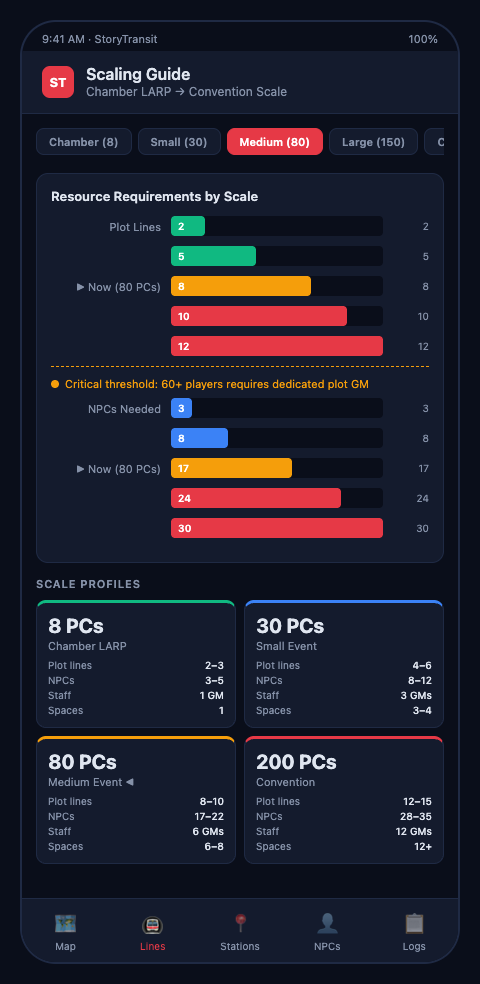
The sixty player threshold. At this scale, you can no longer trust that costumed volunteers will self-organize to cover all active plot stations. You need an explicit zone system, a dispatcher function, and scheduled NPC rotations. Plot runners become line conductors responsible for specific parallel plotlines rather than general helpers. The plot dashboard transitions from optional to mandatory—not just as a planning document but as a live tracking tool during runtime.
This is also where the radio dispatcher function becomes essential. A sixty-player event on a forty-acre venue cannot be coordinated by shouting across the site or by running physical messages between zones. The GOD tent structure—a central coordination hub with radio coverage across all zones—is the minimum infrastructure for this size.
The hundred-fifty player threshold. This is where growing LARP events most often break. The venue is large, the NPC roster is large, and the plot bible has grown to accommodate the expanded player base—but the coordination layer hasn't kept pace. The radio dispatcher is overwhelmed, story beats are missed in peripheral zones, and the post-event debrief reveals that entire parallel plotlines ran dark for half the weekend. The Leaving Mundania account of jeepform program growth captures this transition: programming expanded from three games to sixty hours for forty-plus participants, but the organizational infrastructure had to be rebuilt at each stage rather than simply extended.
The Transit Framework for Growing Events
The most useful conceptual shift when scaling from chamber to convention is to stop thinking about your event as a single story and start thinking about it as a transit system. Each parallel plotline is a line with scheduled stops. Each story beat is a station with an expected runtime and assigned personnel. The plot bible is the route map, and the plot dashboard is the live departure board that shows whether trains are running on time.
This framework scales because it externalizes knowledge. In a chamber LARP, the organizer holds the entire map in their head. At convention scale, that's not viable—you need the map to exist as a physical or digital artifact that any plot runner can read and act on without direct supervision. The transit model makes delegation possible at scale.
StoryTransit is designed around exactly this transition. As organizers grow from chamber to convention scale, the platform maintains the same underlying structure—plot threads as lines, story beats as stations, character arcs as routes—but makes that structure visible to an entire team rather than a single organizer. The radio dispatcher coordinating across a sixty-acre venue has the same dashboard view as the plot runner working a single zone. A new costumed volunteer joining a zone mid-event can read the transit map for their zone in sixty seconds and understand what beats have run and what's still pending.
EPIC EMPIRES, which scaled from concept to an eleven-camp four-day convention, adopted a Round Table governance model to distribute organizational ownership across camp coordinators. That structure maps directly to the transit metaphor: multiple conductors responsible for different lines, with a shared dashboard ensuring they don't cross schedules or strand passengers at platform.
Building the Infrastructure Before You Need It
The most consistent mistake organizers make when growing events is adding infrastructure reactively—after the failure rather than before it. The sixty-player dispatch function is worth building at forty players, before the event breaks. The zone warden system is worth designing at eighty players, before the first peripheral plot station goes dark without anyone noticing.
Franchise larp research identifies eight world-building infrastructures that transfer across event runs: space, character, mythology, staff structure, prop ecosystem, timeline, social contract, and participant culture. Scaling successfully means maintaining continuity across all eight layers as attendance grows—not just expanding headcount while leaving the other seven layers unchanged.
Proactive infrastructure building looks like this: at your thirty-player event, you document every plot assignment even though you could run it from memory. At your fifty-player event, you establish zone wardens even though you could probably manage without them. At your eighty-player event, you run a full dispatcher rehearsal before the event opens, even though you didn't need it last time. Each practice run prepares the system for the next threshold before the event breaks under load.
Advanced Tactics for Convention-Scale Transitions
Formalize the runner coordination layer before you need it. Most organizers hire plot runners reactively. Establish the runner coordination structure at the sixty-player mark, not the hundred-fifty mark. For guidance on managing multiple runners simultaneously across parallel plotlines, the post on runner coordination covers the specific protocols in detail.
Audit your plot bible for scalability. Every story beat in your plot bible should have an explicit NPC assignment and a physical location. Beats that depend on "player discovery" without a triggering NPC are high-dropout risks at convention scale. Players have no mechanism for finding them in a large venue without guidance.
Build convergence beats into the schedule. At every scale above sixty players, design one story beat per session block that draws multiple plotlines to a single location. These convergence beats self-generate coverage—players encounter cross-plot content without requiring runners to manually route them to adjacent lines.
Maintain a transition log. Every time your event crosses a new attendance threshold, document what broke and what you rebuilt. This log becomes your most valuable resource at the next threshold—a record of which systems held and which failed under previous scaling pressure.
What to Preserve as You Grow
Scaling successfully doesn't mean replacing everything that worked at smaller scale—it means preserving what's worth keeping while adding the coordination infrastructure the larger event requires. The intimacy of a well-run chamber LARP, the feeling that every character matters and every story thread receives attention, is the quality that players come back for. Convention-scale events that lose this in favor of logistical efficiency tend to see retention problems that don't appear in smaller formats.
The transit system approach preserves the individual character arc layer at scale by making it visible in the plot dashboard rather than keeping it in the organizer's head. At twenty players, you remember every character's story hook. At two hundred players, that knowledge lives in the platform—but the commitment to ensuring those hooks fire is the same. The story dashboard becomes the mechanism for that commitment: the data structure that lets an organizer track whether the merchant captain's backstory arc has been activated for the player who spent six months writing it.
Knutepunkt, the annual Nordic LARP conference and book series that has canonized scaling and design practices for the global LARP community since 1997, reflects years of accumulated community knowledge about exactly this balance. The most respected large-scale events in the field—Witcher School, Empire, College of Wizardry—are celebrated not just for their size but for the quality of individual experience they sustain at that size. That quality doesn't emerge from logistics alone. It emerges from logistics designed in service of story.
The post on multi-plot logistics covers staffing models and spatial coordination at full convention scale in detail. The North America LARP event management market is projected to reach $830M by 2033, largely driven by organizers investing in digital tools to manage exactly these scaling challenges. To see how the scaling challenge maps onto other formats, the discussion of how to scale four to twenty players in forum game contexts reveals surprisingly parallel inflection points in how coordination systems break and must be rebuilt.
StoryTransit is built to support LARP event organizers at every point in the scaling arc—whether you're hitting the twenty-five player documentation threshold for the first time or managing your seventh convention-scale event. The waitlist is open. Join the Waitlist for LARP Organizers and get early access when the platform launches.