Scaling a Forum Game From 4 Players to 20 Active Posters
What Goes Wrong When a PbP Group Grows
A forum game built for four players has an implicit architecture: the GM tracks a small cast, responds to every IC post within reasonable time, and holds the full story in working memory. Each player has a named arc, each arc intersects in obvious ways, and plot drift is a minor annoyance rather than a structural threat.
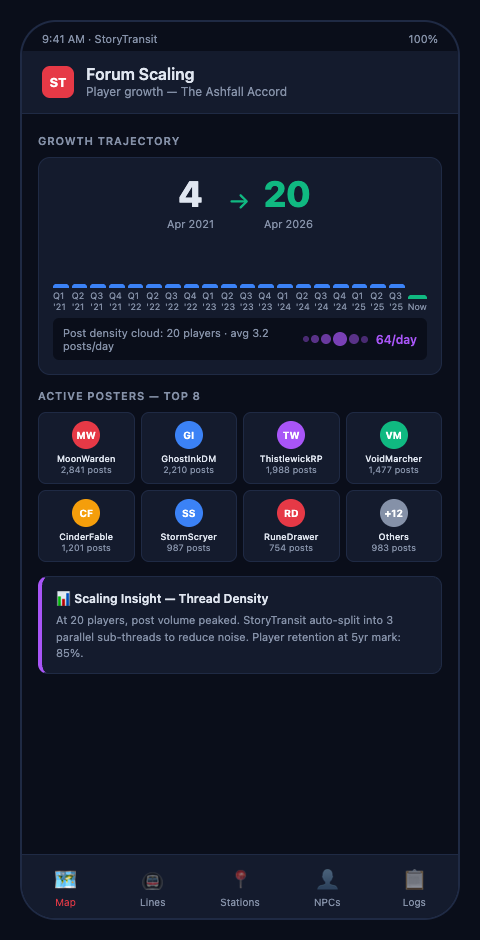
The pbp player dropouts challenge scales with group size: at 4 players, one dropout is immediately visible; at 20, a subplot can quietly orphan for weeks before anyone notices. Expand that game to 20 active posters and the architecture cracks. Research on scaling open online communities documents how community intimacy and content quality both degrade as membership grows unless structural changes intervene. For a forum GM, that degradation looks specific: some players' character arcs stop receiving GM attention for weeks at a time, IC threads bifurcate into sub-groups that never interact, and the OOC thread becomes a wall of noise that new players can't parse.
Practitioner analysis of large online community management identifies three failure points that surface reliably during growth: maintaining connection quality, handling volume at moderation, and sustaining response quality per participant. All three apply directly to play-by-post expansion. The GM who ran 4 players with charm and improvisation suddenly needs logistics.
The growth trajectory matters too. A game that adds 2 players per month over eight months faces different challenges than one that opens recruitment and jumps from 4 to 18 players in three weeks. Slow growth allows structural adaptation; rapid scaling requires pre-built infrastructure or the new players find themselves in a campaign that doesn't accommodate them yet. Myth-Weavers—one of the largest dedicated PbP platforms with 548,000+ members—demonstrates what large-scale PbP infrastructure requires at the platform level, but individual campaign GMs face these challenges at the micro-scale without platform engineering support.
The Transit System Approach to Scaling
The core reframe for scaling a forum game is moving from a character-centric to a line-centric model. At 4 players, you track characters. At 20, you track routes. The transit system metaphor makes this concrete: each major storyline is a transit line, and players' characters are passengers boarding at different stations along those lines. Some lines are express routes (high-pacing main arcs), some are local routes (slower character-development subplots), and some connect the two.
When a new player joins a large pbp group, they're not joining "the campaign"—they're boarding a specific line at a specific station. The GM's job shifts from holding the full story to maintaining accurate route maps and scheduling connections between lines.
StoryTransit supports this shift by letting GMs build visual transit maps that all 20 players can reference. Rather than a GM monologue in the OOC thread explaining where things stand, the map itself shows which lines are running, which are dormant, and where the next stations are. Players orient themselves through the map rather than through memory. At 20 active posters, this player-facing map becomes the campaign's primary orientation tool—the single document that tells a player where their character fits in the current story without requiring them to read every active OOC thread.
Structural practices for large group play-by-post:
Subforum architecture by line, not by player. At 4 players, you might run a single IC subforum with everything in one thread. At 20, subforums organized by storyline line (not character) give players a clear home for their relevant threads. The Merchant Quarter subforum is Line 4. The military campaign subforum is Line 7. Characters move between subforums as their arcs intersect different lines. This structure prevents the "everything in one thread" archive collapse that happens when a large group tries to run a campaign without narrative organization.
Designated line conductors. For very large groups (15+), consider assigning trusted veteran players as "line conductors" for specific storylines—players with posting authority to make minor plot decisions within their line without waiting for GM input on every turn. This distributes the narrative load without surrendering GM authority over line intersections and major plot beats. Line conductors also serve as the GM's eyes within their subforum—reporting dormancy risks and player engagement levels the GM might otherwise miss.
IC post quotas per active line. Set a minimum posting threshold for each active storyline line—for example, each active IC thread must receive at least one substantive post per week. Lines that fall below threshold get flagged for GM attention before they go dormant. Community management research confirms that structured engagement frameworks prevent the silent collapse of participation that plagues large online communities. In a 20-player game, the GM can't monitor all eight active subforums manually every day—the quota system creates an automated early warning.
OOC coordination infrastructure. The OOC thread that works for 4 players is chaos at 20. Large groups need differentiated OOC infrastructure: a general OOC thread for social chat and off-topic discussion, a separate plot OOC thread for GM announcements and narrative decisions, and a rules/mechanics thread for character sheet questions. Combining all three creates an impenetrable wall of text that burns through new player patience within a week. Effects of collective socialization on newcomers research shows that group-based onboarding structures cut newcomer dropout—differentiated OOC infrastructure is the structural analog of that socialization for large groups.
Handling the Human Side of Scale
The structural problems of scaling are easier to solve than the social ones. Research on newcomer behavior in online communities shows that collective socialization—welcoming and integrating new players as a group activity—reduces dropout significantly when communities expand rapidly. In PbP terms, this means existing players need to actively engage with new poster arcs, not just the GM.
Managing pbp player dropouts becomes more complex at scale. The transit map surfaces orphaned subplots faster: an unmanned station on a running line is visible at a glance even when the GM has twenty active arcs to track.
Parallel forum storylines become the primary structure of large-group PbP. The GM who mastered managing two parallel threads at 4 players now manages eight or ten, some of which must eventually converge. Mapping those convergence points ahead of time prevents the plot collapse that happens when two lines meet and the GM hasn't prepared for the collision.
Running a podcast at local to national scale shares structural parallels: the challenge in both cases is maintaining story coherence while expanding the contributor base beyond what any single organizer can hold in memory.
Advanced Tactics for Large PbP Groups
Bumping protocol standardization. With 20 active posters, uncoordinated bumps create noise. Establish a clear OOC protocol: bumps are only permitted if the thread hasn't received a relevant IC response in 72 hours, and the bump must include a brief status note (not just "bump"). This reduces empty bumps while maintaining thread visibility.
Research on forum newcomer contributions shows that positive treatment of new arrivals increases their subsequent posting by 10%—a meaningful figure when you're trying to sustain 20 active voices. Build a formal welcome thread for each new player that includes their character's entry station on the transit map, three relevant recent IC posts to read, and a direct invitation to reply in a specific thread within their first week.
Seasonal arc structure. Large groups benefit from defined "seasons" that give the campaign a natural pacing structure. Each season runs roughly 3–4 real-world months, resolves 3–5 of the active storyline lines, and opens 2–3 new ones. Between seasons, a brief OOC summary post orients everyone before the next season opens.
Async posting cadence differentiation. At 20 players, not all players post at the same cadence, and forcing uniform expectations causes dropout. Consider formalizing two posting tracks: a high-cadence track for players who can commit to posting 3+ times per week, and a low-cadence track for players who post once or twice. Assign characters on the high-cadence track to the main plot lines and characters on the low-cadence track to slower-moving subplots. Both tracks coexist in the same campaign; neither group is second-class. The transit map makes this visible—high-frequency lines run express routes, lower-frequency lines run local ones.
Subforum health monitoring. With 20 active posters distributed across 8–10 storyline lines, the GM needs a regular subforum health check: how many IC posts went into each subforum in the past two weeks? Any subforum with zero IC posts is a line at risk of going dormant. A quick review once per week—scanning post counts across all active subforums—takes ten minutes and prevents the silent death of underattended arcs.
For forum GM scaling, the difference between a large group that runs for years and one that fragments within months is almost always structural rather than social. The players who want to stay will stay—if they can find their place in the story.
StoryTransit's transit map scales with your group. Whether you're at 4 players or 20, the platform tracks every active storyline line, surfaces dormant routes, and gives each player a visual anchor for where their character arc is heading. Play-by-post forum GMs who join the waitlist now will help shape the multi-player features being built for exactly this use case.