How Forum GMs Manage Parallel Storylines for Large Groups
The Twelve-Player Problem
Run a forum game with twelve players split across four concurrent storylines and you'll quickly find that the hardest part isn't writing the content — it's knowing which thread needs your attention first, which storylines are converging, and which players haven't posted in three days because they don't know what their scene is doing.
Retrieving relevant content from multi-thread forums is a genuinely hard information retrieval problem — relevance degrades across archives, and the larger the forum, the harder it becomes for both GMs and players to locate the post they need. In a large group forum game running parallel storylines pbp, this isn't a theoretical challenge. It's the reason campaigns collapse: players can't find their scene, GMs can't track which threads are stalled, and the story map in everyone's head diverges from the actual archived state.
The market is growing into this problem. The TTRPG market reached $2.15B in 2025, and large-group online play drives a growing share of that. But the tools most forum GMs use — a subforum, some pinned threads, maybe a wiki — weren't designed for twelve-player multi-thread narrative management. They were designed for small groups or single storylines.
The result is that most large-group PbPs either stay small (and miss the richness that large groups produce) or sprawl into management chaos within four months.
The Multi-Line Transit Map
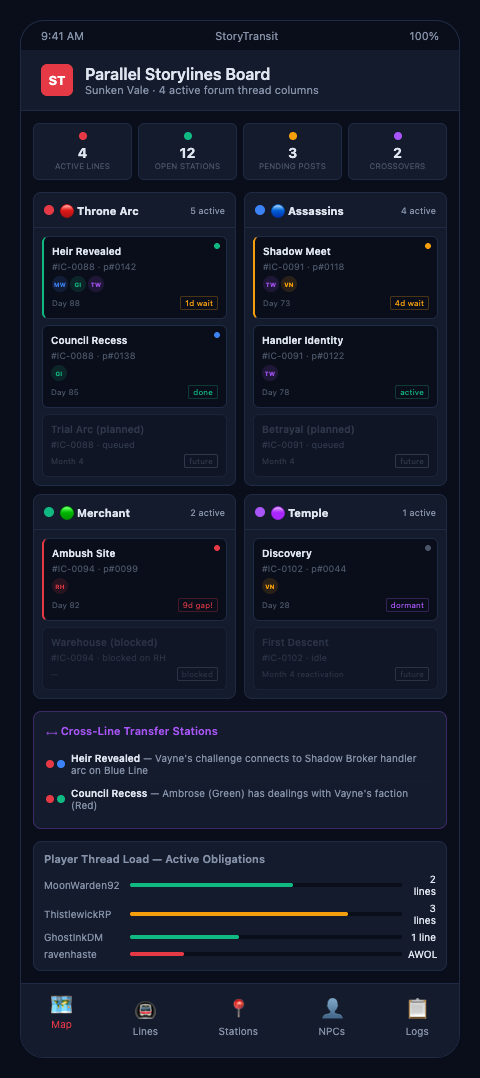
StoryTransit's transit metaphor scales directly to large-group parallel storytelling. Each major plot front becomes a named transit line. Characters are routes. Scenes are stations. Intersections — moments where two storylines collide or share a character — are transfer hubs.
This isn't cosmetic. The transit framing forces structural decisions that pay dividends at scale. It's also the architecture that makes scaling from four to twenty players manageable: without named lines and explicit convergence planning, multi-thread campaigns drift into the exact tangle the forum GM was trying to avoid.
Line definition. Before you open a new IC thread for a parallel storyline, name the line and define its terminal stations: the story beat it starts at and the narrative destination it's heading toward. A line without a defined destination drifts. In a large group forum game with multiple concurrent lines, drift in one storyline disrupts the convergence logic of every other storyline it intersects.
Causally independent but occasionally interdependent story threads are the core multi-thread design pattern in interactive narrative design. In transit terms: each line runs its own route, but transfer hubs create meaningful connection points without requiring every storyline to merge.
Hub scheduling. Identify your convergence points before you write them. A hub scene — where two or more parallel storylines intersect — requires more GM preparation than a single-line scene, because players from different threads arrive with different context. Tag these hubs in your story map weeks before they occur. Brief each player group separately via OOC before the hub scene opens. The scene reads as organic convergence; the preparation was structural.
Line status tracking. Maintain a single OOC thread — or a pinned post — that lists every active IC thread with its current line assignment, the last post date, the current station (scene), and which player characters are present. Update it when scenes close. This is your live transit board: a glanceable map of where every storyline is at any given moment.
Organizing parallel forum RP threads by scene type and access level is the dominant structural practice among experienced forum GMs. The transit map adds the layer that's typically missing: explicit tracking of where each line is heading and when lines are scheduled to converge.
Advanced Tactics for the Multi-Thread Forum GM
At twelve-plus players, play-by-post forum mechanics break down in a specific way: players in slow-moving storylines disengage while players in fast-moving storylines over-post and leave the slow group further behind. The gap widens until the slow storyline stalls completely.
The solution is pacing equalization: actively manage line velocity so no storyline falls more than one scene behind another. When a line gets ahead, introduce a scene that requires waiting for external information (an NPC contact who needs time to respond, a faction decision pending). When a line falls behind, compress: a brief bridge scene that advances the slower thread quickly rather than playing out in full.
Handling player absences across parallel lines. In a large group forum game with four active storylines, a single player dropout has a different impact than in a three-player campaign. If the absent player is involved in two of the four lines, you have two simultaneous intersection stations to manage rather than one. The route impact analysis from the dropout protocol applies line by line: for each storyline the absent player participates in, classify their involvement (suspendable, resolvable, or holding) independently. A player who's peripheral to one storyline but load-bearing in another requires different handling per line — don't apply a single decision to all their intersections.
Posting discipline for multi-thread campaigns. The forum GM managing parallel storylines pbp needs explicit rules about cross-line contamination within their own GM posts. When you write an IC post advancing the Red Line, it should not introduce information that affects the Blue Line without a planned hub scene to deliver that information. Players in Blue Line storylines shouldn't learn Red Line plot developments from a GM post in Red Line threads — they'll learn them at the planned convergence point. This discipline requires the GM to track which information has been revealed in which storyline, and to resist the temptation to have NPCs in one thread reference events from another thread before the hub scene that connects them.
Arc resolution across parallel lines. Multi-thread campaigns accumulate open arcs faster than single-thread ones. With four parallel storylines each generating subplots, the unresolved thread count grows at four times the rate. Quarterly resolution decisions are essential: at the end of each twelve-to-sixteen-week block, review which arcs across all lines have been open longest, which have the least player investment remaining, and which need deliberate closure before the next phase of the campaign. Closing three old arcs cleanly is more valuable than keeping them nominally open while players ignore them. Large group forum game management requires this kind of periodic triage — not as a failure acknowledgment, but as a structural practice that keeps the active storyline count manageable.
The multiple pbp games problem compounds here: a forum GM running one large-group campaign with four parallel storylines is functionally running four campaigns simultaneously. The context-switching cost is real, and the contamination risk — where a decision from one storyline bleeds into the logic of another — requires deliberate structural isolation.
For live-event parallels, runner coordination in LARP settings addresses the same convergence-point management challenge. The solutions differ in format but share the same underlying logic: parallel narrative lines require explicit coordination architecture, not just good intentions.
Parallel paths also reduce total story volume while preserving the feel of player agency. A twelve-player game with four parallel lines doesn't require four times the content of a three-player linear game — it requires well-architected modularity so each line contributes to a shared world without requiring every player to be present for every scene.
Map the Lines Before They Tangle
Player character routes vs. storyline lines. One distinction that helps at scale: a player character's route through the campaign isn't the same as a storyline line. A character might participate in the Merchant Quarter intrigue (Red Line), the political marriage subplot (Blue Line), and carry a personal backstory arc (Green Line) simultaneously. Their route is the path they're traveling; the lines are the shared narrative infrastructure they're traveling on. At four players, these can be treated as synonymous. At twelve or twenty, tracking them separately is essential: the GM needs to know which lines are active independent of which characters are in them, so that a player dropout in the Red Line doesn't make the Red Line invisible on the map.
The common failure mode for large-group forum games isn't ambition — it's architecture. GMs open parallel threads without defining their destinations, schedule convergence points without preparing for them, and try to track line status in their heads rather than on a visible map.
StoryTransit gives play-by-post forum GMs a structured transit map for multi-thread campaigns: named lines, tagged stations, scheduled hubs, and a live status board that shows every storyline's current position at a glance. If you're managing a large group forum game with more than one active plot front, join the waitlist for play-by-post GMs to see how the multi-line model handles your specific campaign structure.