Best Practices for Handling Player Dropouts in Mid-Campaign PbPs
When a Player Goes Silent on Page Forty-Seven
The most common PbP dropout scenario doesn't announce itself. There's no farewell post. The player misses one posting cycle, then a second. By the time you realize they've left, their character is standing mid-scene in an IC thread — involved in two active plot threads, holding an unresolved story hook, and mentioned in an OOC decision your other players are still waiting on.
Most PbP games fail to finish, and erratic posting gaps are the primary driver. The research on this is consistent: posting gap between messages is the single strongest predictor of user churn on discussion boards. For a forum game running at one-post-per-day pace, a player who hasn't posted in five days has crossed a statistically significant disengagement threshold. At ten days, you're dealing with a near-certain dropout — even if they've said nothing.
The damage to play-by-post continuity compounds with each additional day you wait. Other players slow their own posting because they're waiting for the absent character. The IC thread stalls. Players who were posting daily start posting every few days. The campaign rhythm breaks, and disengagement spreads socially.
The question for a forum GM isn't whether to act — it's how to act without destroying the story structure you've built. A single player's silence can cascade into campaign-wide stall: inactive characters block threads, blocked threads stall other players, and stalled players disengage from the whole forum game, not just their scene.
The Transit Network Handoff Protocol
StoryTransit models each player character as a route in the transit network. When a route goes inactive, you don't demolish the line — you suspend service and post notices at every station where that route intersects with other lines.
This metaphor maps directly to pbp player dropout management.
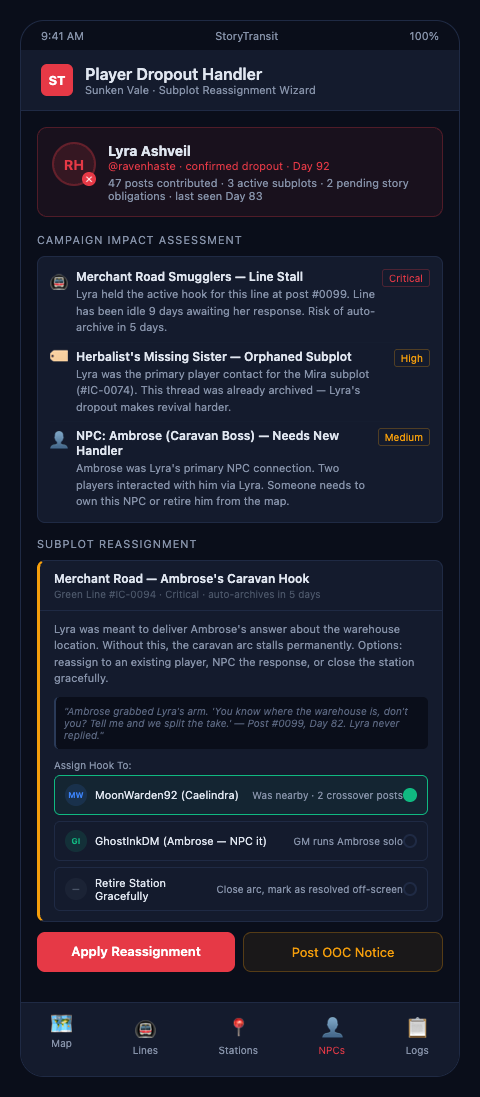
Step one: Identify all intersection stations. Before you NPC the missing character or write them out, map every IC thread where they're currently involved. Each scene they're in is an intersection station — a point where their route crosses another player's arc. You need to know all of them before you act on any of them.
In StoryTransit terms, you're running a route impact analysis. If a character is in three active scenes, you have three intersections to manage. Each one has different requirements: some can be paused, some need narrative resolution, one might be the linchpin of a plot beat you'd planned to resolve this week.
Step two: Classify each intersection. Sort your intersection stations into three categories:
- Suspendable: scenes where the absent character is a participant but not required for the scene to progress. Post a brief IC note ("Valdris steps back to observe") and continue without them.
- Resolvable: scenes where you can provide a narrative conclusion for their thread involvement without them. Write their exit in a way that honors their arc and doesn't leave a story debt.
- Holding: scenes where their involvement is load-bearing — you genuinely cannot resolve the scene without them or a decision about what happens next. Flag these explicitly in your OOC thread.
Step three: Post a route suspension notice. In your OOC thread, be explicit with remaining players: Character X's player has gone quiet, you're suspending their arc pending contact, and here's what happens to the scenes they were in. Transparency prevents speculation and keeps the other players' posting motivation intact. Proactive re-engagement reduces dropout spread when applied before full disengagement occurs.
Step four: Archive the character's state. Log their last IC post, their unresolved story commitments, and any OOC decisions pending from their character. This is the dormant stop record — if the player returns, if you need to hand the slot off during mid-campaign onboarding of a replacement, or if you want to reintroduce their character as an NPC, you have the complete narrative state preserved.
Advanced Tactics: Continuity Beyond a Single Departure
A single dropout is manageable. Three dropouts over a six-month campaign — which is typical for a forum game of any real scope — creates cumulative continuity damage unless you've built structural resilience from the start.
Structured social ties reduce player churn significantly more than informal friendships, which means the best dropout prevention is campaign architecture, not charm. Players who have meaningful structural roles in the story — a subplot they own, an NPC relationship that requires their involvement — post more consistently and disengage more slowly.
When a replacement player takes over a vacated slot, the dormant stop archive becomes the primary onboarding tool. A new player stepping into an existing character slot needs to know the last narrative state, the unresolved story hooks, and the mechanical history of the arc. If you've maintained that record, onboarding is a handoff. If you haven't, it's an archaeology project.
The longer-term recovery question — what happens when a campaign goes fully silent for months, not days — is a different problem entirely. The dropout protocols here are designed for active campaigns where the silence is local to one player or one thread; reviving a silent PbP requires its own playbook, because once the forum itself has gone quiet there is no active structure left to route around the gap.
For LARP organizers dealing with analogous problems, LARP dropout recovery covers how live-event game structures handle sudden character exits — many of the same principles apply across formats.
One tactic specific to forum games: a posting commitment thread. At campaign start, ask players to record their expected posting frequency and their preferred contact method if they go silent. When someone drops off, you have both their availability baseline and a direct channel. It's low overhead at setup and high value at crisis.
Handling Communication Windows and Absent Characters
The silent-player communication window. There's a specific timing problem in pbp player dropout that most GMs handle badly: the window between "player seems quiet" and "player is definitely gone." Acting too early — publicly announcing a player is absent when they've only missed three days — creates social friction and embarrasses players who return with legitimate explanations. Acting too late — waiting three weeks before acknowledging the absence — means other players have already adjusted their own posting to compensate, and the campaign rhythm has already broken.
The right window is five to seven days at one-post-per-day pace. At that point, send a private OOC message to the player (not a public thread bump) asking for a brief check-in. One sentence: "Hey, the scene in the Merchant Quarter is waiting on your character — any idea when you can post, or should I advance around you?" This message respects player privacy, doesn't generate public drama, and gives you actionable information. A player who hasn't responded to a private message in three additional days is functionally gone, and you proceed with the route suspension protocol.
Narrative handling of absent characters. The specific IC move you make when a character goes inactive matters more than most GMs think. Three options produce different results:
Freeze the character in place — they're simply not referenced until the player returns. Works for short absences in non-critical scenes, but feels artificial when other characters should logically be interacting with them.
NPC the character minimally — they're present but reactive, taking the simplest plausible action each scene. Maintains play-by-post continuity without requiring the GM to write the character's full voice. Best for characters who are active participants but not scene leaders.
Write the character a temporary exit — they leave the immediate scene for a plausible in-world reason (sent on an errand, called away by faction business, falling ill). Creates the cleanest narrative solution and gives the player a clean re-entry point when they return.
The choice depends on the character's arc commitments at the moment of dropout. A character who's in the middle of delivering crucial information needs a different handling than one who's been a background participant in a social scene. Map the intersection stations first — then choose the handling that minimizes story debt while keeping the other players' scenes moving.
Three-dropout resilience. For the veteran forum GM running a campaign with eight or more players, plan for three dropouts over a six-month run — because statistically, that's what happens. Building three-dropout resilience into your campaign architecture from the start means: no single player character holds the linchpin position on more than one active plot thread, every plot thread has at least one GM-controlled path to advancement that doesn't require a specific player to post, and the dormant stop registry is maintained so that any character's arc can be handed off with full context. A mid-campaign departure handled badly breaks a campaign. The same departure handled with a prepared protocol is a storyline beat, not a crisis.
Protect Your Story When Players Leave
Player dropout is the leading cause of forum game collapse — but mid-campaign departure doesn't have to mean narrative collapse. The intersection-mapping approach gives you a structured response that protects the plot threads your remaining players are invested in, without requiring improvised handwaving at the moment of crisis.
The dormant stop archive is what makes the difference between a handled departure and a lost arc. A character who left mid-campaign with three active subplot commitments and two pending NPC relationships represents real story infrastructure. With a complete dormant stop record — last IC post, unresolved hooks, mechanical history — another player can step into that slot with full context, or the GM can close the arc organically through NPC-driven consequences that don't require the absent character to post. Without that record, the arc simply disappears, and other players feel its absence as a gap in the world's coherence.
StoryTransit gives play-by-post forum GMs a dormant stop system that preserves every absent character's arc state — story commitments, unresolved hooks, last narrative position — so you can resume, hand off, or close each thread with full context intact. If you're running a PbP forum game with more than four players, join the waitlist for play-by-post GMs and see how the route-suspension model fits your campaign structure.