Reviving a PbP Game After a Months-Long Silence
What a Months-Long Silence Actually Breaks
A play-by-post restart is harder than a first launch because the obstacles are different. When you launch a new PbP campaign, players have full attention and no archive to navigate. When you revive after six months of silence, players face a specific cognitive challenge: they remember that they cared about this campaign, but they can't reliably remember why. The NPC relationships that felt vivid in Month Two are now vague. The slow-burn arc they were invested in is buried somewhere in the Merchant Quarter subforum under pagination they haven't touched in half a year.
Research on dormant social ties confirms that personalized, activity-specific messages are the most effective reactivation lever—generic "we're back!" announcements underperform targeted reminders that show each person what specifically they were doing before the silence. In PbP terms: don't send a mass bump OOC post. Send each player a personal message reminding them of their character's last IC post, the subplot they were in the middle of, and what the next story beat was going to be.
A case study on sustaining online communities through quiet periods shows that structured re-engagement—specific activities designed to rebuild participation habits—outperforms passive waiting. The forum revival needs a plan, not a hope.
The months-long silence also creates a secondary problem: the GM's own memory of the campaign's state has degraded alongside the players'. A GM who didn't maintain running documentation during the active period now has to reconstruct their own understanding of which arcs were in progress, which dormant subplots were seeded intentionally, and what commitments were made in IC posts they haven't read in months. This reconstruction takes days or weeks, delays the restart, and often produces an incomplete picture. Organizational dormancy research on reconnecting dormant ties confirms that trust and shared history are the core reactivation levers—and that the party attempting the reactivation needs access to that shared history to use it effectively.
The Transit System Restart Protocol
A dormant campaign is a transit system where all trains have stopped running. The restart protocol is about bringing lines back online in the right order, not all at once.
The most common mistake in a play-by-post restart is trying to resume all active subplots simultaneously. The bump stale subplots protocol for individual arc revival is the micro-version of the same logic: one arc at a time, with a bridging scene, supported by an OOC summary. The result is an OOC post that lists eight ongoing arcs and asks everyone to remember where they were and continue. Players feel overwhelmed, write vague reconnection posts, and the momentum collapses before it builds.
The transit restart approach is sequential:
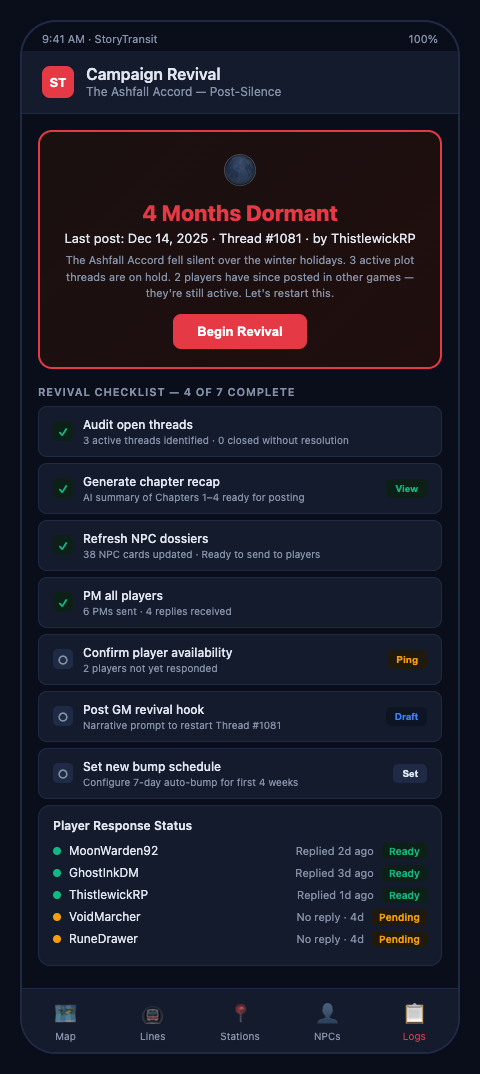
Step 1: Audit the lines. Before posting anything publicly, the GM runs a private review of every active storyline. Which lines have enough player investment to restart? Which ones can be quietly closed with a brief IC summary? Which dormant stops were seeded but never reached—and does restarting still make sense for them? This is the assessment phase, not the announcement phase.
Step 2: Choose the restart line. Pick one storyline line—the one with the strongest unresolved tension, the most engaged players, and the clearest next station. This is the line that opens first. Send individual OOC messages to the 2–3 players most invested in that line with a brief "here's where your character was, here's the next scene, here's what your first restart post should accomplish."
Step 3: Post the restart IC thread. Open a new IC thread (not a bump of the old one—a fresh thread signals genuine restart energy) with a GM-authored opening post that reestablishes the scene state cleanly. Include an OOC note at the top with a one-paragraph campaign catch-up summary and a link to the last significant IC post before the silence.
Step 4: Sequence additional line restarts. Once the first line has 3–5 new IC posts and momentum is established, open the second line. Then the third. Stagger them by one to two weeks so each line has time to establish its own momentum before the next adds volume.
StoryTransit's transit map makes this sequencing explicit: the GM can see which lines have the highest player engagement history, which dormant stops are most overdue, and which storyline intersections would create the most immediate narrative energy at restart.
Handling Players Who Don't Return
Not every player from before the silence will return to a forum revival. Some will have moved on to other games. Some will ghost the restart message. The transit restart protocol needs to account for missing players before the restart posts go live.
For each absent player's character: decide whether the character becomes an NPC (with limited but ongoing narrative role), whether they exit the story through an IC event, or whether their arc is archived as a dormant stop that a future player could pick up. Make these decisions before the restart IC thread opens—don't leave player-character-shaped holes in the opening post.
MIT Sloan's research on reactivating dormant ties emphasizes that dormant connections retain latent value even when they're not active—a player who doesn't return for the restart may return six months later if the campaign is still running. Leave the door open in your IC post conventions.
Within a restarted campaign, apply the same sequential logic to dormant subplot revival: don't try to bump all dormant content at once. One revived subplot per week, sequenced by player investment level.
Mid-campaign onboarding is an adjacent challenge—the protocols for bringing a new player into an established campaign share structural similarities with bringing returning players back after a silence, including the need for targeted catch-up summaries and clear entry points.
Subplot triage revive methods from homebrew DnD GM contexts apply directly to the PbP restart: the triage logic (which subplots are worth the energy to revive) is the same whether you're running a tabletop campaign or a forum game.
Advanced Tactics for Post-Revival Sustainability
The restart commitment thread. Before the IC restart posts go live, create an OOC commitment thread where returning players publicly state their availability and posting commitment for the next 30 days. Even a brief "I can post 3x/week for the next month" creates social accountability that an informal expectation doesn't. Ask for commitments publicly rather than privately—the social visibility of the commitment is what makes it binding.
The catch-up buffer post. Every IC thread in the restarted campaign should have a pinned GM post at the top covering: the last five story events in that thread's arc, the current scene state, and any established facts players need to remember. This removes the friction of archive excavation for every post. The buffer post should be written before the restart IC thread goes live—players need it to write their first restart posts, not as a reference for after they've already posted.
The 30-day checkpoint. Schedule an OOC check-in exactly 30 days after the restart. How many lines are active? What's the posting frequency? Which players have maintained their commitment? This checkpoint creates a natural milestone for assessing whether the revival has taken hold or needs additional structural support. If fewer than half the originally active lines are posting regularly at 30 days, the revival needs intervention—either simplifying the active arc set or directly contacting the players whose lines are stalling.
The silence post-mortem. Before the restart, run a private GM analysis of why the campaign went silent. Was it a real-life event (holidays, semester end, life disruptions)? Posting pace mismatch that created frustration? Loss of momentum after a major arc resolved? A difficult player conflict? The cause of the silence shapes the restart protocol: a pace mismatch requires structural changes, not just a re-engagement message. Understanding the root cause prevents the same silence recurring within three months of the revival.
The forum software market projected at $3.8B by 2030 specifically identifies dormant content revival features as a renewal cycle driver—confirming that platform developers recognize the problem. But platform features alone don't solve the narrative revival challenge; the structural protocol described here is the GM-layer solution that platform tools don't provide.
Discourse revival tools provide platform-level support for surfacing dormant threads to current readers—useful for technically surfacing content, but not a substitute for the narrative-level restart protocol described here.
Play-by-post forum GMs who've been sitting on a dormant campaign don't need a new reason to revive—they need a system that makes revival structurally sound. StoryTransit gives you the transit map to assess which lines are worth restarting, the dormancy tracking to sequence reactivation intelligently, and the player-facing views to help returning players find their footing. Join the waitlist and let's bring your dormant campaign back to life.