The Subplot Triage Process for Reviving a Six-Month-Old Homebrew Campaign
Six Months of Silence and What It Costs
A six-month gap in a homebrew campaign is not unusual. Life interrupts. Schedules fail. A party that was meeting weekly hits a stretch of weddings, relocations, and work crises that stretches a planned two-session hiatus into half a year. By the time the table reassembles, the DM faces a specific and brutal problem: they have 200 hours of campaign history in their notes, and almost none of it is accessible to the players sitting across from them.
The Ebbinghaus Forgetting Curve quantifies the damage: 70–80% of new information is lost within 24 hours without reinforcement. After six months, even plot-critical information from before the hiatus has largely faded from player memory. The half-elf bard may vaguely remember Brenhorn Village. They almost certainly do not remember which Merchant Council member gave them the cryptic warning in Session 22.
GM tips for restarting after a long hiatus confirm the pattern: without structured recap documents, returning groups spend the first session re-establishing context that should have been provided before the session even started. That wasted hour is also the most enthusiasm-eroding hour possible — players who wanted to return to the story find themselves confused instead of engaged.
The problem compounds at the DM's end as well. A six-month gap in active campaign prep means the DM has not been reviewing their own notes during that period. They remember broad strokes — major events, key NPCs, the direction the campaign was heading — but the specific state of each subplot line, the status of each NPC obligation, the current phase of each foreshadowing chain — all of that has faded. The DM returning from a six-month hiatus is not just re-onboarding their players. They are re-onboarding themselves.
This is why the subplot triage process begins before any session prep happens. The first step is not writing new content. It is conducting a full inventory of what the campaign left behind when it stopped — and making explicit decisions about what comes back, what retires, and what waits. The continuity debt audit covers the broader quarterly version of this same process — useful context for understanding how D&D hiatus restart triage fits into an ongoing maintenance discipline, and how homebrew narrative recovery after a gap relates to the same audit principles used during active play.
Subplot Triage: The Four-Category Sort
The core of the revival process is a triage pass through every active subplot in the campaign. Not a recap — a sort. Each subplot gets assigned to one of four categories before any other prep happens.
Viable: The subplot is still relevant, the triggering conditions still exist, and at least one party member has a meaningful stake. This subplot re-enters play immediately.
Stale but salvageable: The subplot was relevant before the hiatus but its context has shifted. The NPC who drove it may need a new motivation, or the political landscape may have changed. This subplot needs a brief in-world update before re-entry.
Graceful exit: The subplot no longer fits the campaign's current direction, or the party's engagement with it was always shallow. Rather than dropping it silently, give it a one-sentence in-world resolution — a rumor, a letter, an NPC offhand comment — and close the line cleanly.
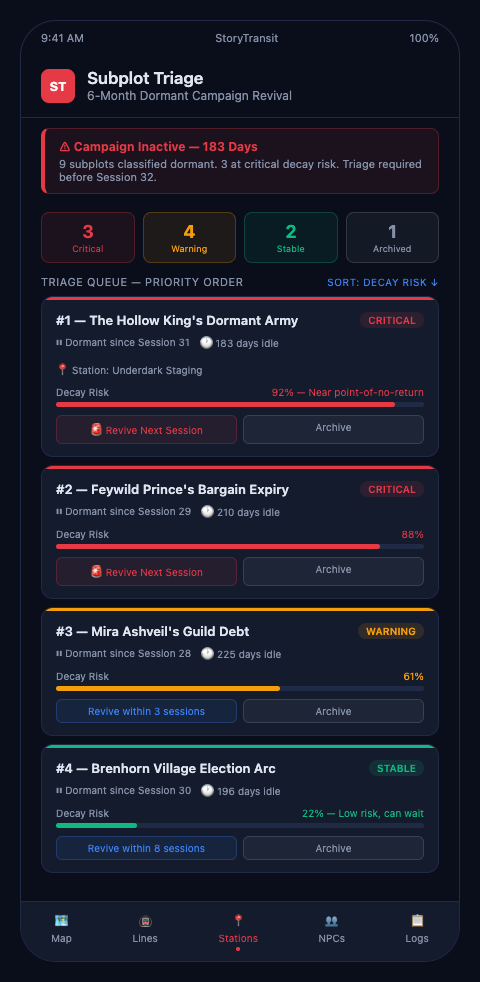
Dormant stop: The subplot is worth preserving but not appropriate for immediate re-entry. Mark it as a dormant stop on the transit map. It stays visible, stays associated with its NPCs, and can be reactivated when conditions allow.
This framework is the logic behind StoryTransit's subplot status system. The transit map does not delete lines — it marks them dormant. A DM returning from a hiatus can look at their map and see immediately which lines are viable, which need updating, and which should be retired, without reading through every note from the last year of play.
Spaced repetition research shows that retention is dramatically better when reinforcement is timed to match natural forgetting curves. Structuring the campaign's re-entry session as a spaced repetition event — brief, targeted recap of only the viable subplots — produces better player retention than comprehensive recaps that try to cover everything at once.
The Re-Onboarding Session Protocol
The session immediately after a major hiatus is not a normal session. It is a re-onboarding event. The DM's job in that session is not to advance the plot — it is to restore the players' relationship with the world.
Restarting a D&D campaign after a long break identifies three practices that work: structured time-skips that account for elapsed real time, collaborative recaps that let players reconstruct their own memories, and visible triage of which subplots are still active.
The protocol in practice:
Pre-session briefing: A two-page document sent to players 48 hours before the restart session. Page one covers the three most important things their characters know. Page two covers the two or three viable subplots that will be active at session start.
Opening vignette: Begin the first session with a brief narrated sequence that re-establishes the world's current state, signals what has changed during the hiatus, and gives each character a reason to care about what comes next.
Collaborative memory recovery: Ask each player, in turn, what their character remembers most vividly from before the hiatus. This surfaces player-priority subplots organically, and the DM can use those answers to confirm which viable subplots have genuine player engagement.
Creating lore documents before re-entry is identified as the single most-cited practice for successful campaign revival. The triage framework makes that document creation tractable — instead of trying to document everything, the DM only documents the viable category.
Advanced Triage for Complex Homebrew Campaigns
NPC status sweep: Before the first revival session, run a rapid status check on every NPC who was active before the hiatus. Where are they? What have they been doing? Which ones have changed enough that their previous relationship with the party no longer applies? This prevents the jarring moment when an NPC behaves inconsistently with their pre-hiatus characterization. A DM who arrives at the revival session knowing that the Merchant Council has reshuffled its leadership during the six-month in-world gap is prepared. One who has not run this sweep discovers the inconsistency mid-session.
Consequence propagation: A six-month real-world gap often maps to a meaningful in-world time period. If the world has been moving while the players were away, run the consequences of that movement before the session — not as a reveal, but as internal DM prep. The world's current state should be consistent with what was in motion before the hiatus. Wars that were progressing should have progressed. Political crises should have resolved or deepened. Factions that were ascendant should have grown. The world does not pause for the party.
Subplot triage documentation: After the triage pass, document the decisions. Which subplots were retired? How? Which are dormant? What reactivation condition would bring them back? This document becomes the foundation of the new campaign phase — the reset point from which continuity is tracked going forward.
AI-powered recap tools like Saga20 auto-generate NPC and subplot wiki pages updated after each session, and can serve as the backbone of the triage document for DMs returning from a hiatus. Even simpler tools — a structured template reviewed before each revival session — produce dramatically better re-onboarding outcomes than unstructured note review. The structure of the triage is what makes it tractable. Without a framework, reviewing 200 hours of campaign history before a revival session is an overwhelming project that never gets done.
The continuity audit framework uses the same systematic approach to assess which obligations need attention and which can be resolved cleanly — the triage categories above are a condensed version of that quarterly practice applied under time pressure.
The foreshadowing threads seeded before a hiatus are particularly vulnerable to being forgotten. Foreshadowing arcs covers how to design foreshadowing that is durable enough to survive real-world interruptions — and how to resurface seeded threads after a long gap without making the callback feel forced.
The same revival challenge appears in actual play production. Revive dormant storyline examines how podcast producers bring back paused narrative arcs for audiences who may have forgotten them — techniques that translate directly to the homebrew revival session.
Restart With Structure, Not Just Enthusiasm
The difference between a six-month campaign revival that succeeds and one that limps through two awkward sessions before regaining momentum is almost entirely the quality of the preparation. A DM who arrives at the revival session with a two-page pre-session briefing, a triage document, and a clear opening vignette is ready to run a real session. A DM who arrives with good intentions and a vague memory of where things were is going to spend that first session — the most enthusiasm-critical session of the campaign's new phase — doing catch-up work that should have happened in prep.
A six-month hiatus does not have to mean a six-session recovery period where the campaign slowly finds its footing again. The subplot triage process compresses that recovery into a single structured prep session and a targeted re-onboarding first session. StoryTransit gives homebrew DMs the visual map that makes triage fast — dormant stops are visible, viable lines are highlighted, and nothing is silently dropped.
Homebrew D&D DMs returning from a hiatus, or bracing for one, can join the waitlist now and get access to the triage tools that make campaign revival systematic rather than stressful. Join the Waitlist for Homebrew D&D DMs and come back to your campaign with a plan, not just a prayer.