Reviving a Dormant Actual Play Podcast Storyline
How Hiatus Compounds Audience Loss
Losing Momentum: Rebuilding Your Podcast After a Long Hiatus — Podcast Consultant documents the exact scenario most returning shows face: a show that returned after a significant gap lost half its audience on the returning season premiere. The production assumed that dedicated listeners would remember the story. They didn't — or at least, not with enough clarity to feel confident re-boarding without structural help.
For ongoing storyline maintenance that prevents dormancy from becoming unmanageable, the active arc tracking framework keeps threads documented even between active recording periods — which means when hiatus ends, the cold arc revival starts from a documented map rather than a memory exercise.
Understanding Listener Churn: 5 Ways to Reduce Branded Podcast Drop-off — CoHost identifies irregular publishing schedule as a primary cause of subscriber churn. But the churn that happens during a hiatus is only half the problem. The other half is the churn that happens at the return premiere when listeners who do show up discover that the cold arc revival doesn't give them enough context to re-engage with confidence.
Understanding Podcast Churn Rate — Podcast Pontifications puts it plainly: returning shows must re-earn listener trust. For actual play podcasts specifically, that re-earning process is narrative as much as promotional. Subscribers who remember that Kaelith was mid-arc in a major storyline when the show paused need to know where that arc stands now — and they need that orientation in the first three minutes of the return episode, not buried in episode three of the new season.
The Transit Map Approach to Cold Arc Revival
The transit metaphor is especially precise for dormant storylines. A dormant stop is a station on a transit line that isn't currently being served — the train hasn't been there in a while, but the stop still exists on the map. Listeners who followed the show before the hiatus remember that the stop exists. They're waiting for the line to start running again. The revival moment is when the train arrives at that stop, and it needs to arrive clearly enough that both returning listeners and any new arrivals who joined during the hiatus gap understand what's happening.
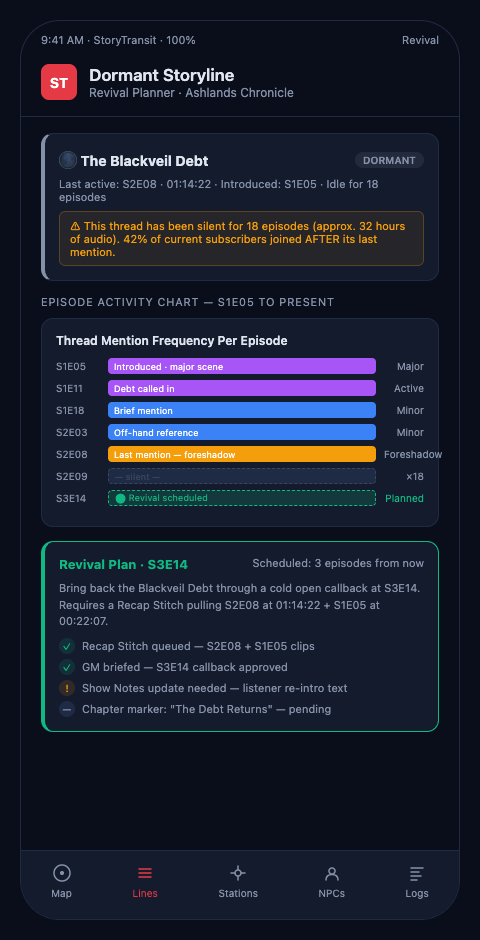
StoryTransit treats dormant storylines as explicitly flagged stops on the transit map. When a production pauses, the current state of every active and dormant line is captured in the map: where each thread was when it went dark, what the last significant station was, and what the planned next stop was before the hiatus interrupted it. When production resumes, that map is the starting point for the return episode — not memory, not production notes scattered across three different apps.
Keep 'em coming back: measuring podcast audience churn — Bumper documents that the new vs. returning listener ratio degrades fast during publishing gaps and continues to erode in the early return period if the re-entry experience is poor. The key insight: returning listeners at the hiatus recovery point behave more like mid-series listeners than like long-term subscribers. They need the same orientation infrastructure — thread status, cold open route mapping, show notes summary — that a season three entry point provides.
A Deeper Understanding of GM Notes — Gnome Stew confirms that well-organized session notes are essential for picking up dormant storylines without retconning. The same principle applies at the production level: the transit map needs to document not just that a storyline was dormant, but what state it was in — which characters knew what, which faction moves were in motion, which plot thread flags the production planted for future payoff.
Advanced Tactics for Returning Podcast Arc Management
The dormant stop inventory. Before recording the return premiere, audit every storyline that was active when the show paused. For each one: what station was it at? What happened in the last scene that advanced it? What was the planned next station? That inventory is the production brief for the cold arc revival — and it's exactly what a well-maintained StoryTransit map captures automatically.
The return episode structure. The returning episode shouldn't open mid-scene as if no time has passed. It needs a structural cold open that acknowledges the gap and maps the currently active and recently dormant lines for both returning and new listeners. That cold open is the re-orientation mechanism — it signals to returning subscribers that the show knows where it left off and to new subscribers that there's a system for catching up.
Algorithmic discovery at the return moment. Podcast Discovery Stats — The Podcast Host documents that returning shows benefit from algorithmic discovery boosts when new episodes publish after dormancy. That means the return premiere is also a first-impression episode for listeners who've never heard the show before — another reason the cold open orientation matters at both the retention and acquisition levels simultaneously.
Returning podcast arc pacing in the first three episodes back. Most hiatus recovery strategies focus on the premiere episode. The three-episode arc is where returning podcast arc management actually proves itself. Episode one re-establishes orientation. Episode two demonstrates that the dormant threads are being actively serviced — at least one cold arc revival in motion by the end of episode two. Episode three shows momentum: something significant has advanced, and the story feels like it has found its stride again. Productions that nail the premiere but run slow episodes two and three lose returning subscribers in exactly the window when algorithmic discovery is bringing new listeners in. Matching the re-orientation work of episode one to the narrative momentum of episodes two and three is the discipline that actually converts the premiere bounce into retained audience.
Hiatus recovery and Patreon communication. Returning shows often have a window of heightened supporter goodwill in the first week back — subscribers who have been waiting appreciate that the show has returned and often respond to direct communication about what the return season will cover. A Patreon post that maps the storyline reactivation plan (which arcs are coming back, in what order, and what state they're in) is both a retention tool for existing supporters and a conversion asset for free subscribers who are evaluating whether to upgrade. That communication works best when the production has a complete transit map to draw from — not reconstructed recall.
The back catalog audit post addresses what to do when a return production discovers that the back catalog contains threads the team doesn't even remember launching. For homebrewers who face structurally similar challenges after campaign gaps, the subplot triage revive guide covers how dungeon masters recover dormant subplots in long-running campaigns — the same discipline applied to a private game rather than a public feed.
Revive the Arc, Not Just the Feed
Storyline reactivation is different from simply resuming episode production. The feed can come back online within a week of the decision to return. The arc revival takes longer and requires explicit structural work — mapping thread state, drafting the cold open, ensuring show notes reflect current line status for mid-series listeners who may be discovering the show during the return window.
Podcast Audiences Still Listen, Evolving Live Events — Sounds Profitable confirms that even dormant listener segments retain memory of favorite shows when properly re-engaged. Your returning audience is waiting for the train to come back. The structural work of returning podcast arc management is what ensures they board it when it does.
Actual play podcast producers who are returning from hiatus or planning to revive cold arcs in a long-running show are exactly who this system was built for. Join the Waitlist for Actual Play Producers and get early access to StoryTransit — so your return premiere arrives at every dormant stop with the clarity that re-converts waiting listeners into active subscribers.