Auditing Your Podcast Back Catalog for Forgotten Plot Threads
The Forgotten Thread Problem in Long-Running Shows
The Podcast Attention Game: Algorithmic Discovery — MIDiA Research documents a pressure that most long-running actual play producers haven't fully accounted for: algorithmic platforms now surface back-catalog episodes — which means episodes from three or four seasons ago are regularly being heard by new listeners for the first time. When those episodes contain unresolved plot threads that the current production has quietly abandoned, those listeners surface them in comments, Discord questions, and reviews.
For related methodology on what to do after the audit identifies a thread worth bringing back, the revive dormant storyline post covers the production steps for cold arc revival — the direct next phase after a back catalog audit surfaces a viable forgotten thread.
Podcast Discovery Stats: How Folks Find Pods — The Podcast Host reports that 63.7% of listeners say back catalog size doesn't deter them from starting a show — once hooked, listeners actively mine archives. For actual play, this means your back catalog is not a passive archive. It's an active narrative record that new listeners are exploring and comparing to your current story state.
The forgotten plot threads that algorithmic discovery resurfaces are a production liability for shows that haven't done systematic catalog review. A debt owed by Lord Thadderon mentioned in episode 8 and never paid. A character introduced in the Sunless Citadel arc who was described as having a future role and then never appeared again. An improvised threat from a minor antagonist that the production forgot to follow up on. These abandoned threads signal to engaged listeners that the production isn't tracking its own narrative — a trust erosion that compounds across multiple instances.
The Back Catalog Audit Framework
A back catalog audit for forgotten plot threads is a three-phase process: extraction, classification, and decision.
Extraction involves going through the episode feed and pulling every explicit narrative commitment — every "we'll find out what that means later," every unresolved antagonist threat, every character who disappeared without explanation, every political arrangement mentioned as ongoing. For shows with 50+ episodes, this is a significant project. Podchaser: The #1 Podcast Database & API provides episode-level metadata and tagging tools that enable systematic catalog audits for long-running shows. The episode descriptions and show notes are the starting point — they capture what the production itself understood to be significant at the time.
Classification maps each extracted thread against the current transit map. StoryTransit provides the framework here: each forgotten thread is either a dormant stop (intentionally paused, planned for reactivation), an abandoned line (the narrative moved away from it without explicit resolution), or a completed station (resolved in a later episode that the audit missed on first pass). The distinction matters because the production response to each is different.
Decision is where the catalog review produces actionable output. Dormant stops get reactivation planning. Abandoned lines either get quiet retcon (acknowledging the thread never resolved is narratively honest) or structured revival. Completed stations that the production underemphasized get noted for potential call-back references that reward long-term listeners.
The Art of Narrative Threads — Number Analytics provides the methodology for identifying and mapping concurrent narrative threads across long-form series. The specific challenge in actual play is that the threads emerged from live improvisation, not from scripted planning — which means the extraction phase requires listening judgment, not just show notes review.
Plotting Multiple Timelines: Braiding Narrative Threads — Lore Architect presents the visual layering technique for tracking intersecting plot threads across long serialized narratives. For an actual play with multiple active character arcs, faction storylines, and world-state threads running simultaneously, visual layering is the only method that reliably prevents classification errors — where a thread that appears forgotten turns out to be an active component of a different arc's station.
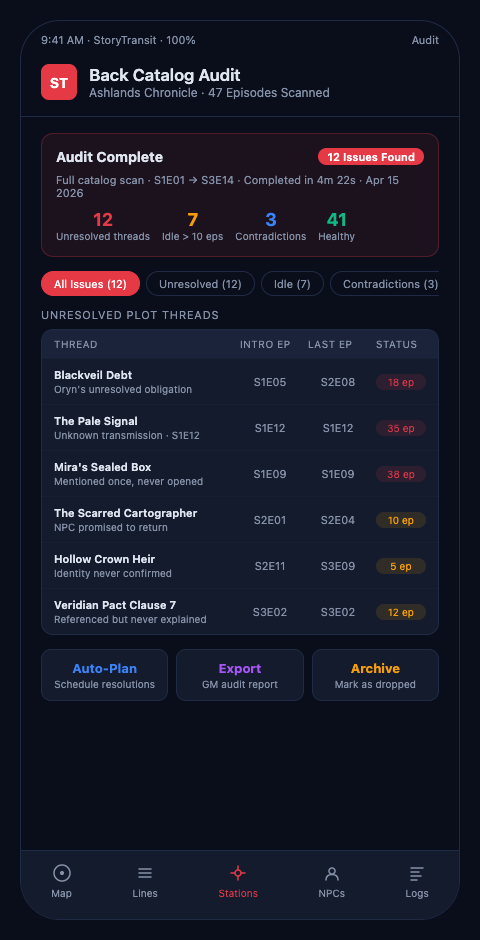
Advanced Tactics for Plot Thread Recovery
The episode scan protocol. Before attempting a full back catalog audit, run a name-and-concept search through available episode transcripts or show notes. Character names, location names, and faction names that appear early in the catalog and then disappear entirely are the first targets for the extraction phase. A name that appears in episodes 5-12 and then vanishes is a forgotten thread candidate until proven otherwise.
Listener-surfaced thread recovery. Active listener communities in Discord, Reddit, or Patreon tiers are frequently the first to identify forgotten threads — sometimes years before the production notices. Veteran producers treat listener questions about old plot points as audit triggers, not just community engagement. A subscriber asking "whatever happened to the Sunless Citadel connection?" is pointing at a thread that needs classification.
Archive analysis as production planning input. The catalog review outputs aren't just a continuity corrective — they're a content planning resource. A dormant line from season two that involves a compelling character who the current cast remembers fondly is a revival candidate that requires no new worldbuilding investment. The active arc tracking framework provides the ongoing system that prevents forgotten threads from accumulating in the first place; the back catalog audit is the corrective for shows that haven't been using that framework from the start.
The audit scope problem. A common mistake in back catalog audit planning is attempting to classify every scene in every episode. That's not feasible for a 60-episode catalog without a dedicated team. A more practical scope: audit show notes and episode descriptions first. They represent what the production considered significant at the time of publication. Then use listener community data — Discord pins, Reddit threads, Patreon questions — to surface threads that the production may have underemphasized in show notes but that the audience tracked closely. That combination of production-documented threads and listener-documented threads covers the most important forgotten plot threads without requiring a full episode-by-episode review as a first pass.
Cross-season continuity mapping. For shows that ran two or more seasons without systematic documentation, the audit is also an opportunity to build the cross-season continuity map that would have prevented the forgotten thread problem. Tracking which threads opened in season one, which carried into season two, and which were quietly abandoned reveals the pattern of where documentation lapsed — which informs how to build the ongoing archive analysis system going forward.
A Deeper Understanding of GM Notes — Gnome Stew establishes the principle that improvised plot details must be captured at session time or they become irrecoverable. For back catalogs that predate systematic documentation, the audit is an attempt to recover what that principle would have preserved. It's harder than maintaining the record, but it's not impossible — and the transit map that the audit builds becomes the foundation for the maintenance system going forward.
For parallel audit work in adjacent creative formats, the audit unreached beats approach used by LARP event organizers addresses the same taxonomy challenge in a live-event context.
The Audit Is a One-Time Investment in Permanent Clarity
For shows that have been running for two or more seasons without systematic thread tracking, the back catalog audit is a significant upfront project. Most actual play teams that have completed one report that it takes two to three weeks of episodic review for a 60-episode catalog. The output — a complete transit map with all threads classified — makes every subsequent production decision faster and more confident.
The forgotten plot threads your archive contains are not liabilities if you find them first. StoryTransit makes them assets: dormant stops waiting for reactivation, character lines with established momentum that can be revived with minimal setup, and narrative foreshadowing that long-term listeners will reward with outsized appreciation when it finally pays off.
Actual play podcast producers managing long catalogs — or building toward one — are exactly who StoryTransit was designed to serve. Join the Waitlist for Actual Play Producers to get early access to the transit map system that turns your archive into a narrative resource instead of a continuity risk.