Auditing Your LARP Event for Plot Beats Players Never Reached
The Beats Nobody Reached
Every LARP event has a shadow event—the version of the weekend that played out only in the plot bible, never reaching the players who came to experience it. Some shadow beats were deliberately held back as dormant stops for future events. Many others were simply missed: an NPC never reached the right zone, a trigger condition never fired, a plot station sat empty for eight hours while players engaged elsewhere in the venue.
Game Wrap research from Analog Game Studies confirms that discovering which plot threads were never encountered is the primary function of post-event review. But most organizers rely on player reports during Game Wrap to identify those gaps—which means they only hear about beats that players knew existed and cared about. Silent gaps—story beats players never knew to look for—go undiscovered entirely. The faction storyline that was supposed to escalate on Sunday afternoon. The NPC who was scheduled to deliver a key revelation in Zone 5. Players never encountered either, but they don't know what they missed, so they don't report it.
The Nordic Larp Wiki's debrief documentation describes how structured debriefs reveal secret plots and unresolved arcs that players never discovered. But revelation-based debriefs still depend on someone in the room knowing about the gap and bringing it up. A plot beat that no NPC delivered, in a zone no plot runner checked on—that beat may never surface unless you have documentation that proves it was planned and a protocol that checks whether it ran.
The story coverage audit is the systematic alternative to hoping debrief conversation catches everything. It compares the full set of planned story beats against the documented record of what actually ran, producing a precise gap map rather than an impressionistic post-mortem picture. The gap map tells you which beats were missed, categorizes why they were missed, and feeds directly into specific design changes for the next event.
Building the Audit Framework
A LARP plot audit operates on the same transit logic that governs live event coordination. When the weekend runs on a transit metaphor—plot threads as lines, story beats as stations—the post-event audit is a route inspection. You're walking every line, checking every station, and categorizing its status: completed, partial contact, bypassed intentionally, or dormant with no player contact.
The audit has four inputs: the pre-event plot bible (the complete list of planned beats), the runtime log (timestamped entries from the plot dashboard showing beat activations and dormant stop flags), the NPC completion reports (what each costumed volunteer actually ran during their shifts), and the post-event player survey (what players report having encountered and whether they felt their storylines reached resolution).
StoryTransit's documentation layer produces the first three automatically. The plot dashboard generates a timestamped record of every story beat that was activated and every dormant stop that was flagged during runtime. The post-event reconciliation export gives organizers a beat-by-beat status list that takes minutes to generate rather than hours of memory reconstruction from a dozen different plot runners. Without that documentation layer, the audit depends entirely on staff recollection—a source that degrades rapidly after the event closes.
The After-Action Review framework from AlertMedia formalizes the comparison between intended outcomes and actual results as the core of any organizational learning process. For a LARP story coverage audit, that comparison is precisely structured: every intended beat is a row in the audit document, every actual outcome is its documented status, and every discrepancy between the two is a finding requiring root-cause analysis.
LARP Portal's character module offers a simpler version of this audit logic: plot staff can search which character backstory hooks and story threads were activated during events. For large events with hundreds of active story elements, a dedicated audit framework extends this functionality to cover the full plot bible rather than just character-tied hooks.
The Three-Category Gap Analysis
When the audit identifies unreached story beats, categorize each gap before deciding how to respond. Running the same generic "improve coverage" discussion without category-specific diagnosis produces vague intentions that don't change the outcome at the next event.
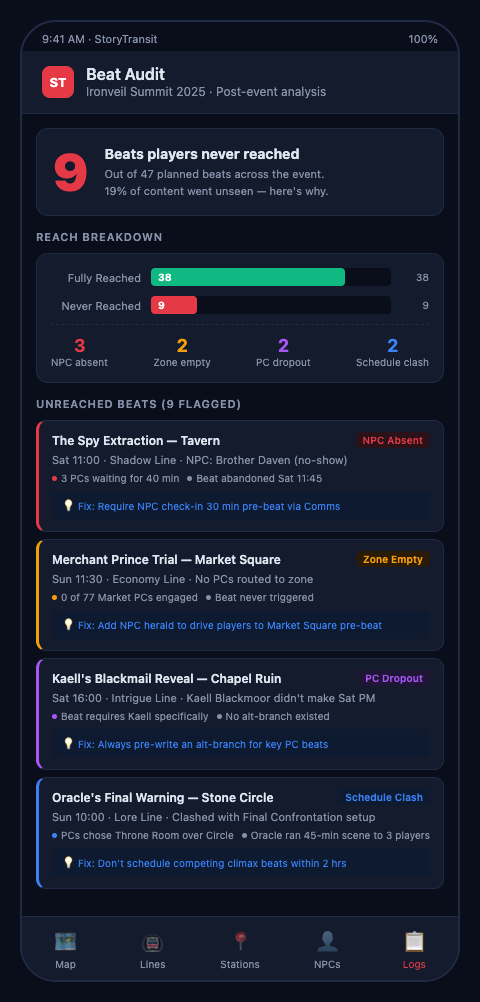
Category 1: NPC delivery failure. The beat was planned, the NPC was assigned, and the player group was in the right zone—but the delivery didn't happen. This is the most correctable failure mode. Common causes: the NPC was redirected mid-shift to cover a higher-priority story beat elsewhere in the venue, the NPC misread which players were the intended recipients of the beat, or the NPC ran short on time and abbreviated the encounter. Fix: tighten NPC briefing cards to include specific player identification cues, add a dispatcher check-in requirement for high-priority beats every thirty minutes, and clarify the priority hierarchy so NPCs know when they can and can't be redirected.
Category 2: Zone coverage failure. The beat was planned and the NPC was available, but no player group reached the zone where the beat was staged. This is a structural design problem rather than an execution problem. Common causes: the zone was physically distant from high-traffic areas with no natural player flow path, the in-game hooks directing characters to that zone were too subtle or delivered too late, or competing story beats in adjacent zones drew players in the opposite direction. Fix: redesign the hook system to deliver zone-directing information earlier and more explicitly, or relocate the beat to a zone that sits naturally on existing player movement paths.
Category 3: Structural design failure. The beat required conditions that never materialized—a faction decision that went the other way, a character who dropped out before their required scene, a chain of prerequisite beats that were themselves missed. These gaps can't be fixed by better NPC deployment or zone design. They indicate a structural fragility in the plot design: the beat was over-dependent on conditions that could have been disrupted in multiple different ways. Fix: rebuild the beat with independent trigger conditions that don't require a specific prerequisite chain, and add a bridge NPC who can deliver the beat's essential information through an alternative mechanism if the primary trigger fails.
Running the Audit in Practice
The most effective story coverage audit follows a four-step sequence that can be completed within forty-eight hours of event close.
Step 1: Collect the documentation. Pull the plot dashboard export, the NPC shift reports, and any runtime notes from plot runners. This takes fifteen to twenty minutes if the documentation was maintained during the event, and several hours if it wasn't—one of the strongest arguments for maintaining runtime documentation even when the event is busy.
Step 2: Build the beat status list. Create a spreadsheet with every planned story beat as a row. Mark each beat as completed, partial contact, bypassed intentionally, or dormant. This list is the audit's core output—the gap map that all subsequent analysis draws from.
Step 3: Categorize the gaps. For every dormant or partial beat, assign it to one of the three failure categories above. This step requires knowing what actually happened rather than just that the beat didn't run—which is why the NPC shift reports and runtime notes are essential inputs.
Step 4: Generate specific fixes. For each Category 1 gap, write a specific change to the NPC briefing protocol. For each Category 2 gap, write a specific change to the zone design or hook delivery system. For each Category 3 gap, write a specific structural change to the beat's trigger conditions. These fixes become the first section of the next event's design notes.
The audit process described here applies most directly to the post-event phase, but it feeds forward into LARP documentation fails—the underlying documentation practices that make a meaningful audit possible. When the audit data feeds into the formal post-event reconciliation session, the plot reconciliation debrief post covers how to structure that session for maximum actionable output. For how similar audit methodologies apply in the play-by-post format, audit unresolved threads covers the comparable process for forum GMs managing long-running serialized narratives.
The Event Experience Scale research measures cognitive, affective, physical, and novelty dimensions of event engagement. When story coverage audits consistently show that a particular type of beat is being missed—revelations, confrontations, resolution moments—that pattern maps directly onto which experience dimensions your event is underdelivering. The audit isn't just operational maintenance. It's the data that tells you what kind of event you're actually running versus what kind you intend to run.
The Public Health Ontario hotwash methodology for multi-team events identifies structured debrief templates as the mechanism for surfacing unaddressed gaps and uncompleted objectives. Applied to LARP, the story coverage audit is that structured template—the systematic equivalent of the hotwash's "what had gaps" question applied to every planned story beat rather than just the ones that participants happened to remember during the debrief conversation.
StoryTransit gives LARP event organizers the documentation infrastructure that makes a real story coverage audit possible without hours of post-event memory reconstruction. Every runtime decision logged during the event becomes post-event audit data. If you're tired of discovering missed plot beats through player survey comments two weeks after the event closes, the platform is built specifically for you. Join the Waitlist for LARP Organizers and run your next post-event review with complete, timestamped data.