Why LARP Plot Documentation Fails and How to Fix It
Four Ways LARP Plot Documentation Fails
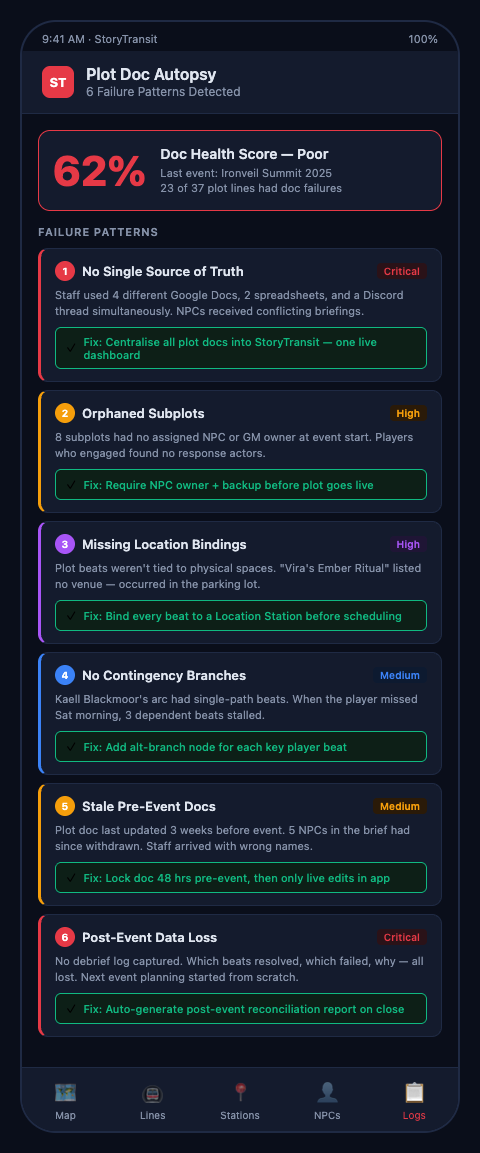
The first way is fragmentation. Your plot bible is in Google Docs. Your NPC assignments are in a spreadsheet. Your station updates are in a shared chat thread. Your runner notes are in someone's personal notebook. When you need to answer the question "what is the current state of Plot F?" during runtime, you are searching four different systems simultaneously. Teams on fragmented platforms spend roughly 30% of their workday searching for decisions made across channels. Pitfalls in Effective Knowledge Management In a LARP context, that search happens while players are waiting.
The second way is non-use during runtime. Most LARP plot documentation is written for the pre-event planning phase and then abandoned once the event starts. Runners fall back on radio communication and personal memory because the documentation is not accessible or structured for runtime queries. LARP designs that go undocumented during execution cannot be analyzed or reproduced. Documentation of Larp Design Documentation that exists but is not used during runtime is functionally the same as documentation that does not exist.
The third way is absence of post-event records. Under production pressure, lessons-learned documentation is routinely skipped. Lessons Learned Practice in a Complex Production Environment The structured post-project review that should capture what worked, what failed, and what was adjusted mid-event is skipped under deadline pressure precisely when it is most valuable. The art and science of post project reviews – PMI For LARP events, this means the next event's organizers inherit the same undocumented failure modes as the last.
The fourth way is the verbal handoff problem. Continuity across NPC shifts depends on written debriefs after each scene — verbal-only handoffs lose critical plot state that cannot be reconstructed later. CotV LARP – NPC Guide When the volunteer who ran the campfire scene at 3 p.m. goes off-shift, and the incoming volunteer asks "what happened in that scene?", a verbal summary loses granularity every time it passes through another person. The scene's plot state effectively disappears.
These four failure modes are independent — a LARP with excellent pre-event documentation can still fail at the runtime use problem. A LARP with solid runtime tracking can still skip the post-event review. Fixing LARP narrative records means identifying which failure mode you are experiencing and addressing it directly rather than assuming that better documentation in any one phase solves all four. Most intermediate organizers have partially addressed one or two of these modes and are experiencing the others without recognizing them.
A Transit Model for Plot Record Keeping
StoryTransit addresses documentation failure by treating every story beat as a station with a live record rather than a narrative paragraph in a static document. The station record is the unit of documentation — and it travels through the event alongside the operational activity it describes.
Here is what a functional station record contains at each phase:
Pre-event: Trigger condition. Actor assignment (which costumed volunteer or runner). Player-facing content (what players will see/hear). Expected post-scene state. One contingency branch if the primary approach fails.
During runtime: Timestamp of activation. Actual outcome (matched expected state, or describe deviation). Player actions that affected the beat. Status: fired cleanly / adjusted / bypassed.
Post-event: Runner assessment of why the beat worked or did not. Any adjustments made during runtime that should inform the next event's pre-event planning. Recommended changes to the contingency branch.
This three-phase record turns a static plot bible entry into a living document that captures how the event actually unfolded. Operational failures often result from unrecorded process decisions that cannot be reviewed after the fact. Operational Failures and Problem Solving – HBS The station record prevents that by making the process decision part of the record at the time it is made, not in a post-event reconstruction.
The station record structure also solves the handoff problem for recurring events. When you run the next event in a campaign series, the post-event records from the previous event are the canonical state of the fiction. Runners joining for the first time can read station records to understand what happened without relying on a single organizer to reconstruct the narrative from memory. Continuity that exists only in one person's head is continuity that disappears when that person is unavailable.
Understanding which plotlines unravel modes are most common at your event type helps you pre-write the right contingency branches. Most plot documentation failures are downstream of documentation gaps in specific beat categories — knowing which categories are highest-risk lets you invest documentation effort where it produces the most protection. Similarly, scheduling regular audit unreached beats reviews after each event surfaces the systematic gaps that individual beat documentation cannot catch on its own.
Building a Documentation System That Survives Runtime
The documentation system that works during runtime is the one that requires minimal effort to update under operational pressure. Complexity is the enemy of runtime compliance — if updating a record takes more than sixty seconds and requires navigating multiple fields, runners will skip it when they are managing six NPC encounters simultaneously.
Design for minimum viable updates. During runtime, a station record update should require three inputs at most: status change (fired / adjusted / bypassed), one-sentence outcome description, and timestamp. StoryTransit autofills the timestamp. The runner provides status and a brief outcome note. That is the entire runtime documentation requirement. If your current system requires more than that to update a record during the event, simplify it — compliance will be higher with a lower-friction system even if the records are slightly less detailed.
Use timestamped logs as the authoritative event record. Systems modeled on computer-aided dispatch log every communication from start to finish. Computer Aided Dispatch Systems – DHS TechNote For LARP events, this means the StoryTransit event log becomes the authoritative record of what happened when — not the runner's memory, not a reconstructed narrative written two weeks after the event.
Build the post-event review into the closing ritual. Document the review session itself, not just the event. Assign a scribe for the review call. Use a template rather than open discussion. Capture the output in the event record while the experience is fresh. Fragmented documentation across platforms causes a measurable drop in decision-making confidence for future events. Pitfalls in Effective Knowledge Management A structured post-project review with documented lessons learned is routinely skipped under deadline pressure. The art and science of post project reviews – PMI Schedule the review before the event ends — make teardown contingent on a thirty-minute debrief, not the other way around.
Archive state at the end of every event for recurring series. If you run events in a continuous campaign, the end-of-event state record is the input to the next event's pre-production. What plot threads are active, what NPCs are established, what player character histories carry forward — all of this needs to be in a retrievable archive, not in the head of one organizer. The back catalog audit approach used in long-running episodic productions — systematically reviewing what has been established to surface forgotten threads — translates directly to LARP campaign documentation. A records review before each new event is the equivalent of that audit.
Fix Documentation at the System Level
LARP plot documentation fails because it is designed for a planning phase and then expected to serve an operational phase without modification. Fixing LARP narrative records means rebuilding documentation around the operational phase — making runtime updates easy, making records accessible to the whole team in real time, and making post-event review a structural part of the event rather than an optional add-on.
There is also a cultural dimension to documentation failure in LARP production. Many organizer teams treat documentation as administrative overhead rather than as story infrastructure. The plot bible gets written with care; the event log gets written under duress; the post-event review gets skipped because everyone is exhausted. Changing this requires making the documentation feel like part of running the event, not like a tax levied after the creative work is done. Station records that are updated during runtime — as part of the operational workflow rather than as a separate documentation task — change this dynamic. The record becomes the work, not a record of the work.
This is what StoryTransit's transit model makes possible: documentation that is structural to the operation rather than adjacent to it. When every runner is working from the same station map, updating it is not documentation — it is just keeping the map current. That shift in framing changes how runners approach the record-keeping requirement, and changes the quality of the documentation that results.
StoryTransit gives LARP event organizers a plot dashboard where station records serve all three phases — pre-event, runtime, and post-event — in one system rather than three. If you are running weekend-long live-action events and have experienced the documentation failure modes described above, join the waitlist for LARP organizers and get early access to a tool built to prevent them.