6 Ways Parallel Plotlines Unravel at Weekend LARPs
Plot Failure at Weekend LARPs Is Structural, Not Personal
The usual post-event analysis blames people. The NPC who improvised off-script. The runner who missed a radio call. The player group who skipped the scene that set up the Sunday climax. In reality, most parallel plotline failures at weekend LARPs trace back to structural problems in how the event was designed to be tracked—not to individual mistakes. Plotline unraveling and LARP plot failure follow predictable patterns: when there's no visual map of the full system, plot coordination breakdown happens in the blind spots, not from lack of effort.
The Larp Domino Effect from Nordic Larp describes how a single plot thread going viral across an event crowds out other storylines, derailing everything running in parallel. That's not bad luck. That's a structure that had no mechanism to balance traffic across its lines. Branching story graph research confirms that branching narrative complexity grows exponentially without active management—story threads become unresolvable when the organizer can't see the full state of the system.
The LARP Events market growing at 11% CAGR is one where organizer reputation is everything. A weekend event that leaves forty players without a coherent story arc generates the kind of feedback that ends future attendance. Understanding the failure modes is the prerequisite for addressing them.
Failure Mode 1: The Domino Cascade
One popular plotline sweeps the event. Every player wants to be involved. Your costumed volunteers for the dominant arc are overwhelmed, and your NPCs for every other arc are standing idle waiting for player contact that never arrives.
This happens because there's no mechanism for redistribution when one line gets overloaded. In a transit system, you'd express the popular line—run more service on it—while maintaining scheduled service on the quieter routes. In a LARP event without a story map, you don't know the other routes are going quiet until it's too late to intervene.
Failure Mode 2: NPC Coverage Gaps
Your plot bible assigns three story beats to the same NPC across a two-hour block. That NPC finishes their first scene twenty minutes late, skips the second to make the third, and the players who were supposed to receive the second scene's information never get it.
Creating Quests Dynamically for Live Action Role-playing games documents how PC-to-NPC ratio imbalances cause plot collapse at runtime—there simply isn't enough crew to cover the required story beats. Without a visual map of NPC assignments across your parallel plotlines, you can't see this collision coming during pre-event planning.
Failure Mode 3: Runner Coordination Breakdown
Three runners are working your sixty-acre venue. Runner A sends the werewolf NPC to the south campfire. Runner B sends the same NPC to the east meadow. The NPC gets contradictory calls on the radio and freezes, missing both scenes.
This is pure runner coordination failure. It happens when runners are working from separate mental models of the event rather than a shared story map. The fix is a single dispatching authority with a single view of all NPC assignments—not multiple runners improvising independently.
Failure Mode 4: Volunteer Burnout and Role Confusion
Volunteer burnout research from Leaving Mundania identifies unclear role assignments and the conflict between volunteer and paid crew expectations as primary causes of NPC plot delivery failure. When costumed volunteers don't know which plotline they're serving, or when their assignments change at runtime without clear communication, they stop delivering scenes reliably.
The structural cause is pre-event planning that assigns NPCs to scenes without modeling the full sequence of demands on each volunteer. An NPC playing five different characters across three plotlines over a weekend has a workload problem that only becomes visible when you map all five assignments on the same timeline.
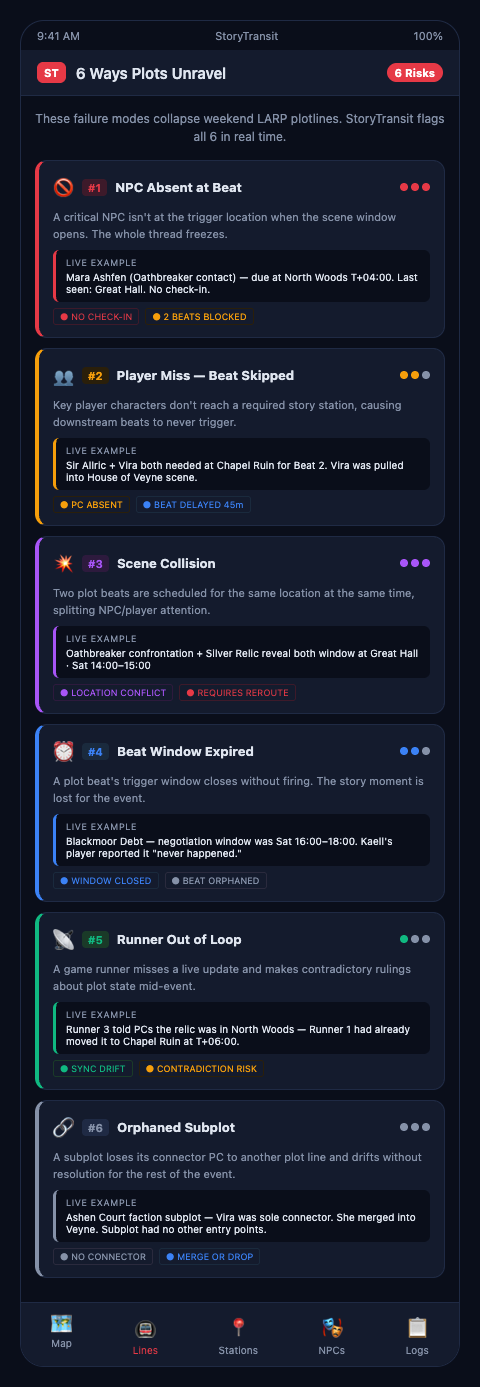
Failure Mode 5: Player Group Drift
Players were supposed to follow the blue line. They're now three stations ahead on the red line because an NPC improvised a scene that advanced them. The story beats on the blue line that were designed to give them the context for Sunday's climax are now inaccessible—the players have moved past the point where those beats make sense.
This is a tracking failure, not an improvisation failure. When you don't have a player story beat log showing where player groups actually are versus where they're supposed to be, drift is invisible until it's irreversible.
Plot management software comparison from LarpManager shows that modern LARP tools specifically address this by letting organizers assign plot modules to characters and track which threads each group has accessed. Player group drift isn't unsolvable—it requires a tracking layer that most organizer toolchains don't have.
Failure Mode 6: The Undiscovered Subplot
Plot B players walked past the bloodstain twice. The clue was physically present. The scene was designed. The NPC was waiting. The players never connected the visual cue to the story beat it was meant to trigger.
This is a story beat design failure with a documentation dimension. When your plot bible describes the bloodstain as a trigger but doesn't specify the conditions under which the trigger is active, your NPC doesn't know whether to intervene or wait. The subplot stays buried. Forum archive subplots die the same way in written games—buried in documentation that nobody reads at the moment of need.
What Prevention Actually Looks Like
Each of the six failure modes has a specific intervention point—and most of them are pre-event, not runtime. These are the standard weekend event pitfalls that experienced organizers learn to design against—not because they are rare, but because live-action story problems of this kind are structural and therefore predictable. StoryTransit makes the intervention points visible before event day: the story map flags coverage gaps, double-bookings, and missing transfer stations while there is still time to fix them.
The domino cascade is prevented by designing explicit traffic management into your story map: which line gets priority if player demand exceeds supply, and how you redirect players away from a saturated arc. NPC coverage gaps are prevented by the assignment audit—listing every station chronologically with its assigned NPC and checking for conflicts before event day. Runner coordination breakdown is prevented by designating a single dispatch authority before the event starts, not after the first conflict emerges.
Volunteer burnout is addressed by modeling each volunteer's full weekend workload on the story map and redistributing before the event. Player group drift is caught by the player beat tracking layer—when you can see where groups actually are versus where they're intended to be, drift is visible in time to redirect. The undiscovered subplot is fixed by adding explicit NPC activation conditions to every prop-triggered station: if players haven't engaged within a defined window, the NPC intervenes.
None of these interventions are complex. They're systematic. The story map is the tool that makes them systematic rather than improvisational.
The Pre-Event Failure Audit
Before your next weekend LARP, run a pre-event failure audit against your story map. Take each of the six failure modes and check whether your current design has a structural defense against it.
For the domino cascade: does your map show which lines will compete for the same player pool, and do you have a mechanism to redirect traffic? For NPC coverage gaps: have you run the chronological assignment check and found zero double-bookings? For runner coordination: is there a single dispatch authority, and do all runners know what decisions require dispatch approval versus field judgment?
For volunteer burnout: has every volunteer seen their full assignment list for the weekend, and has anyone flagged overload? For player group drift: does your dispatch station have a player beat matrix running? For undiscovered subplots: does every prop-triggered station have a defined NPC intervention window?
This audit takes an hour before event day. It prevents the post-event analysis that takes days and still doesn't identify root causes.
Recognizing Failure Early Versus Late
The same failure mode diagnosed at noon Saturday is recoverable. Diagnosed at 9 PM Saturday, it's a Sunday problem. Diagnosed at Sunday debrief, it's history.
Most LARP organizers get good at recognizing failure modes after the fact because that's when they're visible—in the post-event conversation, in player feedback, in the organizer's own memory of what felt off during the event. The skill to develop is recognizing them during the event, while there's still time to redirect.
The story map gives you the early signal. When the red line has three stations pending and it's Saturday afternoon, that's not a problem yet—it's a warning. The warning becomes a problem if nothing changes in the next hour. When the dispatch log shows an NPC who hasn't reported from their station in ninety minutes, that's not necessarily a failure—but it's a signal that requires a follow-up call. When the player beat matrix shows that a player group is two stations behind their expected arc position by Saturday evening, that's a redirect opportunity, not a lost cause.
The organizer who catches the warning and responds before it compounds is the one whose Sunday climax lands for the full player population, not just the thirty who happened to follow the intended path.
The Common Thread Across All Six Failures
Every failure mode on this list stems from the same root cause: the organizer cannot see the full state of the event in real time. They can't see that the red line is dominating while the blue line goes cold. They can't see that one NPC is triple-booked on Saturday afternoon. They can't see that a player group has drifted two stations ahead of schedule.
The story transit map format addresses all six by making the full system visible from a single display. Routes are tracked. NPC assignments are visible. Player progress is logged. Dormant stops are marked. When you can see the whole system, you can catch failure modes before they become post-event regrets.
StoryTransit is built to give LARP event organizers the visibility that plot bibles and spreadsheets can't provide. If your last weekend event had plot threads that went dark for reasons you couldn't fully diagnose afterward, the waitlist is open—join to get early access to the runtime tracking tools built for parallel-plotline events.