Why Forum Archives Kill Subplots (and How to Keep Them Alive)
The Archive Is Where Subplots Go to Die
Your forum host auto-prunes threads older than a year. That's not a warning in your platform's terms of service you've internalized — it's a deletion policy that runs silently, automatically, and without a notification to anyone in your IC thread.
The slow-burn poisoning arc from April? If it lives in a subforum that hasn't been posted in since July, it may already be approaching the pruning threshold. Link Rot: The Web's Forgotten Crisis — Harvard Law Review found that 49% of links in Supreme Court opinions are broken. Forum archives rot at comparable rates, and they do it faster because no one is maintaining them. Learning from failure: The case of the disappearing Web site – First Monday identifies the structural factors: content disappears not because of malice but because nobody built a preservation workflow.
The problem for play-by-post GMs isn't just link rot. It's the preceding layer: before the thread disappears, it gets buried. Buried under pagination, under new threads in the same subforum, under the sheer volume of IC posts that accumulate in a campaign running for six months or more. A subplot that was vivid three months ago becomes a vague recollection by month five. Spaced Repetition for Long-Term Retention — Frontiers Psychology shows that without periodic retrieval, people retain only roughly 25% of information by the end of one week. In a pbp campaign, "the end of one week" is seven IC posts. The buried plot thread is already half-forgotten before anyone stops talking about it.
Dropout in Online Higher Education – Educational Technology Journal identifies narrative discontinuity as a top factor in long-term online community dropout. Players don't announce that a forgotten subplot is why they're losing interest. They just start posting less.
The Dormant Stop System
The fix for forum archive subplots requires treating buried threads the way a transit authority treats a suspended line: it's not deleted from the map, it's marked dormant. You know where it is. You know what conditions would restart it. You're not running service, but the infrastructure is intact.
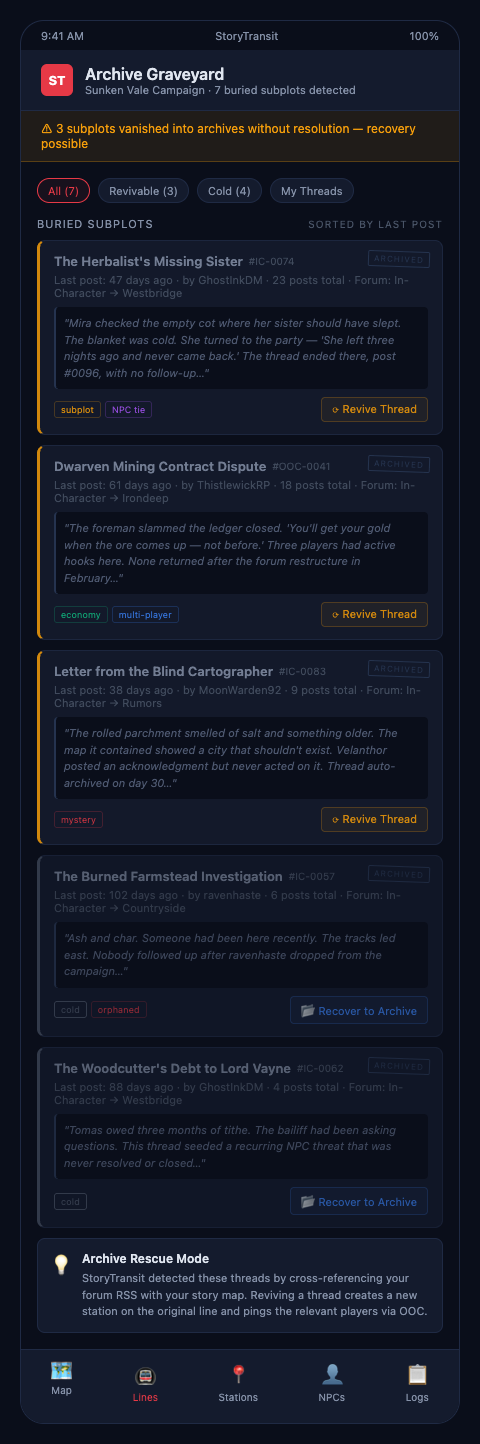
StoryTransit builds this logic directly into the GM workflow. Every subplot you introduce gets logged as a transit line. When a thread goes inactive — whether by player absence, pacing decisions, or deliberate narrative delay — it becomes a dormant stop on the map rather than disappearing from view. The GM can see at a glance which lines are active, which are dormant, and which are approaching the point where revival requires excavation rather than a simple bump.
The practical system has three layers:
The archive log. When you start a new subplot, create a standalone entry outside the forum thread itself: the thread name, the subforum, the current page number, the last IC post number that advanced it, and a one-sentence description of where the arc stands. This entry lives in your OOC tracking document, not in the forum. When the host prunes the thread, your log survives. Myth-Weavers Forums — one of the oldest pbp communities — hosts games spanning years precisely because veteran GMs on that platform maintain off-forum documentation as standard practice.
The revival trigger. For every dormant subplot, write a single sentence: what in-game event would logically restart this thread? "The poisoning arc resumes when a player character visits the Merchant Quarter." This isn't a firm plan — it's a signal. When the trigger condition appears naturally in an IC post, you have a reason to bump the thread back into activity without it feeling forced.
The gap timestamp. Log the real-world date when each subplot went dormant. Not to shame yourself about the delay — to use it. A thread dormant for eleven real-world weeks in a one-post-per-day campaign represents a specific volume of in-game time. That gap is a narrative resource: it tells you how much your NPCs have been doing while the players weren't watching.
Reactivating the Buried Arc
Once you have the dormant stop system in place, subplot revival becomes a scheduled activity rather than an accident.
The most reliable revival method for archived thread histories is what experienced forum GMs call the "transfer station approach." Instead of creating a new thread for the revived subplot, you bring it back through an active thread where a character already has an established reason to encounter it. The poisoning arc's dormant stop sits in the Merchant Quarter subforum. A current IC post in the main adventure thread has a character passing through that district. That's your transfer station — you route the dormant line through active track without needing the players to re-read three months of archived posts.
Keep revival attempts short at first. A single IC post that acknowledges the dormant thread — an NPC mentioning the merchant's suspicious death, an overheard rumor — is enough to reactivate player memory without demanding they excavate the archive. Once the thread is back in recent memory, you can start building toward the subplot's resolution.
Spaced Repetition – Wikipedia shows that periodic re-exposure to information counteracts forgetting, and intervals can be tuned for retention. In forum GM terms: one revival bump every two to three weeks is more effective at rebuilding subplot awareness than one comprehensive recap after months of silence.
The players who bump stale subplots most successfully treat revival not as an emergency but as a standing agenda item. Every three weeks, they scan their dormant stops and ask which one has a revival trigger that matches current IC activity. That discipline is what separates pbp campaigns that reach their intended conclusions from those that accumulate buried plot threads until the weight becomes unmanageable.
LARP organizers face a structurally similar challenge when plotlines unravel modes across a weekend event — the difference is that a forum GM has months rather than hours to notice the problem and correct it.
When Multiple Subplots Go Dormant Simultaneously
A single dormant subplot is manageable. Three dormant subplots running simultaneously — each with its own archived thread, its own NPC dependencies, its own player investment that's slowly fading — is a different category of problem.
The forum GM facing multiple simultaneous dormant stops needs a priority system. Not every subplot can be revived at once; attempting it overloads the campaign's narrative bandwidth and confuses players about what the current focus is. The priority criteria for revival are: player investment (which players have expressed interest in or connection to this subplot), narrative proximity (which dormant stops are closest to active threads geographically or thematically), and time pressure (which threads are approaching the forum's auto-prune threshold).
Applying these criteria to your dormant stop registry produces a short priority list: the one or two subplots that should be revived in the next two to four weeks. The others stay dormant, tracked on your map, with revival triggers ready when the narrative opens a window.
The "breadcrumb revival" technique. For a subplot that has been dormant for two or more months, a direct revival can feel jarring — players who have forgotten the context won't understand why the arc is suddenly active again. The breadcrumb revival addresses this: two weeks before you intend to reactivate the arc, plant a single reference to it in an active IC post. An NPC mentioning a name. A background detail that connects to the dormant thread's last station. This primes player memory without triggering the full arc. By the time you post the official revival station, players already have the thread in their recent memory.
This technique also has the advantage of being testable: if your breadcrumb post generates player questions or OOC interest, you know the subplot still has investment behind it. If it generates no response at all, you have information about whether this particular arc is worth the revival effort or whether it should be closed and its dormant stop retired.
The Real Cost of a Pruned Thread
A pruned thread is not just a lost document. It's a lost constraint. The details in that archived Merchant Quarter subforum — the specific wording of the NPC's warning, the items the players found, the clues that were deliberately seeded — are the ground truth of your fiction. Without them, you're improvising continuity, and players who remember the thread will notice the inconsistencies even if they can't name them.
The dormant stop system doesn't prevent thread pruning — it ensures that the essential information survives it. Your archive log entry for a dormant subplot is the off-forum copy: the last station, the thread reference, the revival trigger. When the host prunes the thread, your log still has what you need to continue the arc. You lose the full texture of the archived posts, but you don't lose the plot.
StoryTransit was built for play-by-post forum GMs who can't afford to lose that ground truth to archive rot. The dormant stop system means you always know where every subplot stands, regardless of how deep it's buried in thread pagination. Join the Waitlist for Play-by-Post GMs to get early access and start preserving your buried arcs before the pruning schedule reaches them.