Bumping Stale Subplots: When and How to Revive Dormant Arcs
The Subplot That Didn't Die — It Stalled
A dormant subplot in a PbP forum game isn't the same as a dead one. The slow-burn poisoning arc from April that players haven't mentioned in eight weeks isn't resolved — it's just waiting. The IC thread is still there, somewhere deep in the forum archive, last bumped on the fourth of the month. The players remember it exists. You remember you planted story hooks that haven't been picked up. The question is what to do with it.
The time gap between posts is the single strongest predictor of permanent departure from an online community. For dormant subplots, the same logic applies with a twist: the longer a subplot stays dormant, the higher the player memory decay — and the harder the revival becomes. Players forget 70–80% of dormant subplot details within 24 hours of the last engagement. After eight weeks, the revival isn't just a narrative bump. It's a full memory reconstruction exercise.
Most forum GMs respond to this by avoiding the revival entirely. The subplot dies by neglect rather than by narrative decision. This is the worst outcome: it leaves open story debt on your forum archive, creates a sense of narrative incompleteness for players who remember the thread, and wastes whatever setup you invested in the arc. Play-by-post forum moderation of your own story map — the practice of actively deciding which arcs to bump stale subplots back into service versus which to quietly retire — is the discipline that separates intentional campaign design from accumulated neglect.
The alternative is deliberate dormant arc revival — planned, timed, and structured to minimize the memory reconstruction burden on players while maximizing the narrative impact of the return.
The Reactivation Protocol
StoryTransit treats dormant subplots as suspended transit lines. The line still exists — the stations are still on the map, the route is still defined. It just isn't running service. Reactivating it requires three steps: announcing the return, running a bridging scene, and re-establishing the arc's position in the larger story map.
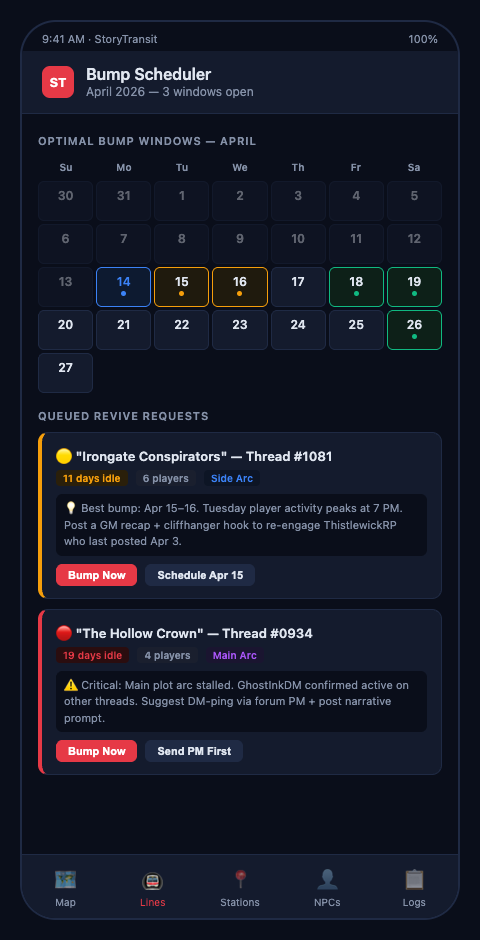
Know when to bump. A recap thread is the right place to signal upcoming dormant arc revival — listing a subplot as "dormant, revival planned next week" in the recap primes player memory before the bridging scene posts. The best time to actually revive a dormant arc is immediately after a high-tension resolution in a different plot line. Alternating fast and slow scenes prevents pacing stagnation, and dormant arc revival works best after a tension peak. Players who just experienced a major story payoff are emotionally primed for a new thread. The dormant arc's return feels like a consequence of the recent action rather than an unrelated interruption.
Write the bridging scene. Don't reopen the original IC thread with a post that assumes players remember where they left off. Write a bridging scene — a short IC post (in a new thread if the original is archived) that reintroduces the dormant arc through action rather than exposition. Coherent narratives integrate distant events; dormant arcs need a bridging cue to reactivate player memory. A bridging scene gives players something new to engage with while naturally restoring the context they forgot.
RPOL veterans recommend a one-page summary thread to reintroduce dormant arcs without requiring players to scroll through the forum archive. This summary sits in your OOC thread: the arc's name, the last story state, the unresolved hooks, and the bridging scene's opening. Players read one post, not forty. This is also what separates a purposeful dormant arc revival from a chaotic forum thread bump — the bump says "this exists," the OOC summary says "here's why it matters now."
Re-establish the arc's station. After the bridging scene, update your story map to mark the dormant arc as reactivated. Assign it a current station — the narrative point it's at now, not where it was when it went quiet. The original arc and the revival are on the same line, but the train has moved. Treating the revival as a continuation from the exact point of dormancy creates a jarring jump; treating it as the arc's current position creates narrative momentum.
Advanced Tactics: Forum Archive Subplots and Long-Dormant Arcs
Arcs that have been dormant for more than three months face a specific challenge: the forum archive subplots problem. The original thread may be on page fourteen of an archived subforum. It may have been auto-pruned if the host's retention policy is aggressive. The IC content that established the arc may no longer be accessible to you or to players.
In this case, the bridging scene does even more work. It isn't just reintroducing the arc — it's reconstructing its narrative foundation from whatever you recorded before the archive went stale. This is why StoryTransit's dormant stop records exist: the arc state logged when the subplot went quiet is the foundation for a revival even after the original threads are inaccessible.
Reintroducing a dormant NPC with a distinctive behavior cue resets player recognition faster than pure exposition. The bridging scene tactic applies here: don't open with a recap of who the character is. Open with them doing something memorable — the specific detail players encoded when they first encountered them. Recognition precedes recall.
When a subplot went dormant because the campaign itself went silent — not just the arc — reviving a silent PbP after months of inactivity is a separate problem. A dormant subplot in an active campaign is a different challenge than a dormant campaign, but the memory reconstruction principles overlap, and the bridging scene technique above still applies once you have posting momentum on any thread.
For how podcast producers handle similar problems in live recording contexts, live thread tracking covers the challenge of maintaining plot thread continuity across long recording gaps — the revival timing principles map across formats.
Bring the Buried Arcs Back
Tracking revival ROI. Not every dormant arc revival succeeds. Some come back strong — the bridging scene lands, players immediately engage, and the arc drives posting momentum for the next six weeks. Some come back weak — players respond politely but don't invest, posting to the revived arc out of obligation rather than interest, and it goes dormant again within three weeks. Tracking which revivals succeed and which don't gives you data on what your players actually care about, which is more reliable than GM intuition about story quality.
A simple rubric: a revival succeeded if the arc generated at least five player-initiated IC posts within two weeks of the bridging scene. A revival failed if the GM is doing all the posting and players are responding minimally. Failed revivals tell you to close the arc formally rather than attempting another bump stale subplots cycle. Closing an arc that players have voted against with their posting behavior is not a failure — it's accurate reading of the room.
The subplot you planted in April isn't dead. It's waiting in the archive, last bumped weeks ago, still carrying the story debt you created when you introduced it. A deliberate revival — timed to a narrative tension peak, built on a bridging scene, supported by a one-page OOC summary — recovers that investment rather than abandoning it.
Deciding which dormant arcs aren't worth reviving. Not every stalled subplot deserves a bridging scene. Some went dormant because the player whose character was central to them has left. Some have been superseded by story developments that make their original premise incoherent. Some were seeded speculatively and never had enough player investment to justify revival bandwidth.
The decision rubric: an arc worth reviving has at least one currently active player who still cares about it (ask, if you're unsure), a revival path that doesn't require extensive retcon, and a story function that connects to at least one active transit line. An arc that fails all three tests should be formally closed rather than left in indefinite dormancy. A brief IC acknowledgment — an NPC mentions the thread's conclusion offhand, a faction's OOC status note indicates the arc resolved quietly — is better than the arc remaining as open story debt.
This is where regular play-by-post forum moderation practice pays off: if you're assessing dormant arcs every six weeks rather than annually, the decision to close versus revive is less fraught. You're making a routine judgment about a three-month-old subplot, not a catastrophic decision about something that's been sitting in the archive for two years. Smaller, more frequent decisions are easier to make well than large infrequent ones.
StoryTransit gives play-by-post forum GMs the dormant stop architecture to track every suspended arc, preserve its last narrative state, and plan its revival against the active story map. Join the waitlist for play-by-post GMs to see how the reactivation protocol maps to the subplots currently waiting in your forum archive.