The Podcast Producer's Guide to Tracking Live Story Threads
What "Live Thread Tracking" Actually Means
A live thread is any story element that was introduced in a recorded session but not yet resolved. It might be a promise made between characters, an NPC's unresolved motivation, a plot item that appeared once and was never followed up on, or a faction that got named but not explained. In a scripted show, the writers' room manages these. In an actual play podcast, they emerge unplanned from the table and become the producer's responsibility.
AP producers engage in casting, play, recording, editing, distribution, and community work simultaneously—thread tracking is the documentation layer that holds all of that together. Without it, editors cut content blind, show notes omit critical context, and the story map fragments across spreadsheets, Discord threads, and producer memory.
The problem compounds fast. By episode 20, a show with active improv-driven play can have fifteen or more open threads in various states of dormancy. Some were flagged in the cold open of episode 8 and haven't resurfaced. Some were introduced by a retired PC and technically still live in the world. The cursed compass from episode 63 is a live thread. Lord Thadderon's real identity is a live thread. Kaelith's unpaid debt to the Sunless Citadel faction is a live thread.
A producer who can't map those threads from session to session can't edit with confidence, can't write accurate show notes, and can't produce a coherent recap episode when the season demands one.
The Thread Tracking System: Transit Logic Applied
The transit metaphor makes thread tracking legible. Each live thread is a transit line. Every episode where that thread moves—where something happens on that line—is a station. The episode where the thread was first introduced is the origin station. The episode where it resolves is the terminus. Everything in between is the route.
Your tracking system needs four fields per thread: thread name, origin episode, current status (active/dormant/resolved), and a one-sentence current-state summary. You don't need a novel per thread. You need enough to reconstruct the line at a glance when you sit down to edit episode 71 and need to know whether the cursed compass thread is active or dormant before cutting that scene.
Serialized narratives require memory architectures—episodic, semantic, and working—to track arcs across episodes. The practical equivalent for a podcast producer is a three-tier document: a working memory layer (what happened in the session you're currently editing), a semantic layer (how that session connects to the established thread map), and an episodic layer (the full thread archive going back to episode one). StoryTransit maps directly onto this structure, with the current-session view feeding into the larger arc document.
Aeon Timeline's Subway View shows how individual threads of people, story arcs, and concepts are intertwined across a timeline—which is exactly the kind of visual layout that makes thread management workable at scale. The transit system visualization isn't metaphorical decoration; it's the most accurate representation of how serialized story threads actually behave.
Thread tracker setup covers the episode-one initialization process in detail. Starting the tracker from the first session means you never face the retroactive documentation problem. Starting at episode 30 means weeks of archaeology.
For producers who already have 40+ episodes without documentation, buried subplots tracking offers a recovery workflow that transfers directly to the podcast context—the archaeology method applies regardless of whether you're running a campaign or a show.
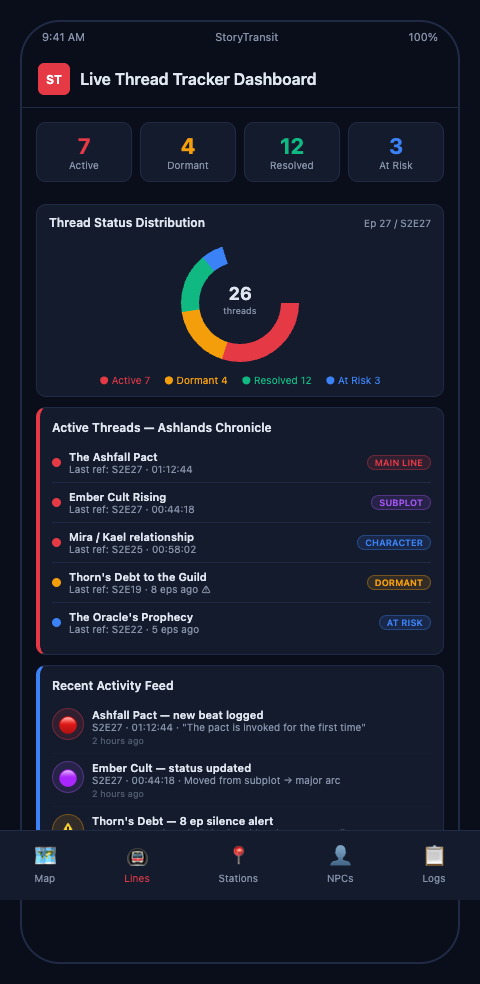
Integrating Thread Tracking Into the Pre-Edit Workflow
The most effective place for thread tracking work is the pre-edit pass. Before cutting a single second of audio, the editor pulls up the map and reviews which threads are active in this session. If listeners drop around the halfway mark, adding a narrative transition mid-episode can re-engage them—but you can only insert that transition intelligently if you know what threads are running.
The pre-edit thread review takes five to ten minutes when the map is current. It takes two hours when the map doesn't exist and the editor is reconstructing context from memory and previous show notes. Building the habit of map maintenance into every episode turnaround is what separates producers who edit efficiently from those who dread long-season projects.
Style sheets and plot grids are essential editor toolkit items for tracking internal consistency across episodes. In practice, a plot grid for an actual play show is a live document updated after every session: rows are threads, columns are episodes, cells contain status markers and brief notes. When you need to know whether the faction war thread touched episode 55, you check the grid. When you need to write show notes that accurately flag the live threads in episode 72, you pull from the grid.
Active arc tracking builds on these mechanics to show how producers manage the distinction between threads that are narratively active and threads that are technically open but dormant. That distinction matters for show notes, recap scripting, and listener orientation.
Thread Flags in Show Notes: Making Tracking Visible to Listeners
Once you have a functioning thread tracker, surfacing it in show notes requires minimal additional work. The thread status from your map becomes a structured section in each episode's description: which active threads appear in this episode, what happened on each line, whether any dormant threads were reactivated.
This serves two audiences. New listeners use the thread flags as orientation tools. Long-term listeners use them as memory aids—a quick reminder of where each line stood before hitting play. Both audiences are more likely to complete the episode and return for the next one when they can locate themselves on the map before starting.
Plottr's visual timeline layers plotlines vertically so writers see character arcs and subplot momentum simultaneously—applied to show notes, this means layering thread status markers so readers get the full arc picture without reading every previous episode's description.
Thread tracking is the foundational infrastructure that makes everything else in actual play production work more reliably: actual play editing becomes faster, show notes become more accurate, recap episodes become easier to script, and new listener onboarding has a documented basis rather than relying on producer memory.
Handling Thread Proliferation in Long Seasons
As a show grows, the number of open threads grows with it. A well-run season can accumulate twenty or thirty simultaneous live threads across plot, character, and world-state categories. At that scale, the tracker becomes harder to maintain without a triage system.
Thread triage is the practice of marking threads by priority tier. Tier-one threads are the season's load-bearing arcs—the threads that will need to be honored in the current story phase. The Lord Thadderon conspiracy is tier one if the show is building toward its reveal. Tier-two threads are active but not urgent—they're running, but they can be dormant for a few episodes without consequence. Tier-three threads are open but low-priority—they can remain dormant indefinitely until the story creates a natural reactivation point.
Triage doesn't remove threads from the tracker. It tells the editor which threads to protect during runtime cuts, which to mention in show notes even during dormant periods, and which can safely stay below the waterline until they become relevant again. A tier-one thread that appears in a session always gets flagged in the show notes and protected in the edit. A tier-three thread can be summarized in a quarterly thread-status update rather than mentioned every episode.
Show bibles in screenwriting serve as continuity guides during production; writers' assistants act as walking bibles for rapid fact-checking. For actual play shows, the thread tracker with triage tiers is the functional equivalent—not a static document but a living reference that every team member can consult before making production decisions.
The triage system also helps producers manage narrative maintenance for listeners. A thread that's been dormant for fifteen episodes needs a brief reorientation note when it reactivates—a cold open mention, a show notes flag, a brief "previously on" callout. The tracker's "last appeared" field makes it easy to see which dormant threads are approaching the threshold where listeners will need reminding before the thread comes back.
The triage process also creates a natural input into the show's narrative planning. When a producer reviews tier-one threads and sees that the Lord Thadderon conspiracy has been dormant for eight episodes, that's information the GM may want. It signals that the thread is approaching the listener-disorientation threshold—which is good data to have before planning the next session, not after recording it. Thread tracking at this level becomes a light feedback loop between the production team and the creative team without requiring heavy-handed story control.
For actual play shows with multiple editors cycling across a long season, the triage tier system is particularly valuable. An editor who picks up episode 55 for the first time doesn't need to understand the full narrative context of every open thread—they need to know which tier-one threads to protect and which tier-three threads can be managed lightly. That information lives in the tracker, not in an email chain or a conversation.
Narrative management in actual play podcast production is one of six simultaneous production responsibilities that producers carry. The thread tracker with triage tiers reduces the cognitive load of that specific responsibility without eliminating the others—so producers can allocate attention across all six production areas rather than letting narrative management dominate.
Actual play podcast producers who build thread tracking into their production workflow see compounding returns across every downstream task. Join the Waitlist for Actual Play Producers to access StoryTransit's live thread management system, built for shows with deep episode archives and active season arcs.