Why Your Actual Play Needs a Thread Tracker From Episode One
The Cost of Starting Late
Every week a thread tracker doesn't exist, the documentation debt grows. After episode 10, you have 10 sessions of untracked story decisions. After episode 30, you have a 30-session archaeology project. After episode 87, you have a full-time job just to reconstruct the thread map—and even then, you're working from show notes, memory, and community wikis rather than authoritative production records.
Continuity errors in serialized media require expensive post-production fixes; tracking from episode one prevents this. The continuity errors in actual play shows don't usually surface as obvious contradictions. They surface as dead threads—a plot commitment made in episode 23 that was never followed up on, a character relationship established in episode 41 that disappeared after a cast scheduling change, a faction introduced in episode 67 that reappears in episode 84 with different motivations because no one documented the original version.
AP producers juggle casting, play, editing, distribution, community—thread tracking cuts cognitive load. When the thread tracker doesn't exist, that cognitive load lands entirely in the producer's memory. One staff change, one long production hiatus, or one editor who wasn't there from the start breaks the continuity chain.
Lack of documentation and planning is a root cause of story continuity failures in long-form podcast production. This isn't a creativity problem. It's an infrastructure problem. The fix is not more talented producers—it's a system that captures story documentation as the show runs, episode by episode, in real time.
What to Track From Episode One
The episode-one thread tracker doesn't need to be complex. Six fields, one row per thread, updated after every session.
Thread name. Short, memorable, what the whole team will call it. "Cursed compass," not "the compass thing from episode 3."
Thread type. Plot thread (world-driven), character arc (PC-driven), or world-state thread (faction conditions, environmental changes).
Origin episode. Where was this thread introduced? Episode one tracking means this field is always accurate.
Status. Active (appeared in recent sessions), dormant (open but not appearing), resolved (concluded). This is the field that prevents dead threads from disappearing unnoticed.
Current-state summary. One sentence. Where does this thread stand right now?
Last appeared. Episode number where this thread last moved. Threads that haven't appeared in 10+ episodes and aren't marked dormant get flagged for producer review.
A plot grid tracks plot lines, character arcs, themes, and locations alongside scenes to ensure every thread progresses. The episode-one tracker is the actual play version of that grid—built for the specific dynamics of live-play recording, where threads are created by improvisation rather than outlines.
Planning the full arc before episode one is the most critical step to prevent mid-series story gaps. Most actual play shows can't plan this way, which makes the episode-one tracker the viable alternative: you can't plan the threads that will emerge, but you can capture them the moment they do.
Live thread tracking covers how the tracker integrates into the production workflow—what happens to the map at each stage from recording to release. Active arc tracking goes deeper on the distinction between active, dormant, and resolved status and how to manage thread status transitions over long seasons.
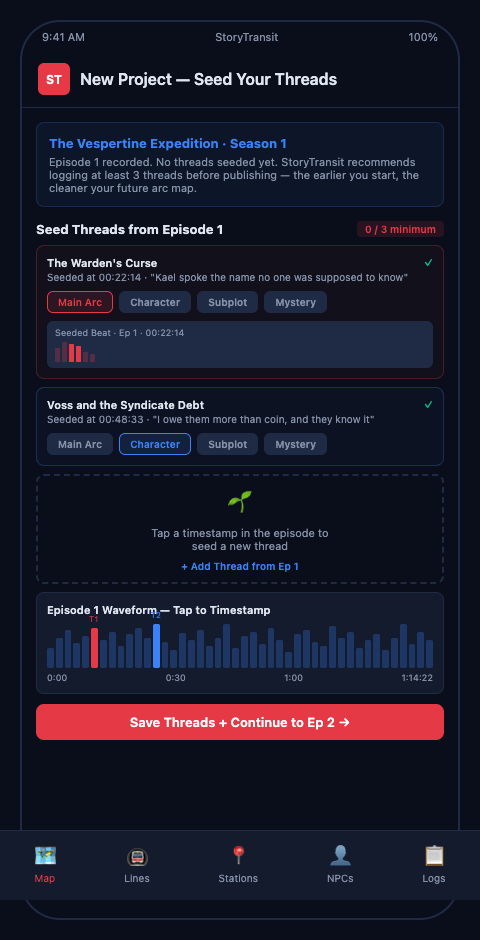
Episode One Initialization: The Setup Session
Before the first episode goes into the feed, spend 30 minutes on tracker initialization. You already know some threads exist from pre-production discussions: the campaign premise, the PC backstories, any world-state conditions the GM has established. Enter these as the first rows. Mark them as active. Write a one-sentence current-state summary for each.
After the first session records, add every new thread that emerged from play. NPC relationships, unexpected plot developments, items with narrative weight. If Kaelith's backstory surfaces in the cold open of episode one, that's an active character arc thread from day one. If Lord Thadderon gets name-dropped by an NPC, that's a dormant plot thread—introduced but not yet active.
Writers need master documents tracking character values, goals, and the specific experiences that triggered each shift. For actual play producers, this translates to character arc rows in the thread tracker: each PC gets a row, with their current arc goal and the most recent scene that advanced it. When a PC retires, their row gets marked resolved—but the threads connected to their arc don't necessarily resolve with them.
Weekly listeners consume approximately eight episodes per week; fans who discover a show binge multiple episodes rapidly. A listener who discovers your show at episode one and binge-listens to episode 20 in a weekend is building story memory fast. Your thread tracker ensures the show maintains the same continuity that listener is unconsciously tracking. When your documentation is as rigorous as your audience's memory, continuity breaks stop happening.
The parallel from written collaborative formats is precise: one-post-per-day documentation in PbP games demonstrates the same principle—real-time documentation is the only system that stays current with live-play storytelling. Retroactive documentation always lags.
StoryTransit is built for episode-one initialization. The tracker setup is part of the onboarding flow—so before your first episode is in the feed, the documentation infrastructure is already running. The map stays current because the habit of updating it is built into the production workflow from day one, not added as an afterthought at episode 30.
The Compound Effect of Episode-One Tracking
The value of an episode-one thread tracker isn't just that it prevents continuity errors—it's that every production task downstream becomes faster and more accurate. Show notes writing, recap scripting, mid-series listener onboarding, pre-edit thread review: all of these tasks are easier when the documentation is current and authoritative.
Consider the editor who joins the production team at episode 30. Without a tracker, their onboarding requires someone to walk them through the story context—hours of catch-up, still incomplete. With a tracker, they open the map and read 30 episodes of documented thread history in 20 minutes. They start editing with accurate story context from day one on the project.
This staff continuity benefit compounds across the full arc. Productions that run 80 or 100 episodes almost always experience team turnover. A producer who leaves after episode 50 is replaceable without losing institutional story knowledge if the tracker exists. A producer who leaves after episode 50 without a tracker takes decades of accumulated story context out the door with them.
The thread tracker also supports the cast's own arc awareness. Players who can review their character arc documentation before a session play more coherently—they're working from shared documentation rather than individual memory, which reduces the session-gap inconsistencies that create continuity errors in the first place. The tracker serves production and creative teams simultaneously.
The actual play organization problem that emerges around episode 20 or 30—where the story has become too complex to hold in anyone's head—is not a sign the show has grown too big. It's a sign the show needs documentation infrastructure to match its scale. Episode-one tracking means you never hit that wall. The documentation grows with the show, episode by episode, and the complexity stays manageable because it's externalized into the map rather than held in memory.
For shows already past episode one—even shows at episode 30 or 50—starting the tracker now is still worth doing. Every episode you add to the tracker from this point reduces future documentation debt. The archaeology work for past episodes is harder, but the forward tracking is exactly as easy as it would have been at episode one. The best time to start was episode one. The second best time is the episode you're currently editing.
The compound effect also manifests in audience-facing tools. A producer with a current thread tracker from episode one can generate accurate character cards for new listeners at any point in the season—because the character state documentation is current. They can update their "start here" episode guide at episode 80 with exactly the same effort it took to write it at episode 20—because the map shows them which threads are active and which junction episodes carry the most narrative weight.
The actual play organization benefit of episode-one tracking doesn't just prevent problems; it creates production capabilities that would otherwise require weeks of retroactive work. Producers can write accurate mid-season recap content without re-listening to the archive—because the thread log has the history. They can answer listener questions about story continuity with authority—because the authoritative record exists. All of these audience-facing tools become available at no additional work cost once the tracker is current.
Documentation from episode one means producers can make arc-aware editing decisions from the very first session. The editor who processes episode two with a current thread tracker from episode one already knows the status of every thread in the show. As the season grows, that continuity of documentation is the difference between an archive that feels like a coherent story and an archive that feels like a collection of individual sessions. Listeners feel that difference even when they can't name it.
Actual play podcast producers who start tracking from episode one never have to choose between a forty-hour documentation sprint and a broken continuity record. Join the Waitlist for Actual Play Producers and initialize your StoryTransit tracker before your first session goes live.