How Producers Track Which Story Arcs Are Still Active
The Arc Status Problem at Scale
A producer working on a single-arc story has it easy. The thread is either active or it's done. At episode six, arc status lives in memory; at episode twelve, it fits in a Google Doc. By episode 30, the show has accumulated arcs from three different sub-campaigns, two recurring NPCs whose storylines crossed and diverged, a prophecy thread that was introduced in the cold open of episode four and mentioned once since, and a guest character whose relationship with Kaelith is technically still unresolved.
Nobody is tracking all of that reliably. Actual play production labor is informal with no standardized arc-tracking infrastructure across shows. The spreadsheet the producer made in month one has grown into something nobody trusts, and the shared Notion wiki has entries from two different team members that contradict each other.
The failure mode is predictable: a thread that the audience has been tracking quietly disappears because no one in production knows it's still live. Or a dormant arc gets reactivated inconsistently — a new session introduces a callback that contradicts how the arc was left — because the current status wasn't documented anywhere reliable.
The subscriber impact of this failure is real. Listeners who track arcs carefully notice when a thread stops appearing. The first time it might seem like a deliberate pause. By the third time, it reads as a broken promise — the story set something up and walked away from it. This perception accumulates across a season and can drive churn at precisely the moments when a show's story should be building audience investment. Accurate arc status tracking is not just an organizational preference; it's an audience retention tool.
The Narrative Archive Dashboard
StoryTransit approaches arc status tracking through the transit network model. Every story arc is a line on the map. Live arcs have active trains running. Dormant arcs have established infrastructure but no current traffic. Resolved arcs are archived — the stations still exist on the map as history, but no new traffic is routed through them.
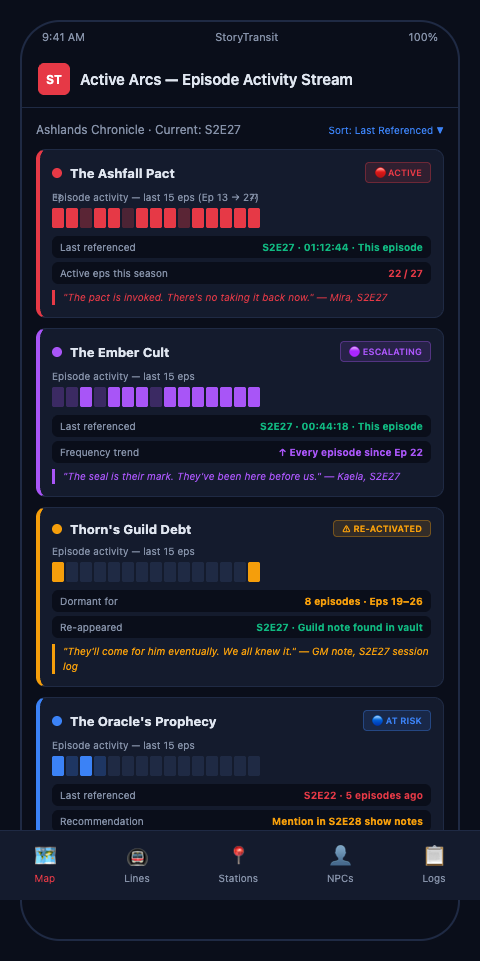
The narrative archive dashboard is the operational view producers use to answer one question at a time: which arcs are live right now?
The dashboard organizes arcs into three status categories:
Active arcs are threads with narrative momentum — something happened in a recent episode, and the story is clearly building toward a future payoff. Active arcs get flagged in every pre-edit brief and reviewed after every session. The count of active arcs at any given point is also a useful pacing signal: if the show has twelve active arcs and the episode feed has six episodes remaining in the season, something needs to accelerate or get cut.
Stalled arcs are threads that were active but haven't been touched in two or more episodes. They're still live — the promise hasn't been broken — but they're at risk of going dormant if they don't get addressed soon. Stalled arcs are the most dangerous status category because they're easy to forget and hard to reactivate without the audience noticing the gap. A stalled arc that drifts into dormancy without a planned reactivation is a continuity liability, and when the show has been running long enough that you're not sure which episodes contain which activations, a back catalog audit is the mechanism that makes stalled-arc recovery possible at all.
Dormant arcs are threads that have been intentionally or unintentionally put on hold. The cursed compass from episode four. Lord Thadderon's vendetta that was clearly foreshadowed but hasn't surfaced since the season one finale. Dormant arcs require the most careful reactivation planning — when they come back, they need to feel intentional rather than like a producer scrambling to close an open tab. The dashboard flags dormant arcs with their last activation episode, which makes it easier to decide whether a reactivation needs a brief cold open callback or a more substantial recap moment.
The Workflow Behind Arc Status Tracking
Maintaining accurate arc status requires a consistent update loop, not a one-time setup. The loop runs at three points in the production cycle.
Post-session update. After each recording session, the producer updates arc status based on the session debrief. Any arc that was touched in the session gets its status reassessed. New arcs get added. Arcs that reached a resolution point get moved to the archive. This update takes ten minutes if the session debrief captured the right context. The key discipline is updating the dashboard before the next edit begins — not after. An editor who starts work with a stale dashboard is working from the wrong map.
Pre-edit review. Before the editor receives the audio, the producer pulls the current arc status dashboard. Active and stalled arcs are flagged in the editing brief. This ensures the editor knows which threads are carrying live traffic and which scenes are load-bearing. TV showrunners are responsible for arc continuity across seasons and use structured systems to maintain it — the arc status dashboard is the producer's equivalent. For a show past episode 20, this pre-edit review is the single most impactful thing a producer can do to improve edit quality without changing the editing process itself.
Post-edit reconciliation. After the edit locks, the producer updates the dashboard again based on what survived the cut. If a scene carrying a stalled arc was cut for runtime, that arc may need to be escalated — the GM needs to know it still needs addressing in a future session. This reconciliation step also catches cases where a scene was cut that carried an arc the producer didn't know was still live — a gap between what the dashboard said and what the recording contained, which is itself a signal that the post-session update missed something.
AI tools can now extract active versus resolved narrative threads from serialized TV episodes, and arc timeline tools visualize how storylines evolve across episodes. These are useful signals for where arc-tracking tooling is heading. StoryTransit sits in this category — a purpose-built narrative tracking system for actual play producers, not a repurposed project management tool.
Airtable's relational database excels at structured arc tracking, and many producers start there. The limitation is that Airtable doesn't understand the narrative relationships between arcs — it tracks rows, not story logic. Fiction continuity tools like Plottr and Bibisco help writers track active versus resolved storylines, but these are designed for planned fiction, not for the evolving, improvised structure of an actual play podcast. StoryTransit's transit network model is built around the specific way actual play stories grow — branching, looping back, unexpectedly accelerating — rather than the linear arc model of scripted storytelling.
Producers managing guest character arcs across multiple appearances will find the arc status system intersects directly with guest character arcs — guest storylines need their own status tracking independent of the main arc dashboard. For producers interested in how arc tracking works in live, real-time contexts, real-time beat tracking from LARP production covers the same challenge in a synchronous format.
Making Arc Status a Production Habit
Arc status tracking only works if it's updated consistently. The best system in the world is useless if the dashboard reflects episode 18 and you're prepping episode 26. The producers who maintain accurate arc status treat it as a core production artifact, not a reference document they'll get to eventually.
The habit is easier to maintain when the update points are anchored to existing production events rather than scheduled as separate tasks. The post-session update happens because the session debrief happened. The pre-edit review happens because the editor brief is being prepared. The post-edit reconciliation happens because the edit just locked and the next session prep is starting. When arc status updates are embedded in the workflow rather than added on top of it, they get done.
The arc count is also a useful season-pacing signal. If the dashboard shows fourteen active arcs at episode 20 of a 30-episode season, that's too many threads to close satisfyingly in the remaining episodes. The producer can surface this to the GM while there's still time to triage — decide which arcs can resolve early, which get carried to the next season, and which ones might be gracefully retired to the dormant category before they drag the ending down. This kind of pacing visibility is only possible when the arc status dashboard is current.
For shows using guest players, the arc status system also needs to account for arcs that are dormant specifically because the guest player hasn't returned yet — not because the thread was abandoned. These arcs have a different reactivation path than standard dormant arcs: they require coordination with the guest player's schedule as well as story planning. The dashboard should flag these with a distinct status so they don't get treated as ordinary dormant arcs.
StoryTransit's arc status workflow is designed to fit inside the production cycle you already have — not to add a separate documentation project on top of it. The dashboard updates happen at the points where the team is already meeting: post-session debrief, pre-edit brief, post-edit reconciliation.
Actual play podcast producers who want a purpose-built arc tracking system can join the StoryTransit waitlist. Join the Waitlist for Actual Play Producers and get early access to the narrative archive dashboard before public launch.