Managing Guest Character Arcs Across Multiple Seasons
The Guest Character Problem at Scale
A one-off guest appearance in an actual play podcast is relatively simple to manage. The guest plays a character for one session, the arc is bounded, the production team documents it and moves on. The moment a guest becomes recurring — returning in season two with the same character and an evolving storyline — the complexity multiplies in ways that are easy to underestimate.
By season three, a show with even moderate guest involvement might have four or five recurring guest characters at various stages of their storylines. Each one has an established relationship with the main cast. Each one's arc has touched multiple episodes across a production gap that might span twelve to eighteen months. And the guest player, who is not in every session, may have a very different memory of where their character's arc stood than the production team does.
Recurring guest characters require deliberate arc design to avoid contradicting established story facts. Multi-season planning must account for returning characters whose arcs span production gaps. These principles from episodic TV apply directly to actual play production — with the added complication that the guest characters are improvised by players who may not have listened to every episode since their last appearance.
Critical Role's guest character returns only work because character history was documented and preserved. That documentation is not accidental — it's the production infrastructure that makes the guest returns narratively coherent.
The problem is also specific to guest characters in a way that doesn't apply to main cast arcs. Main cast characters are in every session; their arc history is constantly refreshed in the production team's memory. A guest character who appears four times across two seasons has a history that needs to be reconstructed from documentation rather than recalled from experience. The gaps are exactly where the continuity errors happen.
The Guest Arc Transit Map
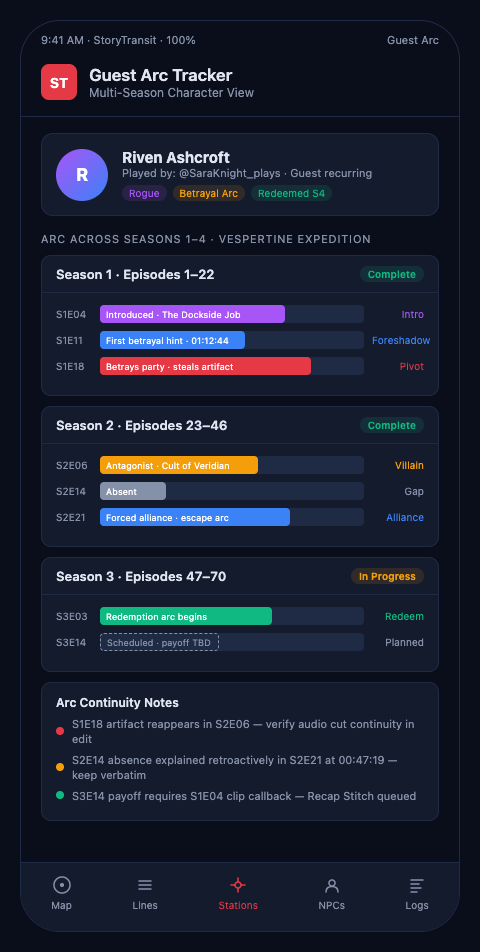
StoryTransit handles guest character arcs as dedicated routes on the narrative transit map — routes that run on their own schedule, connect to the main lines at specific junction stations, and have their own status tracking independent of the core arc dashboard.
Each guest character gets a route profile that captures four categories of information.
Arc history. Every episode in which the guest character appeared, with a brief summary of where the character's arc stood at the end of each appearance. This is the production team's source of truth — not the guest player's memory, not the GM's recollection, but the documented record of what aired. The arc history is built from the actual episode content, not from session notes alone. For a guest character who appeared in season one episode 7 and is returning in season three episode 4, the arc history is the only reliable record of what the audience heard.
Relationship state. The current status of the guest character's relationships with main cast members. These relationships are the load-bearing narrative structure for a recurring guest — they determine how the character can plausibly return and what the audience will expect from them. A guest character whose relationship with the main party ended ambiguously in season one needs a documented relationship state that the GM and production team can reference when planning the season two return. Without this, the GM may write the return as if the ambiguity was resolved when it wasn't.
Open threads. Any narrative promises made through the guest character that haven't resolved. A vow taken in season one. A secret revealed in season two that the character doesn't know the party knows. A grudge that was never addressed. These open threads are the specific continuity obligations that a returning guest appearance must respect. They're also often the richest material for the return episode — the audience remembers the unresolved tension and will reward a callback to it.
Return brief. Before each guest appearance, the production team prepares a brief that summarizes the arc history, relationship state, and open threads for the guest player. Podcast platforms offer guest management tools but lack story-arc continuity tracking across seasons. The return brief is the production team's answer to that gap — a document that brings the guest player up to speed on where their character's arc stands without requiring them to relisten to twenty episodes.
Managing Cross-Season Guest Continuity
The return brief solves the immediate coordination problem. Managing guest arcs across a full multi-season run requires additional practices.
Standalone arc value. Guest character episodes need standalone value while contributing to the overarching seasonal arc. When planning a guest return, the production team should confirm that the episode works as a self-contained story experience for listeners who don't remember the guest character from season one — even if the episode also advances the long-term arc for listeners who do. This dual-layer design is what keeps guest appearances from feeling like inside references that only reward subscribers who've been there from the start.
Production gap documentation. When a guest character's arc spans a multi-month production gap, the documented arc history is what prevents the gap from becoming a continuity crack. The longer the gap, the more critical it is that the arc history was captured from the episode content rather than from memory. Recurring characters economize storytelling by reusing established personas but require careful continuity tracking. A production team that relied on memory for the first year of guest arc documentation will find that memory has degraded significantly by the time the character returns in year two.
Guest debrief post-appearance. After each guest appearance, add the new episode's arc developments to the guest character's route profile before the production team's memory of the session fades. The window for accurate documentation closes fast — within 24 to 48 hours, the specific details of what happened and what it meant start blurring. The post-appearance debrief captures the arc state while it's still clear.
Audience continuity signals. For shows with an active community, the audience often tracks recurring guest character history more carefully than the production team does. Community discussions about guest character returns — "I wonder if she still has that grudge from season one" — are useful signals for which open threads the audience is most invested in. Monitoring these discussions before a guest return can inform which open threads the return brief should emphasize.
Return brief version history. Keep a dated version of each return brief alongside the live route profile. This creates an audit trail — if a continuity question arises mid-season, you can see exactly what the guest player was told before their last appearance and verify whether the current arc state is consistent with what they were briefed on.
Managing guest arcs connects to the broader challenge of running a show with network-level complexity. Multi-show shared lore covers what happens when guest arcs span not just multiple seasons but multiple shows in the same network. Season three onboarding addresses how to present guest character history to new listeners arriving at a point where those arcs are already well-developed. For producers thinking about how recurring characters are documented across long-running campaigns, villain roster management from the homebrew GM world covers the same documentation discipline applied to recurring antagonists across multi-year play.
The Guest Character as a Narrative Asset
A well-managed recurring guest character is one of the strongest long-term narrative assets an actual play podcast can develop. The audience builds investment in them. Their returns create genuine anticipation. Their arcs add narrative density that the main cast alone can't generate.
That value is only accessible if the arc is tracked. Instagantt season planning templates handle guest scheduling but don't address narrative arc continuity tracking. The scheduling tools exist; the narrative tracking tools are what's missing. A guest appearance that lands poorly because the continuity wasn't maintained doesn't just fail in isolation — it damages the audience's trust in future guest appearances and in the show's broader arc management.
The audience investment in recurring guest characters is also disproportionately high relative to the character's episode count. A guest who has appeared in four episodes across two seasons may have generated more listener discussion and community engagement than some main cast arcs that span the full run. The audience notices when that character returns — and they notice when the continuity feels off. The route profile and return brief are what ensure the character who returns in season three feels continuous with the character the audience built investment in during season one.
For shows early in their guest arc management practice, the route profile system doesn't need to be elaborate. A simple document per guest character — arc history, relationship state, open threads — is sufficient for the first few seasons. The system scales with the show: as the guest character's history grows, the document grows with it. The key is establishing the documentation habit early, while the arc history is still recent enough to reconstruct accurately from memory and episode audio.
StoryTransit's guest arc management tools — the route profile, the return brief, the cross-season continuity tracker — are built specifically for this gap. Actual play podcast producers managing multi-season guest storylines can join the waitlist now. Join the Waitlist for Actual Play Producers to get early access to the guest arc management system before launch.