Expert Methods for Dropping New Listeners Into Season Three
The Mid-Series Listener Problem Is Getting Larger
Actual Play Podcast Growth Report — Sounds Profitable documents that actual play podcasts on Spotify grew 110% between 2021 and 2023. That growth means a large and increasing share of any show's new subscribers are arriving mid-series — discovering the feed through recommendations, algorithm surfacing, or cross-promotion at a point well past episode one. Podcast Listener Statistics 2026 — DesignRush confirms that only 3.9% of loyal listeners skip back catalogs, meaning the expectation that new arrivals will "go back to the beginning" is not a realistic onboarding strategy.
Season three is where the mid-series listener problem becomes acute. By that point, most actual play shows have built substantial narrative complexity: multiple major arcs in progress, character histories spanning dozens of episodes, faction dynamics with deep roots in season one lore. A listener arriving at episode 75 and encountering a reference to the Sunless Citadel plotline from episode 12 has no context — and without structural help, they often leave.
The Podcast Consumer 2024 — Edison Research confirms that habitual listeners skip shows that feel inaccessible mid-series. The actual play format's greatest strength — deep, long-running serialized narrative — is also its biggest barrier for late-entry audiences when producers haven't built explicit onboarding infrastructure.
Designing the Season Three Entry Point
The expert approach to mid-series onboarding treats season three's first episode as a dual-purpose production: a continuation for existing listeners and an orientation for new arrivals. That requires knowing exactly which transit lines are active as season three opens — and presenting them at the right level of detail for a listener with zero prior context.
The expert listener strategy here is counterintuitive: don't open season three where season two left off. Open it with the current state of the system. Most producers open a new season with the dramatic consequence of the season two finale — the immediate emotional hook for existing subscribers. That choice works for retention but fails for the late-entry audience, who has no context for why the consequence matters. A season three entry point that opens with the system map — "here are the three arcs entering this season and where each one stands" — serves both audiences simultaneously. Existing listeners get their orientation brief in 90 seconds and move on. New arrivals get the permission structure they need to board the feed at this point rather than going back to episode one.
For parallel methodology in managing similar mid-series entry challenges, listener drop-off prevention in earlier episodes creates the foundation that makes season three onboarding viable — shows that have retained their early audience have more continuity infrastructure already in place.
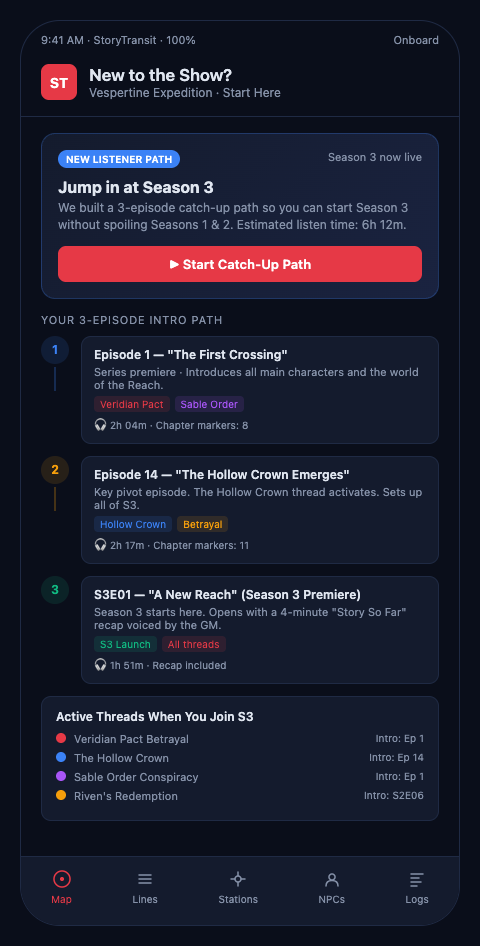
StoryTransit makes that map explicit. Each active plot thread at the season three opening is a transit line with a definable current station and a brief origin story — where the line started, what's already happened on it, and where it's heading next. The season three entry point episode can be structured around those transit lines rather than around a chronological recap of 74 episodes.
Podcast Onramps and Episode Entry Points — Pacific Content presents data-backed research on which archive episodes attract first-time listeners and how gateway episodes function as structural entry infrastructure. For actual play, the season premiere is the natural gateway, but it has to be engineered to function that way — not assumed to work by default.
Master the Listener Journey: Boost Podcast Engagement — Ausha documents that listeners who encounter a show mid-series need structured onboarding to convert to regular audience members. The key word is "structured" — an ad-hoc recap within a regular episode is not the same as a designed entry point that anticipates late-entry audience needs.
The transit map structure provides three specific onboarding assets: a thread status list for show notes (what's active, what's dormant, what just resolved), a cold open that names the active lines for new arrivals before the session begins, and an optional dedicated recap episode that functions as a subway map for the full narrative system.
How to Structure a Podcast for Higher Listener Retention — Hello Audio confirms that a hook plus roadmap at episode start dramatically reduces drop-off for first-time episode listeners. The season three cold open that maps the active transit lines is exactly that roadmap — executed at the series level rather than the episode level.
Advanced Tactics for Late-Entry Audience Conversion
The transit map show notes block. Every season three episode's show notes should include a one-paragraph "story so far" that describes the currently active transit lines in plain language. This doesn't require a full recap — three sentences on the main arc, one sentence on each secondary arc that's in motion. New listeners scan it before listening; returning listeners skip it. The cost is minimal; the onboarding value for the late-entry audience is significant.
The season three orientation episode. Before the first session of season three, produce a standalone 15-20 minute orientation episode that isn't session content — it's a structured narrative overview of the active arcs entering the new season. Frame it explicitly as a "for new listeners" episode. Existing listeners will skip it; new ones will treat it as a permission slip to join the feed at this point rather than at episode one.
Thread depth calibration by arc. Not all active arcs need equal explanation for new listeners. The primary arc — the siege timeline, the Lord Thadderon conflict, whatever is dominating season three — needs three to four sentences. Secondary arcs can be described in one or two. Dormant arcs don't need explanation at all; flagging them as "dormant stops" in show notes is sufficient for a listener who hasn't encountered them yet.
The catching up listeners priority problem. Mid-series onboarding documentation needs a clear target audience: the listener who is specifically evaluating whether to join the feed at season three. That listener is not looking for a comprehensive archive guide — they're deciding whether the current state of the narrative is accessible enough to justify commitment. Show notes and orientation episodes that pitch the show's quality rather than mapping its current state miss that audience entirely. The practical rule: every season three onboarding asset should answer one question — "can someone who starts here follow what's happening?" — before it addresses any other goal.
The guest character arcs framework provides the complementary skill set — when late-entry listeners encounter recurring guest characters mid-series, the arc documentation system ensures those characters arrive with enough context to read naturally even without prior exposure. For parallel methodology in text-based serialized communities, the mid-campaign onboarding guide covers how play-by-post GMs handle the same challenge in a different format.
Make Season Three Accessible Without Simplifying It
The expert listener strategy for mid-series onboarding is not about dumbing down the narrative. Season three can be exactly as complex as the story requires — Kaelith's arc can have seventeen layers of foreshadowed consequence, Lord Thadderon's motivations can involve season one callbacks that reward long-term listeners. The orientation structure exists alongside that complexity, not instead of it.
StoryTransit gives producers a systematic way to make that orientation structure part of the production workflow rather than an afterthought. When the transit map is current, generating a season three entry point brief takes minutes, not hours.
Actual play podcast producers who are heading into a new season with a growing audience and a complex narrative are exactly who this system was built for. Join the Waitlist for Actual Play Producers and get early access to StoryTransit — the platform that turns your narrative complexity into a strength for mid-series listeners instead of a barrier.