Why Listeners Drop Off at Episode 15 (and How to Prevent It)
Why Episode 15 Is the Danger Zone
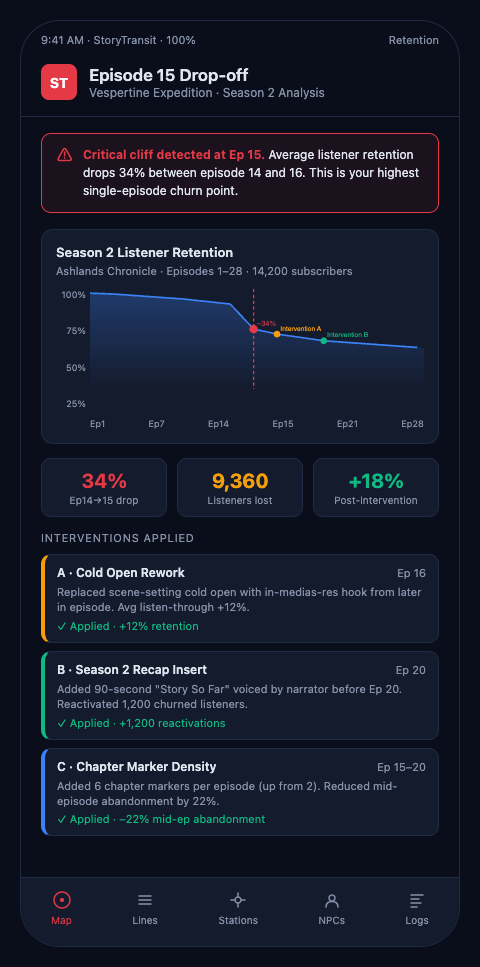
The drop-off doesn't happen because episode 15 is bad. It happens because of what episode 15 represents: the show has been running long enough to accumulate real complexity, but not long enough to have built the institutional audience trust that keeps listeners through rough patches. Audience churn at this stage is a structural problem, not a quality problem — and any podcast dropout retention strategy that treats it as a marketing failure misses where the engagement drop is actually occurring. Listener engagement doesn't collapse at episode 15 because the show got worse; it collapses because the show got harder to follow.
By episode 15, the average actual play podcast has introduced multiple active arcs, a cast of recurring NPCs the audience is expected to remember, several unresolved questions that have been building for weeks, and at least one callback that requires remembering something from episode four. New subscribers who found the show at episode 10 or 12 are now sufficiently lost that continuing feels like work. Subscribers who've been present from the start but missed a few episodes in the middle have accumulated enough gaps that they're no longer confident they understand what's happening.
Less than 20% of listeners remain after one month; 96% have churned within six months of first listen. Listener churn increases when episode value or narrative clarity drops mid-series. Mid-series drop-off accelerates when listeners feel lost or unable to track ongoing story threads. These patterns converge at episode 15 because that's when complexity and accessibility are most out of balance.
Serialized podcasts face an entry-barrier problem: new listeners discovering the show at episode 15 face a wall. The wall is the accumulated story complexity with no onboarding infrastructure to help them scale it.
The other dimension of the episode 15 problem is pacing perception. Even subscribers who've followed the show since episode one can start to feel that the story isn't going anywhere around episode 15. Multiple threads are active, but none has reached a resolution milestone yet. The complexity feels like clutter rather than depth. This perception is addressable — and it doesn't require changing the story. It requires production decisions that help the audience track the story they're already in.
The StoryTransit Approach: Reorientation Architecture
StoryTransit treats the episode 15 drop-off as a transit problem. When too many lines are running, new and returning riders need a system map — something that tells them which lines are currently active, which stops matter right now, and how to get back on track if they've missed a few stations.
Reorientation architecture is a set of production decisions that build this map into the show without interrupting the story. The architecture has four components.
Cold open context anchors. At episode 15 and beyond, the cold open should do double duty: set up the episode's immediate action while also briefly anchoring any active arc that's central to the episode's content. This doesn't require a full recap — thirty seconds of context positioning ("After Lord Thadderon's revelation last week...") is enough to orient a listener who missed episode 14. The cold open becomes a mini-reentry point with zero friction for committed listeners. For the subscriber who's been present from the start, it functions as a brief momentum signal; for the listener who's slightly behind, it's the thread they needed to feel caught up.
Show notes arc index. Every episode from episode 10 onward should have a show notes section listing the active arcs relevant to that episode. Not a summary — just a labeled list with episode links for where each arc was introduced. Listeners who are fuzzy on the cursed compass storyline can click back to episode four without stopping the episode. Structural hooks and content checkpoints at episode milestones reduce drop-off. The arc index in show notes is the lowest-effort reorientation tool a producer can deploy — it costs five minutes per episode and pays back in subscriber retention over a full season.
Episode 15 subscriber re-engagement. Treat episode 15 as a soft relaunch opportunity. A brief in-episode moment acknowledging that the story has grown ("we're fifteen episodes in, here's the landscape") validates the audience's investment and gives orientation to anyone who feels behind. This is not a full recap — it's an acknowledgment that the show is aware of its own complexity and is holding the door open. The re-engagement works because it addresses the emotional driver of drop-off: the feeling that the show has moved on without the listener.
Binge-friendly arc summaries in the feed. Binge-watching increases narrative transportation and parasocial bonds; interruption weakens these effects. Listeners who find the show at episode 15 and want to binge from the beginning are your best long-term subscribers — they're building exactly the kind of parasocial investment that drives retention. Audience completion rate benchmarks are 70-90%; mid-episode drop-off patterns require active intervention. Short arc summary posts in the episode feed give binge-listeners landmarks without requiring them to listen to every episode in sequence.
The reorientation architecture also has compounding value across the back catalog. A subscriber who discovers the show at episode 40 and binges backward through the feed encounters cold open context anchors, show notes arc indexes, and mid-season recaps at regular intervals throughout their catch-up journey. Each orientation touchpoint reduces the probability that they'll feel lost and drop off before reaching the episodes where the show has achieved its best narrative work.
Long-Term Retention Beyond Episode 15
Solving the episode 15 drop-off is a starting point. Maintaining subscribers through episode 30, 40, and beyond requires ongoing reorientation architecture — not a single intervention.
The most effective long-term tactic is keeping the story map legible as complexity grows. Shows that manage this don't simplify the story — they add orientation infrastructure proportionally. As a new arc launches, a show notes link to its origin episode gets added. When a dormant arc reactivates, a cold open context anchor references its history. The infrastructure scales with the narrative. This proportional approach means the audience's cognitive load stays roughly constant even as the story becomes more intricate.
The orientation infrastructure also functions as a production discipline. When the producer has to write the arc index for episode 20's show notes, they're auditing which arcs are active. When they're scripting the cold open context anchor, they're identifying which arc most needs attention in this episode. The production practices that create orientation for listeners also create clarity for the production team.
Season three onboarding covers what happens when this orientation architecture needs to handle not just mid-series listeners but full-season newcomers — the same principles apply at larger scale. For arcs that went dormant and are coming back, revive dormant storyline addresses the specific challenge of reintroducing a thread without it feeling like a retcon. Producers working with other serialized community formats will find pbp player dropouts instructive — the same arc continuity challenges that cause listener churn in podcasts appear in play-by-post dropout patterns.
What Listeners Are Actually Telling You
Subscriber drop-off is not a judgment about the story. It's a signal about orientation. Listeners who leave at episode 15 are not saying the show is bad — they're saying they couldn't find their footing when the story got complex. That's a production problem, not a creative one.
The production fix is available at every episode from the first one onward. Shows that build reorientation architecture from episode one don't have a crisis at episode 15 — they have a stable audience that knows how to stay oriented as the story grows. Shows that try to retrofit orientation architecture at episode 20 after the drop-off has already happened face a harder recovery, because some of those lost subscribers won't return for a single re-engagement moment.
The episode 15 metric is also a useful benchmark to track explicitly. If the producer knows which episodes generate subscriber drop-off — via podcast host analytics, listen-through rates, or subscriber count changes — they can correlate that data with the reorientation architecture deployed at those points. Episodes with cold open context anchors and show notes arc indexes should have lower drop-off than episodes without them. This feedback loop turns orientation architecture from a production best practice into a measurable retention intervention.
Mid-series listener onboarding is not a one-time problem to be solved at episode 15. The show will continue to grow, new subscribers will continue to arrive at different points in the back catalog, and lapsed listeners will continue to return after gaps. The orientation architecture should be durable enough to serve all of those listeners at any entry point — which means it needs to be maintained as a standing feature of the production workflow, not deployed as a one-off fix.
StoryTransit gives producers a live view of arc complexity at any episode point, which makes it possible to deploy reorientation architecture before the drop-off happens rather than in response to it. The goal is a show where the audience can always find their seat, no matter when they boarded the train.
Actual play podcast producers who want to stop losing subscribers at the complexity wall can join the StoryTransit waitlist. Join the Waitlist for Actual Play Producers to get early access to the retention architecture tools and the episode 15 intervention framework.