Managing Villain Rosters Across a Five-Year Campaign
Eleven Villains and None of Them Feel Real
By Session 60 of a five-year campaign, the party has typically amassed an antagonist portfolio: the archlich who set everything in motion, the merchant guild chair who enabled the cult, the cult's regional commander who defected, the former cult commander now working for the party, the corrupt city guard captain who disappeared after Session 35, the noble house patriarch quietly funding chaos in Brenhorn Village, the assassin who keeps getting hired to eliminate party members, and four others introduced at various points for various reasons.
Which of those eleven has an active plan right now? Which ones know about each other? Which ones have changed their goals based on what the party has done? If you can't answer those questions without 20 minutes of note archaeology, your villain roster has outgrown your tracking system. The same catalog NPCs before memory fails principle applies to antagonists — without structured records, villain consistency erodes the same way NPC consistency does, just with higher narrative stakes.
Roll20's campaign duration research shows D&D campaigns average six months to two years, with villain tracking across that span requiring systematic documentation. At five years, you're in the extreme tail of that distribution — which means your villain roster complexity is also in the extreme tail.
Story Grid's analysis of antagonist function frames the core design principle: the antagonist designs the crucible. Villains without their own story arcs feel like obstacles, not characters — and obstacle-villains are forgettable even when they're mechanically dangerous. For a villain to matter at Session 87, they need to have been doing things between Session 35 and Session 87.
Storytelling DB's Villain's Journey framework makes this structural: villains need independent story arcs that the protagonist interrupts, not just reactive opposition. Every villain on your roster should have goals they'd be pursuing regardless of what the party is doing — and those goals should be advancing based on real-world time and campaign events.
PMC research on hippocampal narrative construction found that the hippocampus integrates events into coherent narratives and that reintroduced characters trigger stronger recall than new ones. A villain who disappeared at Session 35 and returns at Session 60 with consistent motivation and accumulated consequences hits harder than a new antagonist introduced cold — provided you've maintained the continuity between appearances.
The Villain Roster Transit System
Each villain is a line on your campaign map. The line runs from their introduction station through their arc — their plan advancing, responding to the party's interference, achieving partial goals, suffering setbacks — toward a terminus that's either resolution or catastrophic payoff.
The key tracking discipline is maintaining each villain's current state independently of the party's current focus. The party has been ignoring the noble house patriarch for 20 sessions while pursuing the archlich. That doesn't mean the patriarch paused. His plan continued. His resources shifted. His leverage over the city guard captain either materialized or was lost when the captain disappeared.
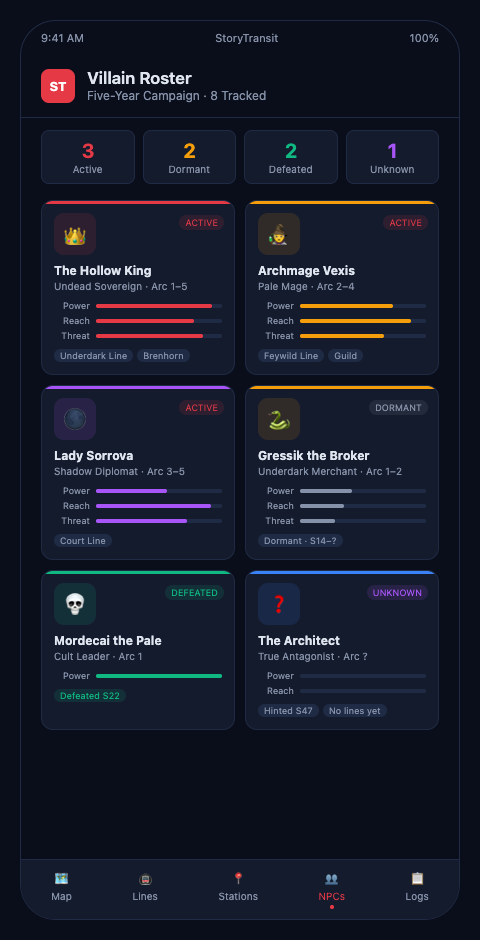
Before each session, consult your villain status board — one entry per active villain with four fields: current location/status, current plan phase, most recent action, and next planned action if uninterrupted. This is your antagonist operations log. It's how you know what the merchant guild chair is doing this week even if the party hasn't thought about her in two months.
Villain rosters work in tiers. The Tier 1 villain is your current primary antagonist — the one the party is actively engaging. Tier 2 villains are complications and secondary threats whose plans intersect with the Tier 1 conflict. Tier 3 villains are dormant antagonists — their threats exist, their plans are running, but they're not visible to the party right now.
Weaving many NPCs across a five-year roster requires the same tier discipline for supporting characters — the villain roster is a specialized case of the broader NPC management challenge, with the additional requirement that each villain maintains independent narrative agency. The villain roster system is sustainable only when it sits within a larger NPC cataloging discipline. You can't track antagonist arcs if your NPC catalog has gaps.
For event-based storytelling contexts, the challenge of managing multiple antagonist threads running simultaneously appears in NPC schedules for festival LARP events — a different format facing the same coordination challenge with higher real-time stakes.
StoryTransit's villain roster module tracks each antagonist as a transit line with its own stations, status, and advancement schedule — automatically surfacing Tier 2 and Tier 3 villains who haven't appeared recently but whose plans should be advancing.
Building Your Five-Year Villain Tracker
The villain tracker has four components, separate from your general NPC catalog.
The villain dossier. One page per active villain: name, backstory summary, core motivation, current goal, resources available, and relationship web (who they know, who they employ, who they fear). The core motivation is the foundational element — it must remain consistent across every appearance. If the merchant guild chair is motivated by personal survival above faction loyalty, that fact shapes every decision she makes across five years of play.
The plan advancement log. For each villain, a chronological record of their plan's progress. Session 20: guild chair secures leverage over the city guard captain. Session 34: guild chair uses that leverage to redirect an investigation away from the cult. Session 45: cult discovers the guild chair's double-dealing and sends an assassin. These entries are how you know what the guild chair's situation is when the party finally confronts her in Session 70.
The interference record. Every time the party's actions affected a villain's plan — intentionally or otherwise — log it here. Session 48: party killed the assassin sent after the guild chair, saving her life without knowing it. That interference has consequences. The guild chair now owes an unknown debt to people who don't know they're owed it. That's a story engine.
The network map. A simple diagram showing relationships between villains. Who works for whom? Who knows about whom? Who has leverage over whom? The corrupt city guard captain worked for the noble house patriarch. The cult's regional commander was blackmailing the captain. When the captain disappeared, both the patriarch and the commander had to respond — you can only know that if the network map made that relationship explicit.
Master the Dungeon's campaign management tools provide dedicated villain tracking with motivations, leverage, and relationship webs — a practical template for the dossier and network map components above.
The Angry GM's plot architecture framework recommends organizing antagonists into manageable tiers to prevent complexity overload in multi-year campaigns — the tiering system is the structural discipline that keeps a roster of eleven villains from becoming unmanageable.
Advanced Tactics for Long-Campaign Villain Management
The villain quarterly review. Every 10-12 sessions, review your full villain roster. Promote dormant Tier 3 villains who have been inactive long enough that the party has likely forgotten them — a surprise resurgence is more effective than a planned one. Retire Tier 2 villains whose story arcs have reached natural conclusions without requiring party confrontation.
Reactive plan shifts. Villains who never update their plans based on party actions feel mechanical. After any session where the party significantly advances or interferes with a villain's agenda, update that villain's next planned action. The merchant guild chair doesn't continue pushing the same plan after the party exposed her leverage scheme — she adapts. Document the adaptation.
Villain-to-villain consequences. The most sophisticated villain roster moment is when two villains' plans intersect without party involvement. The noble house patriarch and the cult's regional commander come into conflict over the same resource. The party didn't cause this — but they'll need to navigate it. Plan these collisions in advance based on your villain network map.
Consistency as character. A villain at Session 87 should speak, reason, and act consistently with who they were at Session 20 — accounting for how they've changed based on what's happened to them. Writer's Magazine's antagonist craft analysis confirms that a villain's goals, wound, and internal logic must be consistent across every appearance for narrative credibility. Your villain dossier's core motivation field is what enforces that consistency.
Homebrew conflict across a five-year campaign is only as rich as the antagonists driving it. Eleven villains is a feature, not a bug — provided each one has a documented arc, a consistent motivation, and a plan that keeps advancing even when the party isn't looking.
Your Villains Deserve Better Tracking Than Memory
A five-year campaign's villain roster is one of its richest narrative assets — but only if those antagonists remain consistent, active, and connected across years of sessions. Build the dossier, maintain the plan log, map the network, and run quarterly reviews. Your players at Session 100 will encounter villains they first met in Session 20 and recognize them as the same characters — older, changed by consequences, but unmistakably the same people. That's what homebrew conflict at its best feels like.
StoryTransit's villain roster tools give homebrew D&D dungeon masters the dungeon master villain tracking system that five-year campaigns demand. Join the waitlist and start treating your antagonists like the full characters they were always meant to be.