Weaving 40+ NPCs Into One Coherent Storyline: Expert Methods
The 40-NPC Incoherence Problem
Most DMs hit the NPC coherence wall somewhere between Session 30 and Session 60. The cast has grown organically — each session introduced one or two new characters, each subplot brought its own set of supporting actors. Now the party has 42 named NPCs in their history, and the DM cannot reliably remember who hates whom, which faction employs which merchant, or whether the half-elf bard's contact in Brenhorn Village is still alive. This is where weaving many NPCs into a coherent character storyline stops being a craft question and becomes an infrastructure question. The dungeon master expert at managing large casts is not necessarily the one with the best memory — it's the one who built the best external system, allowing homebrew interconnection to be visible rather than implied.
The resulting play experience is visible to players even when they cannot name the problem: NPCs behave inconsistently, motivations shift without in-world explanation, and the world stops feeling like a living system with its own logic.
The Cognitive Science of Narrative establishes the mechanism: narrative comprehension requires attention, arousal, and memory working together. For 40+ NPCs, unassisted recall fails. The cognitive architecture that handles four characters confidently collapses when that cast grows to 40.
Cognitive Load Theory is precise about working memory limits — externalized relationship maps reduce the intrinsic cognitive load that would otherwise crush a DM managing a large cast during live sessions. The solution is not a better memory. It is moving the relationship map outside your head.
The incoherence problem is particularly dangerous because it is self-reinforcing. The DM who cannot remember which NPCs are connected to which subplots starts to treat each NPC as an isolated character. Isolated characters produce isolated interactions. Isolated interactions cannot produce the layered, echoing sense of a living world that makes a long homebrew campaign feel like more than a series of disconnected adventures. By the time the DM recognizes the problem, the NPC web has been operating without structure for long enough that rebuilding it retroactively is a significant project.
The expert approach is to build the NPC web as a first-class structure from the beginning of the campaign — and to maintain it actively as the cast grows. Not a list. A network. Every NPC's place in the network is defined by their relationships, not just their characteristics.
The Transit NPC Web: Interconnection as Infrastructure
Expert DMs who handle large NPC casts treat every character as a node in a network, not an entry in a list. The distinction sounds small but changes the entire organizational approach. A list of 42 NPCs is 42 things to remember. A network of 42 NPCs is a structure you can navigate — each NPC is findable through their connections, not through sequential recall. The backstory transit lines approach treats player character histories as the structural anchors that pull other NPCs into the network — one of the most effective ways to bootstrap a D&D NPC web from existing campaign material.
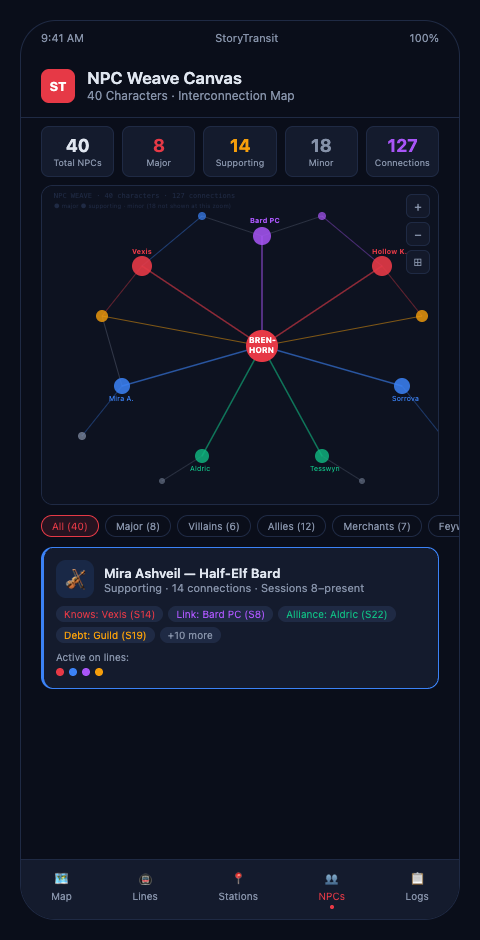
In transit terms: each NPC is a station. Relationships between NPCs are the lines connecting stations. Factions are the routes — groups of stations that share a line. The party's relationships with NPCs create their personal route through the NPC web.
StoryTransit's NPC web view displays this network directly. A DM preparing for a session can pull up any NPC's node and immediately see every relationship, faction affiliation, active subplot connection, and outstanding obligation to the party. That situational awareness takes ten seconds in a visual network and ten minutes in scattered notes.
From Nodes to Narratives demonstrates exactly this approach: knowledge graphs connect NPCs via semantic relations, enabling structured tracking of character interdependencies that would be impossible to maintain manually. The academic framework and the DM practice converge on the same architecture.
The expert NPC management structure:
Faction grouping: Every NPC belongs to at least one faction. Factions have shared motivations, shared enemies, and shared resources. When the party interacts with any faction member, the faction's state is what updates — not just the individual.
Relationship typing: Not all NPC connections are equivalent. Explicitly type every relationship: allied, hostile, indebted, blackmailing, secretly allied, estranged. A typed relationship map is dramatically more useful than an untyped one for predicting NPC behavior.
Motivation priority stacks: Every NPC has a ranked list of current motivations, not a single motivation. When the world changes, motivations shift in predictable ways based on priority. An NPC whose primary motivation is wealth may become an ally if their financial interests align with the party, regardless of prior hostility.
Outstanding obligation tracking: Every promise, threat, debt, and favor between NPCs and between NPCs and the party is logged as an outstanding obligation. Obligations are the mechanism through which NPCs create coherent long-term behavior.
Preventing Motivation Drift Across Long Campaigns
The second failure mode after incoherence is motivation drift — NPCs whose behavior slowly shifts away from their established characterization, not through in-world development but through DM inconsistency accumulated over 200 hours of campaign history.
Mastering Retcon identifies inconsistent NPC motivations as a leading cause of audience-breaking continuity errors in long-running fiction. In a D&D campaign, the equivalent is the villain who suddenly seems to want something different, or the mentor figure whose advice contradicts what they said 47 sessions ago.
Kanka's relationship system is specifically described as "second to none" for mapping NPC connections in large casts — a recognition from the community that NPC relationship infrastructure is a distinct tooling need, not a side feature.
The practical defense against motivation drift is quarterly NPC audits — a review of every named NPC's current stated motivation against their behavior in the last five to ten sessions. Drift is usually incremental and invisible until it has accumulated into an obvious inconsistency. Catching it at the drift stage is far less costly than correcting it after a player notices.
50 million lifetime D&D players represent a vast base of long-running homebrew campaign DMs who have each independently discovered the coherence wall problem. The community solutions — NPC wikis, relationship maps, motivation trackers — all converge on the same structural need: externalizing the NPC web so the DM can navigate it rather than remember it.
Motivation drift also has a subtler form that is harder to catch: motivation evolution that was never explicitly documented. When a player action genuinely changes an NPC's motivation — a meaningful interaction that would realistically shift their priorities — that change needs to be logged as an explicit update, not left as an implicit assumption. The NPC web that captures only initial states and not evolution states will eventually diverge from the DM's actual understanding of each character, creating the same incoherence problem through a different mechanism.
Advanced Tactics for the D&D NPC Web
The NPC hierarchy principle: Not all 42 NPCs need the same level of detail. Tier 1 NPCs (actively engaged with the party) get full continuity sheets. Tier 2 NPCs (potential re-entries) get faction, motivation, and one outstanding obligation. Tier 3 NPCs (background characters) get faction and status only. This prevents the documentation burden from becoming unsustainable. The hierarchy also creates a natural promotion path: an NPC who was Tier 3 background color in Session 5 can be promoted to Tier 1 when the party's actions bring them into central focus, with their record expanded at the moment of promotion.
Subplot line co-ownership: Every subplot line is co-owned by at least two NPCs. Single-NPC subplots are brittle — if that NPC dies or is sidelined, the subplot has no mechanism for continuation. Two-NPC subplots can survive the loss of either individual. When a co-owning NPC is removed from play, the DM immediately assigns a new co-owner from the existing cast — an NPC whose faction or motivations give them a plausible reason to inherit the subplot's energy.
The relationship change log: When an NPC's relationship with the party or another NPC changes meaningfully, log the session number and the triggering event. A one-line entry per change creates a relationship history that makes NPC behavior explainable in retrospect. Over 200 hours of campaign history, this log becomes the evidence the DM can cite when a player asks why a previously hostile NPC has become an ally — or when the DM themselves needs to reconstruct the sequence of events that produced the current state of a complex relationship.
Web integrity checks: Once per real-world month, review the NPC web for isolated nodes — NPCs who have appeared in recent sessions but have not been connected to any existing faction line or subplot. Every isolated node is a continuity liability. Either connect them to the existing network or make an explicit decision to keep them as self-contained background characters with no subplot implications.
The methods here extend naturally to villain management — villain roster management covers how to maintain coherent antagonist behavior across a five-year campaign, where the motivations and relationships are highest-stakes. Backstory transit lines create structured anchors for long-term character-driven subplots — every NPC in a player's history is a node on their line, and tracking those nodes is what keeps the NPC web coherent as the cast grows.
Actual play productions face the same NPC coherence challenge with an additional public accountability layer. Character arcs mapping examines how podcast producers maintain character consistency across 40-episode seasons — techniques with direct application to homebrew NPC management.
Manage the Cast Your Campaign Deserves
StoryTransit's NPC web is built specifically for homebrew DMs who have grown a cast too large for manual tracking but too important to let drift. When 40+ characters are interconnected in a navigable network, every session starts with full situational awareness instead of frantic note-searching.
A practical starting point for DMs who haven't yet built a web: spend one prep session building Tier 1 records for the ten NPCs your players have interacted with most in the last 20 sessions. That's faction, typed relationships to the party and to each other, motivation priority stack, and outstanding obligations. Ten records, built from recent session memory rather than comprehensive retroactive archaeology. Those ten characters are almost certainly the ones generating 80% of your continuity risk — incomplete records for a background blacksmith don't compound the way incomplete records for a faction lieutenant do. Build the web where the load is highest first, then expand outward session by session.
Homebrew D&D DMs who want their large NPC rosters to behave as a coherent cast — with consistent motivations, trackable relationships, and subplot lines that stay visible across 200 hours of campaign history — can join the waitlist now. Join the Waitlist for Homebrew D&D DMs and give your characters the structural support they need to stay coherent through year five.