Mapping Character Arcs Across a 40-Episode Podcast Season
The 40-Episode Arc Problem
At episode 40 of a long-form actual play podcast, most character arcs have been developing for roughly 18 months of real time and 80–120 hours of recorded play. The cast has made hundreds of in-character decisions, each one potentially shifting the direction of a character's development. The PC who started the campaign as a mercenary with no allegiances has, over 40 episodes, acquired relationships, suffered losses, and made choices that have materially changed who they are.
Without a character arc map, that development is invisible—not to the audience, who experienced it session by session, but to the producer who needs to describe it, to the editor who needs to protect it in cuts, and to the cast themselves when they need to reflect on where a character has come from.
Content over 20 minutes has a 26% completion rate; character investment is key to holding audiences. Listeners who stay for 40 episodes of an actual play podcast aren't staying for the system mechanics or the tactical encounters. They're staying because they care about what happens to Kaelith, whether Lord Thadderon's conspiracy gets exposed, whether the party's relationship with the Sunless Citadel faction ever resolves. Character investment is what converts occasional listeners into long-term subscribers.
As content length increases, completion rates drastically decrease—making character hooks essential for long episodes. The solution isn't shorter episodes. It's stronger character arcs that give listeners a reason to stay through the slow-build segments and come back after taking a break.
The Transit Route Approach to Character Arc Mapping
In the transit metaphor, character arcs are named routes that run through the city alongside the plot thread transit lines. The cursed compass is a Red Line plot thread. Kaelith's arc is the Blue Route—a specific journey from one character state to another, with defined stations, junction points where the route intersects with plot threads, and a current position on the route.
Character arc mapping requires three documents working together.
The arc declaration. A one-page per-character document capturing the starting state, the intended destination, and the three to five developmental stages in between. Identifying 3–5 developmental stages per protagonist; visual timeline tracks beliefs, skills, relationships is the standard approach for long-form serialized characters. In actual play, the declaration is provisional—the cast shapes the arc through play—but having a provisional route makes it easier to recognize meaningful development when it happens.
The episode-by-episode arc log. For each episode, one sentence per active character: what happened on their arc in this session, if anything. Not every character moves in every episode—that's fine. An entry that says "No arc movement this episode" is still useful information. It tells you this character's route was dormant here and helps you identify arc stagnation when it accumulates across too many consecutive episodes.
The current-state summary. One paragraph per character, updated at meaningful arc transitions. Where is this character now? What do they want? What's standing in their way? What's the open question on their arc?
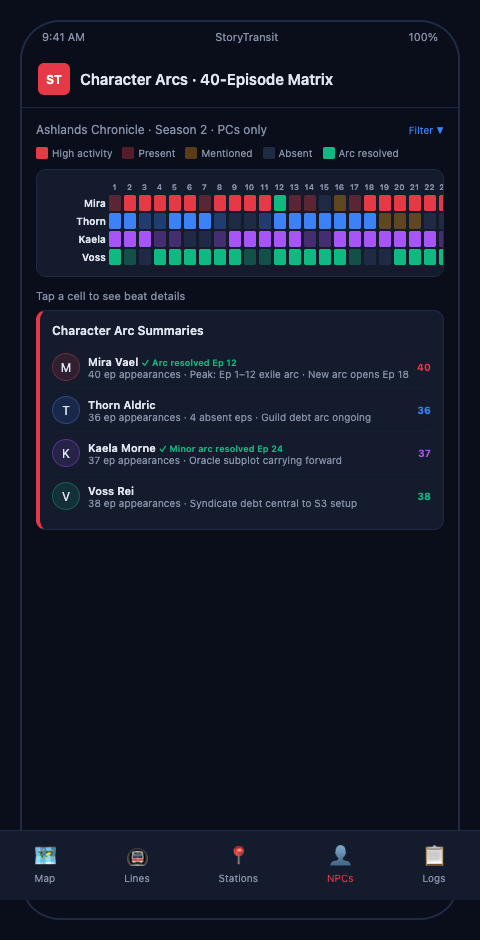
Per-character timelines with auto-calculated character ages and backstory evolution are the software-level implementation of this approach. StoryTransit applies the same per-character route logic within the overall transit map—each character arc visible alongside the plot threads it intersects, with current positions and arc status markers.
Guest character arcs extends this framework to recurring guest players and multi-season arc structures. Foreshadowed arc coordination covers how producers can flag GM-planted arc setups in the editing pass so the development beats don't get cut for runtime.
Using Arc Maps for Production Decisions
A functioning character arc map changes three production behaviors.
Editing decisions become arc-aware. An editor who knows Kaelith's arc is currently in a transitional phase—moving from isolation toward connection—will recognize that a scene where Kaelith accepts help from another character is arc-load-bearing and protect it regardless of runtime pressure. Without the arc map, that scene looks optional. With it, the editor knows it's a station on the Blue Route that can't be skipped.
Show notes reflect character development. Episode descriptions that include character arc status flags give listeners a way to track development across episodes without keeping their own notes. "Kaelith arc: first meaningful trust scene since episode 28" tells the invested listener exactly what to watch for and reminds them of the arc context that makes this moment significant.
Recap scripting becomes character-led. A season midpoint recap structured around character positions—where each PC's arc stands right now—is more engaging than a plot summary and more useful for mid-series arrivals. Listeners orient to characters faster than they orient to plot mechanics. Parasocial rapport built around show hosts and characters is the pivotal driver of long-term listener loyalty—the recap that centers character arcs is building the emotional investment that keeps subscribers around for the next 40 episodes.
Campaign 3 episode one generated over 2.1 million Twitch views and 2.67 million YouTube views in its first two weeks. Critical Role's ability to generate that scale of audience for a new campaign launch reflects years of built character investment infrastructure—audiences who followed previous campaigns came back because they knew the show would deliver on character arcs at scale.
PC goal integration in LARP events addresses the same challenge of tracking character development across complex, player-driven story events. The goal-tracking logic translates directly to the podcast context.
Complex serial narratives are cognitively challenging; character complexity drives primary engagement. For 40-episode seasons, cognitive complexity doesn't reduce engagement—it deepens it, provided the producer has the documentation infrastructure to keep character development coherent across the full arc.
Handling Retired PCs and Arc Interruptions
A 40-episode actual play season almost always includes at least one cast change. A player leaves, a PC retires, a character arc concludes before the season does. These transitions create specific documentation challenges that the arc map is uniquely positioned to address.
When a PC retires, their character arc row doesn't get deleted from the map—it gets marked resolved or archived. The arc log for that character remains accessible, because the threads that character touched are often still live. If Kaelith's player retires at episode 35, every arc junction where Kaelith intersected with the Lord Thadderon conspiracy is still relevant to that plot thread's resolution. The editor and producer need to know what Kaelith established in those junction episodes, even after the player is gone.
The character's unresolved threads also need explicit handling in the arc map. A PC who made a commitment, formed a relationship, or carried a plot item doesn't stop mattering narratively just because they're no longer at the table. Marking those threads as "retired PC residue" rather than resolved keeps them visible to whoever manages those threads going forward.
New player onboarding benefits directly from the arc map's history. When a new player joins at episode 38, the arc log for the retired PC gives them the full history of that character's arc—not just a verbal summary from the GM, but a documented record they can read before the session. This makes the transition smoother for the incoming player and reduces the risk of the new character inadvertently contradicting established arc history.
Keeping series alive across long character arcs means tracking beliefs, skills, and relationships that evolve over developmental stages. For actual play shows with cast changes, this tracking is the institutional memory that keeps the story coherent when the people who originally held that memory leave the production.
The arc map also reveals arc stagnation before it becomes a listener problem. If a PC's arc log shows "No arc movement" for ten consecutive episodes, that's a flag for the producer and GM to address—either by creating conditions for arc development, or by acknowledging in recap content that this character is in a holding pattern while other arcs advance. Listeners who are invested in a specific character's arc will disengage if that arc stalls without acknowledgment.
Arc stagnation is particularly common in shows where one character's arc dominates a story phase while others wait. This isn't a story problem—uneven arc pacing is natural in actual play. It's a documentation problem: without the arc log to make the pattern visible, producers don't know it's happening. The editor doesn't know to look for a scene that advances a backgrounded character. The show notes don't flag that Kaelith's arc has been dormant for eight episodes and is due for a station. The arc map makes the pattern visible, which makes it addressable.
When actual play shows maintain character arc maps over a full 40-episode season, those maps also become the source material for end-of-season reflective content. A cast retrospective, a producer write-up, a community discussion about where each character ended up—all of these become richer with a documented arc history behind them. The map turns the season's organic development into a legible story that both the production team and the audience can look back on with clarity.
Character complexity and parasocial connection are the primary drivers of engagement in complex serial narratives. StoryTransit's character arc tracking gives actual play producers the documentation infrastructure to support that complexity across a full 40-episode run—without requiring the cast or GM to do anything differently at the table.
Actual play podcast producers running long-form seasons need character arc maps that stay current across dozens of episodes without becoming a documentation burden. Join the Waitlist for Actual Play Producers to access StoryTransit's character route tracking, built for the arc tracking realities of season-long TTRPG podcast production.